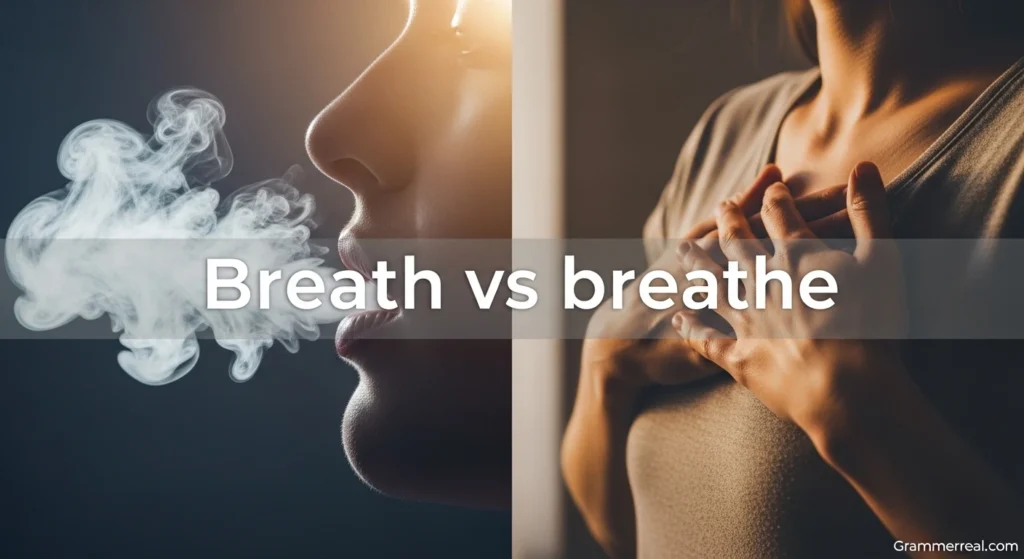
Many people confuse breath vs breathe because the two words look almost the same. They are closely related, but they do different jobs in a sentence. One word is a noun, and the other is a verb. This small difference can change the meaning of your writing.
If you learn how to use them correctly, your sentences will sound clear and natural. Students, writers, and English learners often mix them up in daily use. The good news is that the rule is simple and easy to remember. In this guide, you will learn the meaning, grammar, pronunciation, examples, and common mistakes linked to breath vs breathe. By the end, you will feel more confident when speaking and writing.
Understanding the Basic Difference Between Breath vs Breathe
The easiest way to understand breath vs breathe is to learn the role of each word.
- Breath is a noun. It is the air you take in and send out of your lungs.
- Breathe is a verb. It means to take air in and send it out.
Simple Examples
- Take a deep breath before you start.
- I need a moment to breathe.
- Her breath was warm in the cold air.
- Please breathe slowly and calmly.
If you can replace the word with air, you often need breath. If the word shows an action, you usually need breathe.
Why Breath vs Breathe Is Commonly Confused
Many learners struggle with breath vs breathe for several reasons.
1. The Words Look Similar
Only one letter changes: e at the end of breathe. Because of this, people type the wrong form quickly.
2. The Words Sound Similar
The pronunciation is close, though not the same. This causes confusion when learners hear the words.
3. They Share the Same Meaning Family
Both words relate to air, lungs, and life. Since they are connected in meaning, people may forget that they have different grammar roles.
4. Fast Writing Causes Errors
When people write messages, essays, or emails quickly, they may not stop to check whether they need a noun or a verb.
Breath vs Breathe: Meaning in Detail
What Does Breath Mean?
Breath means the air that goes in and out of your body. It can also describe one cycle of breathing.
Examples:
- He held his breath underwater.
- She took one deep breath.
- After the run, my breath was heavy.
It may also describe smell from the mouth.
- His breath smelled like coffee.
What Does Breathe Mean?
Breathe means to move air into and out of the lungs.
Examples:
- Fish cannot breathe outside water.
- Try to breathe through your nose.
- I could not breathe because of the smoke.
It can also be used in a wider sense, such as relaxing or living freely.
- After the exam, we could finally breathe.
Pronunciation Guide for Breath vs Breathe
Correct pronunciation helps you remember the difference.
- Breath sounds like breth. The ending sound is soft, like th in thin.
- Breathe sounds like breeth. The ending sound is voiced, like th in this.
Easy Memory Trick
- Breath = short ending sound
- Breathe = longer ending sound with the final e
Say them aloud several times:
- breath
- breathe
- breath
- breathe
This practice can train your ear.
Grammar Rules for Breath vs Breathe
Grammar becomes simple when you know the word type.
Breath Is a Noun
A noun names a person, place, thing, or idea.
Examples:
- Your breath is visible in winter.
- Every breath matters.
- She let out a tired breath.
Because it is a noun, it can follow articles such as:
- a breath
- the breath
- one breath
Breathe Is a Verb
A verb shows action or state.
Examples:
- We breathe every second.
- She breathes quietly at night.
- They are breathing faster now.
- He breathed deeply yesterday.
Notice how the verb changes with tense and subject.
Verb Forms of Breathe
- Base form: breathe
- Present simple: breathe / breathes
- Past simple: breathed
- Present participle: breathing
- Past participle: breathed
Examples:
- I breathe slowly.
- She breathes slowly.
- He breathed deeply.
- They are breathing now.
Contextual Examples of Breath vs Breathe In
Using context is one of the best ways to master breath vs breathe.
Health and Exercise
- Take a deep breath before lifting the weight.
- Remember to breathe during exercise.
- His breath became faster after running.
- Try to breathe in a steady rhythm.
Stressful Moments
- She took a calm breath before speaking.
- Please breathe and relax.
- One slow breath can help focus the mind.
- Sit down and breathe for a minute.
Nature
- The cold air took my breath away.
- It feels good to breathe fresh mountain air.
- Every breath felt clean and cool.
- We stopped to breathe in the sea air.
Emotional Writing
- I held my breath while waiting for the result.
- He could barely breathe with excitement.
- Her breath shook with fear.
- They paused to breathe after the shock.
Common Mistakes With Breath vs Breathe
This section shows errors many people make.
Mistake 1: Using Breath as a Verb
❌ I need to breath slowly. ✔ I need to breathe slowly.
Reason: The sentence needs an action word.
Mistake 2: Using Breathe as a Noun
❌ Take a deep breathe. ✔ Take a deep breath.
Reason: The sentence needs a thing, not an action.
Mistake 3: Forgetting Verb Agreement
❌ She breathe well now. ✔ She breathes well now.
Reason: Third-person singular subjects take -s in the present simple tense.
Mistake 4: Wrong Past Form
❌ Yesterday he breath deeply. ✔ Yesterday he breathed deeply.
Reason: Past tense needs breathed.
Mistake 5: Confusing Sound With Spelling
Some people spell by sound alone. Always check whether the sentence needs a noun or a verb.
Easy Memory Tricks for Breath vs Breathe
Trick 1: The Final E Means Action
Breathe has an extra e. Think of that extra letter as extra movement.
Trick 2: Breath Is Short Like One Puff of Air
Breath is shorter and names one thing.
Trick 3: Use a Test Sentence
Ask:
- Can I say take a ___? → breath
- Can I say I ___ now? → breathe
Trick 4: Look for Helpers
If you see words like can, should, will, to, you often need a verb.
- can breathe
- should breathe
- want to breathe
American vs British English Differences
When discussing breath vs breathe, the main meanings stay the same in both American and British English. The grammar rules do not change.
Spelling
- American English: breath / breathe
- British English: breath / breathe
No difference here.
Pronunciation
Accent may change slightly depending on region, but the basic distinction remains:
- breath ends with the soft th sound
- breathe ends with the voiced th sound
Usage Style
Both forms are common in everyday speech, writing, health advice, sports language, and literature in both varieties of English.
So, if you use the correct noun or verb form, you will be understood in both American and British English.
Idiomatic Expressions Using Breath and Breathe
Idioms help learners understand real-life English.
Expressions With Breath
Hold Your Breath
Meaning: wait in suspense or stop breathing for a moment.
- We held our breath during the final score.
Catch Your Breath
Meaning: recover after effort.
- Sit down and catch your breath.
Take My Breath Away
Meaning: surprise or impress greatly.
- The view took my breath away.
Under Your Breath
Meaning: quietly or in a low voice.
- He spoke under his breath.
Expressions With Breathe
Breathe Easy
Meaning: relax after worry.
- We could breathe easy after hearing the news.
Breathe Life Into
Meaning: give energy or freshness.
- The new coach breathed life into the team.
Breathe In
Meaning: inhale.
- Breathe in slowly.
Breathe Out
Meaning: exhale.
- Breathe out gently.
Practical Tips to Use Breath vs Breathe Correctly
1. Identify the Job of the Word
Ask whether you need a thing or an action.
2. Read the Sentence Aloud
Many mistakes become clear when spoken.
3. Check the Word Before It
- a, the, one, my → often breath
- can, will, should, to → often breathe
4. Learn Set Phrases
- deep breath
- hold your breath
- breathe deeply
- breathe slowly
5. Edit Carefully
During revision, check every similar-looking word.
6. Practice With Short Sentences
- I breathe.
- One breath.
- She breathes well.
- Take a breath.
Mini Practice Exercise
Choose the correct word.
- Please ___ slowly.
- Take a deep ___.
- She could not ___ in the smoke.
- He held his ___ underwater.
- The baby ___ softly.
Answers
- breathe
- breath
- breathe
- breath
- breathes
How This Topic Improves Writing Skills
Learning breath vs breathe improves more than one spelling mistake. It builds stronger grammar habits.
Better Word Choice
You learn to choose the right form based on meaning and sentence role.
Better Grammar Control
You notice nouns, verbs, tense, and subject-verb agreement.
Better Editing Skills
You become more careful with similar words.
Better Readability
Correct word use makes writing smoother and easier to understand.
Better Confidence
Small grammar wins help learners trust their English skills.
Writing Techniques Used in This Guide
This article was written with clear grammar and easy style. Important grammar rules were applied carefully.
Correct Tense Use
Past, present, and continuous forms were used where needed.
Subject-Verb Agreement
Singular subjects match singular verbs.
- She breathes.
- He breathed.
Plural subjects match plural verbs.
- They breathe.
- We are breathing.
Clear Sentence Structure
Short and medium sentences were mixed to improve flow. Fragments and run-on sentences were avoided.
Simple Vocabulary
Easy words were chosen so learners at many levels can understand the topic.
Natural Repetition of the Main Topic
The phrase breath vs breathe appears naturally to help focus the lesson without sounding forced.
Conclusion
Understanding breath vs breathe is easier than many learners think. Breath is a noun that names the air you take in and out, while breathe is a verb that describes the action of taking in and releasing air. The spelling difference is small, but the grammar difference is important. If you check whether the sentence needs a thing or an action, you will usually choose the correct word. Pronunciation can also help you remember the rule. Practice with common phrases, review your writing, and read sentences aloud. With regular use, the confusion between breath vs breathe will disappear, and your English will become clearer and stronger.
FAQs
1. What is the main difference between breath and breathe?
Breath is a noun. Breathe is a verb.
2. Is it “take a deep breath” or “take a deep breathe”?
The correct phrase is take a deep breath.
3. Is it “I can’t breath” or “I can’t breathe”?
The correct sentence is I can’t breathe.
4. Why do people confuse breath vs breathe?
They look similar, sound similar, and share related meanings.
5. How do I remember which one is the verb?
Breathe ends with e and shows action.
6. What is the past tense of breathe?
The past tense is breathed.
7. Can breath be used as a verb?
No. Standard English uses breathe as the verb.
8. Are breath and breathe different in British English?
No major difference exists. Spelling and grammar stay the same.



