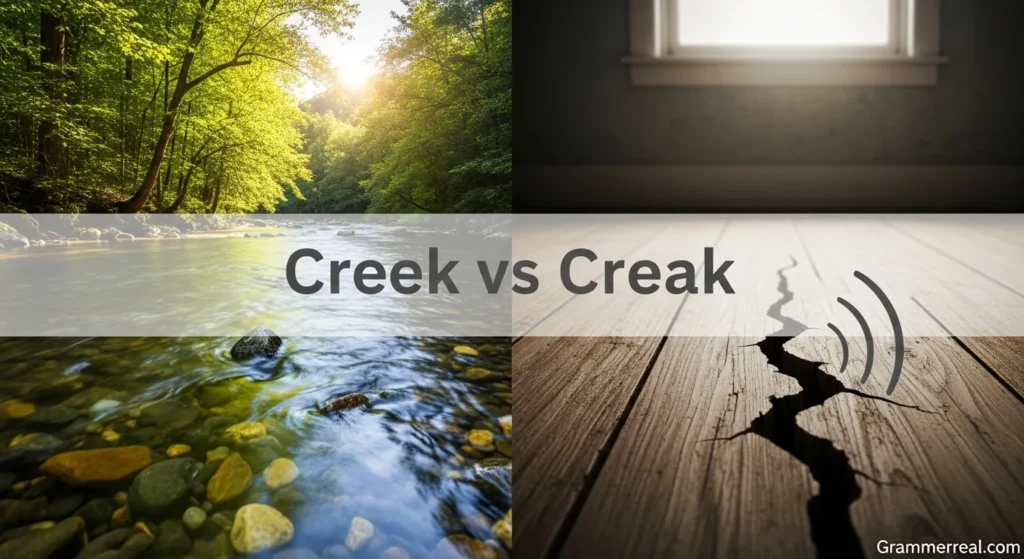
Many English words sound the same but have very different meanings. One common pair is creek vs creak. These two words are easy to confuse because they are pronounced alike in many accents.
However, they belong to different parts of speech and describe very different things. Creek is usually a noun that names a small stream or narrow waterway. Creak is most often a verb or noun linked to a sharp, rough sound made by wood, metal, or old parts that move. Learning creek vs creak can improve spelling, reading, and daily writing. It can also help you avoid mistakes in school work, emails, and stories. In this guide, you will learn the meanings, uses, examples, and memory tricks for this word pair. By the end, the difference between creek vs creak will feel simple and clear.
What Does Creek Mean?
A creek is a small stream of water. It may flow through a forest, field, village, or town. In some places, it can also mean a narrow inlet or small channel connected to the sea.
Simple Examples of Creek
- We walked beside the creek after lunch.
- Fish were swimming in the clear creek.
- The bridge crosses a small creek near our house.
- Children played by the creek on a warm day.
- The boat entered a quiet creek near the shore.
Easy Way to Remember Creek
Think of the double ee in creek as water flowing in a long line. Water moves, and a creek carries water.
What Does Creak Mean?
A creak is a rough, squeaky sound. It often comes from old doors, wooden floors, stairs, beds, chairs, or metal parts. As a verb, it means to make that sound.
Simple Examples of Creak
- The old door began to creak slowly.
- I heard a creak in the hallway at night.
- The floorboards creak when someone walks across them.
- Her chair gave a small creak as she sat down.
- The gate will creak unless we oil the hinges.
Easy Way to Remember Creak
Think of the ak sound at the end of creak as a short, sharp noise. Old things often make that kind of sound.
Main Difference Between Creek vs Creak
The biggest difference in creek vs creak is meaning.
WordPart of SpeechMeaningExampleCreekNounA small stream or waterwayWe sat near the creek.CreakVerb / NounA harsh squeaking soundThe stairs creak at night.
So, if you mean water, use creek. If you mean sound, use creak.
Why People Confuse Creek vs Creak
Many learners mix up creek vs creak because the words sound alike. Words that sound the same but have different meanings are called homophones. English has many pairs like this.
Examples:
- right / write
- sea / see
- flour / flower
- creek / creak
Because the ear hears the same sound, writers often choose the wrong spelling. This happens most when typing fast or writing from dictation.
How to Use Creek in Sentences
Here are more examples that show correct use of creek.
Nature and Travel
- We followed the path along the creek.
- Birds gathered near the creek every morning.
- The map shows a creek behind the farm.
Story Writing
- The hero crossed the creek before sunset.
- Moonlight shone on the quiet creek.
School Writing
- A creek is smaller than many rivers.
- Plants often grow well near a creek.
How to Use Creak in Sentences
Here are more examples that show correct use of creak.
Home and Furniture
- The bed began to creak when I moved.
- That old chair gives a loud creak.
- The stairs creak every night.
Machines and Metal
- The gate will creak without oil.
- The swing made a soft creak in the wind.
Story Writing
- A sudden creak broke the silence.
- She froze when the floorboards creak under her feet.
Common Mistakes With Creek vs Creak
Many mistakes happen because the words are alike in sound. Here are common errors and fixes.
Mistake 1: Using Creek for Sound
Wrong: The door made a loud creek. Right: The door made a loud creak.
Mistake 2: Using Creak for Water
Wrong: We swam in the creak. Right: We swam in the creek.
Mistake 3: Forgetting Word Type
Wrong: The room creeked loudly. Better: The room creaked loudly.
Here, creaked is the past tense of the verb creak.
Mistake 4: Missing Context
Wrong: We heard the creek at night. This may confuse readers. Did you hear water or a sound?
Better:
- We heard the creek flowing at night.
- We heard a creak at night.
Verb Forms of Creak
Because creak can be a verb, it changes form.
TenseExamplePresentThe floorboards creak.PastThe floorboards creaked.FutureThe floorboards will creak.ContinuousThe gate is creaking.
Correct Grammar Examples
- The door creaks when it opens.
- The door creaked yesterday.
- The door is creaking now.
- The doors creak every winter.
Notice how the verb changes to match the subject and tense.
Is Creek Ever a Verb?
In modern everyday English, creek is mainly a noun. Most people use it to name a water feature. It is not commonly used as a verb in normal writing. That is another helpful clue in creek vs creak. If you need an action word, you probably mean creak.
American vs British English Differences
The meanings of creek vs creak stay the same in both American and British English. Still, there are a few small usage notes.
Creek in American English
In American English, creek often means a small stream. It is common in place names, such as Mill Creek or Pine Creek.
Creek in British English
In British English, creek may also mean a narrow inlet or tidal channel near the sea. It can still refer to water, but local use may differ.
Creak in Both Varieties
Creak keeps the same meaning in both forms of English. It refers to a squeaking or groaning sound.
Examples:
- The floorboards creak.
- The old gate gave a creak.
Pronunciation Notes
Some speakers pronounce creek with a longer vowel sound, while others say it more shortly. Even so, it often sounds very close to creak, which causes spelling mistakes.
Idiomatic and Descriptive Uses
Neither word appears in many fixed idioms, but both are used in vivid descriptions.
Expressions With Creek
- Up the creek: in trouble or in a difficult situation.
- Without a map, we were up the creek.
- Dry creek bed: a channel with no water.
- We crossed a dry creek bed.
Expressions With Creak
- Creak under pressure: struggle under stress.
- The old system began to creak under pressure.
- Every creak and groan: every small sound.
- At night, she heard every creak and groan of the house.
Context Clues to Choose the Right Word
When choosing between creek vs creak, ask what the sentence is about.
If the Topic Is Nature or Water
Use creek.
- trees
- fish
- bridge
- river
- rain
- valley
Example: Rain filled the creek quickly.
If the Topic Is Sound or Movement
Use creak.
- door
- floor
- stairs
- gate
- chair
- bed
Example: The old stairs creak loudly.
Memory Tricks for Creek vs Creak
Simple memory tools can help.
Trick 1: Double E = Stream
Creek has ee like a long line of water.
Trick 2: AK = Sharp Noise
Creak ends in ak, which feels short and sharp like a squeak.
Trick 3: Use Images
Picture a forest path and a small stream for creek. Picture an old wooden door for creak.
Trick 4: Use Sentence Tests
Try this frame:
- We sat beside the _____. → creek
- I heard the _____ in the hall. → creak
Practice Sentences
Choose the correct word in each sentence.
- We walked beside the (creek / creak).
- The old bed began to (creek / creak).
- Fish swam in the clear (creek / creak).
- I heard a strange (creek / creak) downstairs.
- The bridge crosses the (creek / creak).
Answers
- creek
- creak
- creek
- creak
- creek
Writing Tips for Students
If you want cleaner writing, follow these steps when using creek vs creak.
Read the Sentence Again
Pause and ask: Is this about water or sound?
Check the Part of Speech
If it is an action, you likely need creak.
Read Aloud
Hearing the sentence may help, but always check the meaning too.
Use Spell Check Carefully
Spell check may miss errors if both words are real words.
Build Word Lists
Keep a notebook of confusing pairs:
- creek / creak
- there / their
- hear / here
- peace / piece
How This Improves Grammar and Writing
Learning pairs like creek vs creak helps more than spelling.
Better Word Choice
You choose the exact word you need.
Better Sentence Clarity
Readers understand you faster.
Stronger Proofreading Skills
You learn to check context, tense, and grammar.
Better Vocabulary
You remember more words and meanings.
Better Confidence
Clear writing builds trust in school and work.
Grammar Rules Used in This Guide
This article follows important grammar habits that improve writing.
Correct Subject-Verb Agreement
- The door creaks.
- The doors creak.
Correct Tense Use
- Yesterday, the gate creaked.
- Today, the gate creaks.
Clear Modifiers
- The old wooden door gave a loud creak.
Complete Sentences
Each sentence has a clear subject and verb.
Mixed Sentence Length
Some sentences are short and direct. Others are longer and more detailed. This creates a smooth reading flow.
Quick Review of Creek vs Creak
Use this short review anytime.
- Creek = water, stream, channel
- Creak = squeaky sound, make a noise
- Creek is usually a noun
- Creak is a noun or verb
- Same sound, different meaning
Conclusion
Understanding creek vs creak is simple once you focus on meaning. Creek refers to a small stream or waterway, while creak refers to a rough squeaking sound or the act of making that sound. These words sound alike, so confusion is common, but context gives the answer quickly. If the sentence is about nature, use creek. If the sentence is about doors, floors, beds, or gates, use creak. Checking grammar, tense, and sentence meaning will help you avoid mistakes. Small lessons like this build stronger spelling, clearer writing, and better confidence. With practice, choosing between creek vs creak will become natural and easy.
FAQs
1. What is the difference between creek vs creak?
Creek means a small stream of water. Creak means a squeaky sound or to make that sound.
2. Are creek and creak pronounced the same?
Often yes. In many accents, they sound the same or very similar.
3. Is creek a noun or verb?
Usually, creek is a noun.
4. Is creak a noun or verb?
It can be both.
- Noun: I heard a creak.
- Verb: The stairs creak.
5. Which word relates to nature?
Creek relates to nature and water.
6. Which word relates to old doors and floors?
Creak relates to sounds from old objects.
7. What is the past tense of creak?
The past tense is creaked.
8. Can I say “the creek creaked”?
Yes, but only if you mean the water area made a sound in a creative or poetic way.



