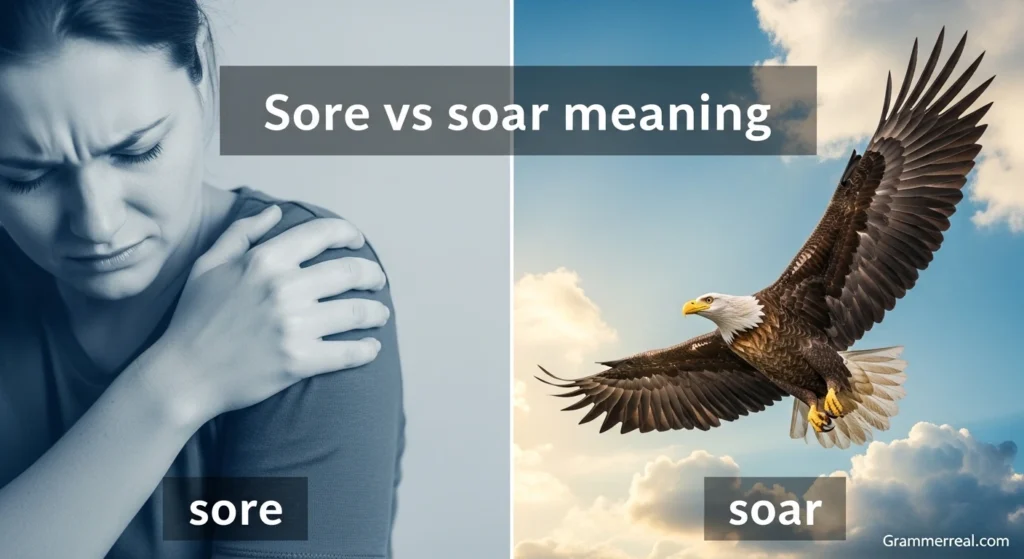
Many English learners mix up sore and soar because the two words sound the same in many accents. They are homophones, which means they are words with the same pronunciation but different spellings and meanings.
Understanding sore vs soar meaning helps you write clearly and avoid common mistakes. If you choose the wrong word, your sentence can become confusing or even funny. For example, “My grades are sore” does not make sense, but “My grades are soaring” does. In simple terms, sore usually relates to pain, hurt, anger, or irritation, while soar usually means to fly high or rise quickly. These words appear in daily speech, school writing, business reports, sports news, and casual conversation. Once you learn their meanings, patterns, and examples, you can use them with confidence. This guide explains sore vs soar meaning in very simple language so it is easy to remember and use correctly.
What Does Sore Mean?
The word sore is most often an adjective. It usually describes pain, discomfort, or irritation in the body.
Common meanings of sore:
- Painful or aching
- My legs are sore after the long walk.
- She has a sore back today.
- Sensitive or tender
- The cut is still sore.
- His arm feels sore when touched.
- Angry or upset (informal use)
- He is sore because his team lost.
- Do not be sore about the result.
- Serious or severe (less common use)
- The company faced sore losses.
Easy way to remember sore:
Think of sore muscles, sore throat, or sore feelings. If pain or hurt is involved, sore is usually the correct word.
What Does Soar Mean?
The word soar is usually a verb. It means to rise high in the air or increase quickly.
Common meanings of soar:
- To fly high
- Eagles soar above the mountains.
- The bird soared across the sky.
- To rise quickly
- Prices soar during shortages.
- Her confidence began to soar.
- To feel excited or uplifted
- My heart soared when I heard the good news.
Easy way to remember soar:
Think of a bird in the sky. If something rises, flies, or increases fast, soar is usually the right word.
Sore vs Soar Meaning: Main Difference
The easiest way to understand sore vs soar meaning is this:
- Sore = pain, hurt, upset
- Soar = rise, fly, increase
Compare these examples:
- My feet are sore after running.
- Sales soared after the new product launch.
- She has a sore throat.
- The kite began to soar in the wind.
- He felt sore after the argument.
- Spirits soared after the victory.
One word relates to pain or anger. The other relates to upward movement or fast growth.
Why People Confuse Sore and Soar
Many learners confuse these words because:
- They sound the same.
- Spell-check may not catch the error.
- Both are common words.
- Fast typing can cause mistakes.
- Learners remember sound before spelling.
For example:
- Wrong: My profits are sore.
- Correct: My profits are soaring.
- Wrong: My neck is soar.
- Correct: My neck is sore.
This confusion is normal, but practice fixes it quickly.
Contextual Examples of Sore
Seeing words in real sentences makes learning easier.
Body pain
- My shoulders are sore after lifting boxes.
- Her knees feel sore after climbing stairs.
- I stayed home because I had a sore throat.
Emotional pain
- He is still sore about the unfair comment.
- She felt sore after being ignored.
Sports use
- The team looked sore after the hard match.
- Players often feel sore the next day.
Daily life
- My fingers are sore from typing all day.
- That new shoe made my heel sore.
Contextual Examples of Soar
Nature and flight
- Hawks soar over the valley.
- The plane soared into the clouds.
Money and numbers
- Rent prices soared last year.
- Online sales soared in winter.
Feelings and success
- Her confidence soared after the speech.
- Our hopes soared when we saw the results.
School and work
- His grades soared after he studied daily.
- Productivity soared after the new system began.
Common Mistakes with Sore and Soar
Using sore for growth
- Wrong: Attendance was sore this month.
- Correct: Attendance soared this month.
Using soar for pain
- Wrong: My arm is soar today.
- Correct: My arm is sore today.
Wrong verb tense
- Wrong: Prices sore yesterday.
- Correct: Prices soared yesterday.
Wrong form in a sentence
- Wrong: I feel soar after exercise.
- Correct: I feel sore after exercise.
Mixing meaning by sound only
Some people choose words by sound, not meaning. Always check the sentence idea first.
Grammar Forms of Sore and Soar
Understanding grammar forms helps you use these words correctly.
Sore as an Adjective
Sore usually describes a noun.
- sore muscles
- sore throat
- sore feet
- sore feelings
In a sentence:
- My legs are sore.
- She has a sore wrist.
Soar as a Verb
Soar shows action.
Present tense:
- Birds soar.
- Prices soar.
Past tense:
- The eagle soared.
- Costs soared last year.
Present participle:
- The bird is soaring.
- Demand is soaring.
Future tense:
- Profits will soar.
- Confidence will soar.
Sore as a Noun (Less Common)
Sometimes sore can be a noun meaning a painful spot.
- He touched the sore on his hand.
This use is less common in everyday writing.
American vs British English Differences
There is little difference in the meaning of sore and soar between American and British English. Both varieties use these words in almost the same way.
American English examples:
- I have a sore throat.
- Prices are starting to soar.
British English examples:
- My feet are sore after walking.
- Energy bills may soar.
Small note on pronunciation:
In many American accents, sore and soar sound almost exactly the same. In many British accents, they also sound alike. Because of this, spelling matters a lot.
Idiomatic Expressions with Sore
English uses sore in several common phrases.
1. Sore loser
A person who becomes angry after losing.
- Do not be a sore loser.
2. Sore point
A topic that upsets someone.
- Money is a sore point in that family.
3. Sorely missed
Deeply missed.
- She was sorely missed at the event.
4. Sore spot
Something sensitive or painful, physical or emotional.
- That subject is a sore spot for him.
Idiomatic Expressions with Soar
1. Soar to new heights
To improve greatly.
- The company soared to new heights.
2. Spirits soared
People felt very happy.
- Spirits soared after the announcement.
3. Prices soared
Costs rose quickly.
- Food prices soared this season.
4. Heart soared
Someone felt joy.
- My heart soared when I saw my family.
Memory Tricks for Sore vs Soar Meaning
Simple memory tricks make learning faster.
Trick 1: Sore has “ore” like “more pain”
If you feel pain, think sore.
Trick 2: Soar has “oa” like open air
Birds fly in the open air, so think soar.
Trick 3: Check the sentence idea
Ask yourself:
- Is it about pain? Use sore.
- Is it about rising? Use soar.
Trick 4: Replace the word
If “hurt” fits, choose sore. If “rise” fits, choose soar.
Practice Sentences
Choose the correct word.
- My back is ___ after moving furniture.
- Sales began to ___ in summer.
- She had a ___ throat.
- The eagle will ___ above the lake.
- He is still ___ about losing the game.
Answers:
- sore
- soar
- sore
- soar
- sore
Practical Tips to Avoid Mistakes
Read your sentence slowly
Check the meaning before you submit or send it.
Focus on grammar role
- If it describes pain, use sore.
- If it shows action of rising, use soar.
Learn in pairs
Study both words together. This helps memory.
Write your own examples
- My legs are sore.
- My motivation soared.
Use them in speech
Speaking helps memory grow stronger.
Sore vs Soar Meaning in Student Writing
Students often use these words in essays, reports, and messages.
Good examples:
- My confidence soared after I passed the test.
- My hand felt sore after writing for hours.
- Tourism soared during the holiday season.
- He stayed home because of a sore throat.
Weak examples corrected:
- Wrong: My marks were sore.
- Correct: My marks soared.
- Wrong: I am soar after football.
- Correct: I am sore after football.
Using the correct word improves clarity and shows strong language skills.
Writing Techniques Used in This Guide
This guide uses clear grammar and simple sentence structure so learning feels easy.
Grammar rules applied:
- Correct subject-verb agreement
- Prices soar.
- He feels sore.
- Correct tense use
- Costs soared last year.
- Costs are soaring now.
- Correct modifiers
- very sore muscles
- sharply soaring prices
- Complete sentences Every sentence includes a clear subject and verb.
- Correct punctuation Commas and periods help the reader follow ideas.
Style choices used:
- Short and long sentence mix for smooth rhythm.
- Clear headings for easy reading.
- Repetition of key ideas for memory.
- Friendly tone without difficult words.
- Real examples from daily life.
These methods make the content easier to understand and remember.
How Learning Sore vs Soar Improves Writing
When you master sore vs soar meaning, your writing becomes more accurate. You avoid embarrassing mistakes. Readers understand your message faster. Your vocabulary also becomes stronger because you know exact meanings. This practice teaches you to notice spelling, sound, grammar, and context at the same time. It also trains you to check every sentence carefully. Small word choices can create a big difference in quality.
Conclusion
Understanding sore vs soar meaning is simple once you focus on the main idea. Sore usually means pain, tenderness, irritation, or being upset. Soar usually means to fly high, rise quickly, or increase fast. Although the words sound alike, their meanings are very different. Always check the context of the sentence before choosing one. If the sentence is about hurt, choose sore. If the sentence is about rising or growth, choose soar. Practice with examples, use memory tricks, and review your writing slowly. With regular practice, you will use both words correctly and confidently.
FAQs
What is the main difference between sore and soar?
Sore means pain or upset feelings. Soar means to rise, fly high, or increase quickly.
Are sore and soar pronounced the same?
Yes, in many accents they sound the same, which is why people confuse them.
Is sore a noun or adjective?
Usually it is an adjective, as in sore throat or sore feet.
Is soar a verb?
Yes, it is usually a verb, as in Birds soar or Prices soared.
Can sore mean angry?
Yes. Informally, sore can mean upset or angry.
Can soar be used for emotions?
Yes. Example: Her spirits soared.
Which word is correct: sore throat or soar throat?
Sore throat is correct.
Which word is correct: profits sore or profits soar?
Profits soar is correct.
How can I remember the difference quickly?
Pain = sore. Rise = soar.
Why is this pair important for learners?
Because these words sound alike but mean different things. Learning them improves spelling, grammar, and clear writing.



