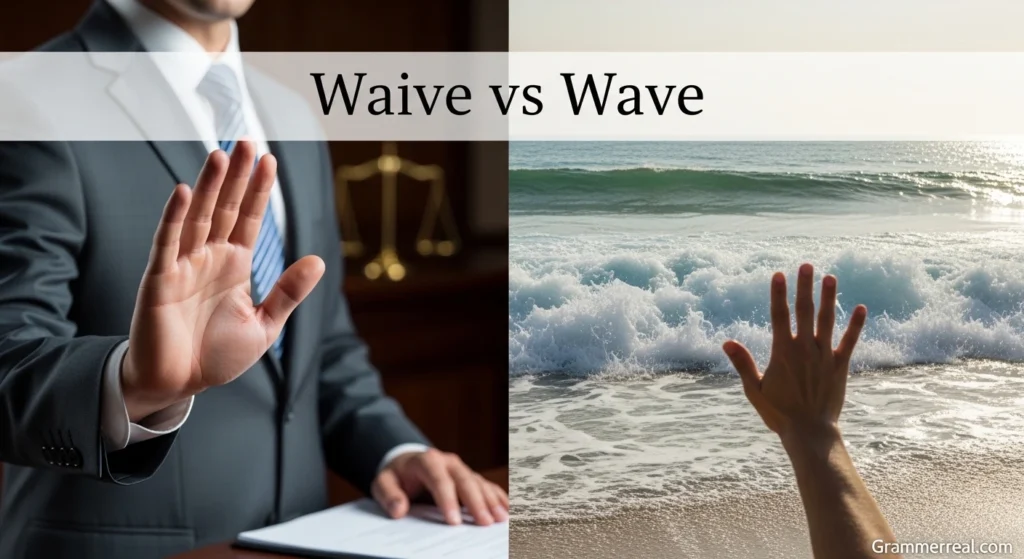
Many English learners mix up waive vs wave because the two words look similar and sound close in fast speech. However, their meanings are very different, and using the wrong one can change your sentence completely.
Waive usually means to give up a right, fee, rule, or claim on purpose. Wave usually means to move your hand, hair, water, cloth, or another object back and forth. When people study waive vs wave, they often need clear examples more than hard grammar rules. This article explains both words in simple language so you can use them with confidence. You will learn meanings, sentence patterns, common mistakes, and memory tips. You will also see differences in American and British English usage. By the end, waive vs wave will feel easy and natural.
Understanding the Main Difference Between Waive and Wave
The easiest way to remember waive vs wave is this:
- Waive = give up something officially or willingly
- Wave = move something side to side or up and down
These meanings are not interchangeable. If you choose the wrong word, the sentence may sound strange or funny.
Examples of Waive
- The bank agreed to waive the late fee.
- She decided to waive her right to speak.
- The school may waive the entry requirement.
- He signed a form to waive liability.
- The company will waive shipping charges today.
In each example, something is being given up, removed, or excused.
Examples of Wave
- Please wave when you see me.
- She waved at the bus driver.
- The flag waves in the wind.
- He gave a quick wave and left.
- Her hair formed soft waves.
In each example, there is motion, shape, or greeting.
What Does Waive Mean?
The verb waive is often used in formal, legal, business, school, and official settings. It means to choose not to use a right or to cancel a charge or rule.
Common Uses of Waive
1. Waive a Fee
- The gym will waive the joining fee this month.
- They waived the service charge.
2. Waive a Right
- He chose to waive his right to appeal.
- She waived her right to remain silent.
3. Waive a Requirement
- The university may waive the language test for some students.
- Experience can sometimes waive a degree requirement.
4. Waive a Condition
- The landlord agreed to waive the deposit.
- The seller waived the final inspection.
Grammar of Waive
Verb forms:
- Base form: waive
- Present simple: waive / waives
- Past simple: waived
- Past participle: waived
- -ing form: waiving
Examples:
- I waive the fee.
- She waives the fee.
- They waived the fee yesterday.
- The fee has been waived.
- We are waiving penalties today.
What Does Wave Mean?
The word wave can be a verb or a noun. It is common in daily speech.
Wave as a Verb
It means to move a hand or object in the air.
- She waved goodbye.
- He waves every morning.
- Please wave if you need help.
It can also mean to move in a flowing way.
- The grass waved in the wind.
- Curtains waved near the open window.
Wave as a Noun
It means a moving line of water, energy, sound, or shape.
- A huge wave hit the boat.
- Radio waves carry signals.
- Her hair has a natural wave.
- A wave of excitement filled the room.
Grammar of Wave
Verb forms:
- Base form: wave
- Present simple: wave / waves
- Past simple: waved
- Past participle: waved
- -ing form: waving
Examples:
- I wave at friends.
- She waves often.
- They waved from the car.
- He has waved already.
- We are waving now.
Why People Confuse Waive vs Wave
Many learners struggle with waive vs wave for several reasons.
1. Similar Spelling
Only one letter changes position:
- waive
- wave
That small difference can be easy to miss.
2. Similar Sound
In some accents, they sound close. Fast speech can make the difference harder to hear.
3. Both Are Verbs
Since both words can act as verbs, learners may guess incorrectly.
4. Autocorrect Errors
Typing tools sometimes suggest the wrong word if context is unclear.
Side-by-Side Comparison of Waive vs Wave
WordMeaningCommon ContextExampleWaiveGive up, cancel, excuseFees, rights, rulesThey waived the charge.WaveMove by hand or in motionGreeting, water, hairShe waved at me.
This quick table helps clarify waive vs wave at a glance.
Contextual Examples of Waive vs Wave In:
Understanding context is the best way to master waive vs wave.
Business
- The store will waive delivery costs today.
- The manager gave a friendly wave to customers.
School
- The college may waive the test score requirement.
- Students waved flags during the event.
Travel
- The airline might waive change fees.
- People waved as the train departed.
Law
- He signed papers to waive his claim.
- The crowd waved signs outside the court.
Daily Life
- Can you waive this small charge?
- Please wave when you arrive.
Common Mistakes With Waive vs Wave
Using Wave for Fees
Wrong: The bank will wave the fee. Correct: The bank will waive the fee.
Why? Fees are canceled, not moved.
Using Waive for Greeting
Wrong: She waived at me. Correct: She waved at me.
Why? Greeting uses motion.
Wrong Past Tense
Wrong: He waive the fee yesterday. Correct: He waived the fee yesterday.
Wrong: She wave at me yesterday. Correct: She waved at me yesterday.
Wrong Subject-Verb Agreement
Wrong: She waive the charge. Correct: She waives the charge.
Wrong: He wave every day. Correct: He waves every day.
American vs British English Differences
When studying waive vs wave, it helps to know that meanings stay the same in American and British English. Both varieties use these words in the same core ways.
Waive in American and British English
- waive a fee
- waive a right
- waive a requirement
These uses are common in both regions.
Wave in American and British English
- wave goodbye
- wave a flag
- sea wave
- wave of emotion
Again, meanings are shared.
Small Style Differences
Some legal or business phrases may appear more often in one country than another, but the word choice itself does not change. For example, one form may say “application fee waived,” while another says “fee has been waived.” Both are correct.
Idiomatic Expressions With Wave
The word wave appears in many common expressions.
1. Make Waves
Meaning: cause trouble or create change.
- He does not want to make waves at work.
2. A Wave of Emotion
Meaning: a sudden strong feeling.
- A wave of relief came over her.
3. New Wave
Meaning: a new style or movement.
- That band was part of the new wave scene.
4. Ride the Wave
Meaning: use success or momentum.
- The company hopes to ride the wave of growth.
5. Wave Through
Meaning: allow someone to pass.
- Security waved us through.
Idiomatic and Fixed Uses With Waive
Waive has fewer idioms because it is more formal, but it appears in many set phrases.
1. Waive the Fee
- They agreed to waive the fee.
2. Waive Rights
- She refused to waive her rights.
3. Waive Conditions
- The buyer may waive conditions before closing.
4. Waive Penalties
- The company will waive penalties for late payment this week.
Practical Tips to Remember Waive vs Wave
Tip 1: Think of Paperwork for Waive
If lawyers, schools, banks, or forms are involved, the word is often waive.
Tip 2: Think of Motion for Wave
If hands, flags, water, hair, or signals move, use wave.
Tip 3: Use a Memory Trick
- Waive has ai. Think: “I agree to give it up.”
- Wave has ve. Think: “move every way.”
Tip 4: Test the Sentence
Ask yourself:
- Is something canceled or surrendered? → waive
- Is something moving or greeting? → wave
Tip 5: Read the Sentence Aloud
Sometimes context becomes clearer when you hear it.
Sentence Patterns for Better Writing
Good sentence patterns help you use waive vs wave correctly.
Waive Patterns
- waive + fee
- waive + right
- waive + rule
- waive + requirement
- waive + charge
Examples:
- They waived the charge.
- She waived her right.
Wave Patterns
- wave at + person
- wave to + person
- wave + object
- wave goodbye
- waves of + noun
Examples:
- He waved at me.
- She waved a scarf.
- Waves of joy spread.
Mini Practice Section
Choose the correct word in each sentence.
- The hotel will ___ the parking fee.
- She gave me a quick ___.
- They may ___ the age rule.
- Children ___ from the bus window.
- A huge ___ hit the shore.
Answers:
- waive
- wave
- waive
- waved
- wave
How Grammar Rules Improve Accuracy
When learning waive vs wave, grammar matters as much as meaning.
Correct Tense
Use past forms for past time.
- They waived the fee yesterday.
- She waved last night.
Correct Agreement
Use singular verbs with singular subjects.
- He waives the rule.
- She waves daily.
Use plural verbs with plural subjects.
- They waive charges sometimes.
- We wave often.
Clear Modifiers
Wrong: She waived quickly the important right. Better: She quickly waived the important right. Best: She waived the important right quickly.
Avoid Run-On Sentences
Wrong: She waved at me I smiled back. Correct: She waved at me, and I smiled back.
Avoid Fragments
Wrong: Because he waived the fee. Correct: Because he waived the fee, customers were happy.
Better Writing Through Word Choice
Precise word choice makes writing stronger. If you confuse waive vs wave, your message may become unclear.
Compare:
- The company waived the fee. This means the fee was removed.
- The company waved the fee. This sounds incorrect because a fee cannot usually be moved in the air.
Compare:
- She waved at the crowd. This means she greeted them.
- She waived at the crowd. This sounds wrong in normal usage.
Using the right word builds trust and clarity.
How This Exercise Improves Writing Skills
Studying waive vs wave does more than teach two words. It improves several writing skills.
1. Vocabulary Precision
You learn to choose exact words.
2. Grammar Control
You practice tense, agreement, and sentence structure.
3. Editing Skills
You learn to check confusing words before publishing or submitting work.
4. Reading Comprehension
You understand formal texts, contracts, emails, and stories more easily.
5. Confidence
You write and speak with fewer mistakes.
Quick Review Checklist
Before you finish any sentence with waive vs wave, ask:
- Am I talking about canceling something? → waive
- Am I talking about movement or greeting? → wave
- Is my tense correct?
- Does the verb match the subject?
- Is the sentence clear and complete?
Conclusion
The difference between waive vs wave is simple once you know the core meanings. Waive means to give up, cancel, excuse, or surrender a right, fee, rule, or condition. Wave means to move something, greet someone, describe water movement, or show a flowing shape. These words may look alike, but they belong in very different contexts. Careful grammar, correct tense, and clear sentence structure make them easier to use. If you remember “official giving up” for waive and “motion or greeting” for wave, you will choose correctly most of the time. With practice, this common confusion becomes easy to fix.
FAQs
1. What is the main difference between waive and wave?
Waive means to give up or cancel something. Wave means to move your hand, flag, water, or another object.
2. Is it waive a fee or wave a fee?
The correct phrase is waive a fee.
3. Is it waved at me or waived at me?
The correct phrase is waved at me.
4. Can waive be used in daily speech?
Yes, but it is more common in formal settings like banks, schools, travel, and law.
5. Can wave be a noun?
Yes. Example: A large wave hit the beach.
6. Do waive and wave sound the same?
They may sound similar in some accents, but spelling and meaning are different.
7. What is the past tense of waive?
The past tense is waived.
8. What is the past tense of wave?
The past tense is waved.



