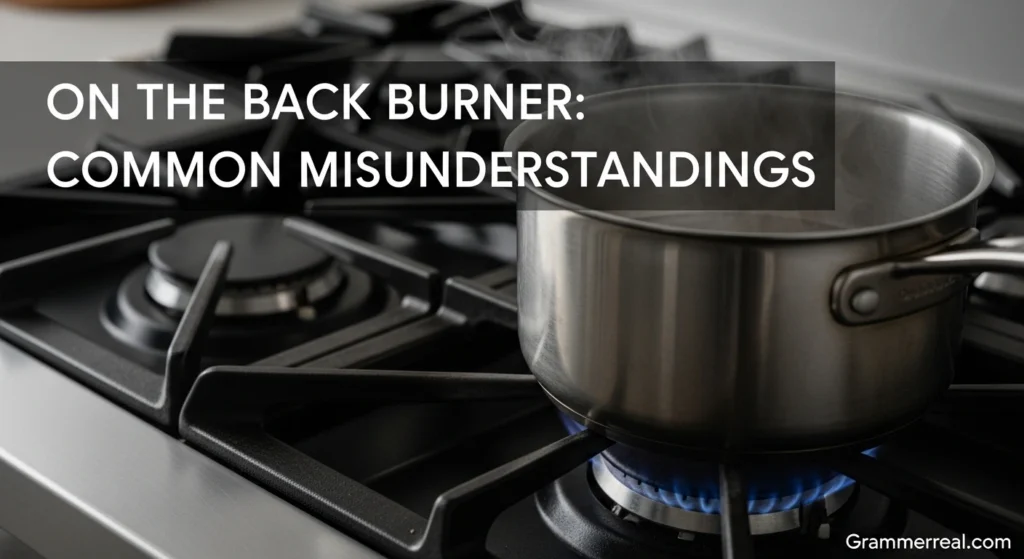
The kitchen hums with a soft, steady warmth. A pot rests quietly at the edge of the stove. Steam curls up in thin, lazy lines, carrying a gentle smell of spices and hope. Nothing rushes here. Nothing burns. Instead, everything waits. You can almost hear time breathing. This is the feeling of something being “on the back burner”—not forgotten, not lost, just waiting for the right moment to come alive.
The phrase “on the back burner” means putting something aside for now. You do not cancel it. You do not throw it away. Instead, you pause it. You give your attention to something else that needs you more right now. Later, when the moment feels right, you return to it with fresh eyes and fresh energy.
This idea matters because life often feels full and loud. Tasks pile up. Dreams compete. Time feels small. So, knowing what to pause—and when to return—becomes a quiet superpower. It helps you stay calm, focused, and in control of your path.
Meaning of On the Back Burner
The idiom on the back burner means delayed or given low priority. It describes something that is not urgent right now.
In simple words, it means you decide to do something later, not now.
Examples:
- We put the trip on the back burner.
- She left her art project on the back burner.
- The company placed the new plan on the back burner.
In each sentence, the action is delayed.
The phrase creates an image of cooking. When you cook, the front burner gets more heat and attention. The back burner gets less heat. So, something on the back burner is less important for now.
Origin of the Phrase
The idiom comes from cooking. In a kitchen, a stove usually has front and back burners. Cooks use the front burners for food that needs quick attention. They use the back burners for food that can cook slowly.
Over time, English speakers started using this kitchen idea in daily speech. They used on the back burner to describe delayed plans or ideas. Today, the idiom appears in business, school, and personal life.
Grammar Structure
The basic structure is:
Subject + put/place/leave + object + on the back burner
Examples:
- I put the idea on the back burner.
- They placed the project on the back burner.
- She left her plan on the back burner.
You can change the verb tense.
Present tense:
- I put my goals on the back burner.
Past tense:
- I put my goals on the back burner last year.
Future tense:
- We will put this issue on the back burner.
Passive form (less common but possible):
- The plan was put on the back burner.
Incorrect examples:
- I put on the back burner the plan.
- I put the plan in the back burner.
Correct examples:
- I put the plan on the back burner.
Always use the preposition on.
Contextual Examples
Let us look at daily situations.
Work:
The manager put the new marketing idea on the back burner because the team had urgent tasks.
Education:
The student put her painting hobby on the back burner during exam week.
Family Life:
They put home repairs on the back burner to save money.
Health:
He put his fitness goals on the back burner due to a busy schedule.
These examples show that people use this idiom when priorities change.
Common Mistakes
Learners sometimes make small errors.
- Wrong preposition Incorrect: on the back stove Correct: on the back burner
- Changing word order Incorrect: On back the burner Correct: On the back burner
- Using it for very short delays This idiom usually suggests a longer delay, not a few minutes.
- Forgetting the object Incorrect: I put on the back burner. Correct: I put the plan on the back burner.
Always include what you delay.
American and British English Usage

Both American and British English use on the back burner in the same way. The spelling and meaning stay the same.
The idiom appears often in business news and workplace talk. For example:
The company put expansion plans on the back burner.
It is common in spoken and written English.
Tone and Emotional Meaning
On the back burner sounds neutral. It does not always suggest something bad. It simply shows a change in priority.
Compare:
- I canceled the plan.
- I put the plan on the back burner.
The second sentence sounds softer. It suggests the plan may happen later.
Because of this softer tone, people often use it in professional settings.
Practical Tips for Use
Use the idiom when something is delayed but not forgotten.
Always use the preposition on.
Include the object clearly.
Match the verb tense with the time of action.
Do not overuse it in one paragraph.
Example with tense control:
Last year, we put the travel plan on the back burner. Now, we are ready to start again. Soon, we will take it off the back burner.
Clear tense shows clear meaning.
Sentence Structure and Clarity
Short sentence:
We put the project on the back burner.
Longer sentence:
Although we liked the idea, we put the project on the back burner because we needed to finish urgent work first.
Avoid fragments.
Incorrect: On the back burner because of exams. Correct: She put her hobbies on the back burner because of exams.
Avoid run-on sentences.
Incorrect: We put the plan on the back burner we had no money. Correct: We put the plan on the back burner because we had no money.
Good punctuation improves clarity.
Similar Expressions
Here are similar phrases:
- Delay
- Postpone
- Set aside
- Defer
- Put on hold
Delay and postpone sound direct. Put on hold is very close in meaning. On the back burner sounds more informal and visual.
Writing Practice
Try these exercises:
- Write a sentence about work using on the back burner.
- Change this sentence to future tense: We put the idea on the back burner.
- Write a longer sentence that explains why something is on the back burner.
Practice improves grammar and confidence.
Reflection on Grammar and Writing Technique
In this article, we used simple vocabulary. We wrote clear and direct sentences. Most sentences use active voice. We matched subjects and verbs carefully.
We kept the structure fixed: put + object + on the back burner. Avoided fragments and run-on sentences. We used short and longer sentences to improve rhythm.
We repeated the idiom naturally but not too often. Balanced repetition helps learning without causing SEO problems.
Clear grammar and simple wording make the idiom easy to understand.
Conclusion
Life does not need to rush like boiling water all the time. Sometimes, it needs to simmer softly on the back burner. That quiet space allows ideas to grow, dreams to rest, and energy to rebuild.
When you place something on the back burner, you are not giving up. Instead, you are choosing the right moment. You are trusting time. You are allowing life to unfold in a calm and thoughtful way.
So next time you feel overwhelmed, remember the gentle kitchen scene. Let some things wait. Let some dreams rest. And when the moment feels right, bring them forward again—stronger, clearer, and ready to shine.
FAQs
What does on the back burner mean?
It means to delay something or give it low priority.
Is it formal or informal?
It is mostly informal but common in business talk.
Can I use it in past tense?
Yes. Example: We put it on the back burner.
What preposition should I use?
Always use on.
Does it mean cancel?
No, it means delay, not cancel.



