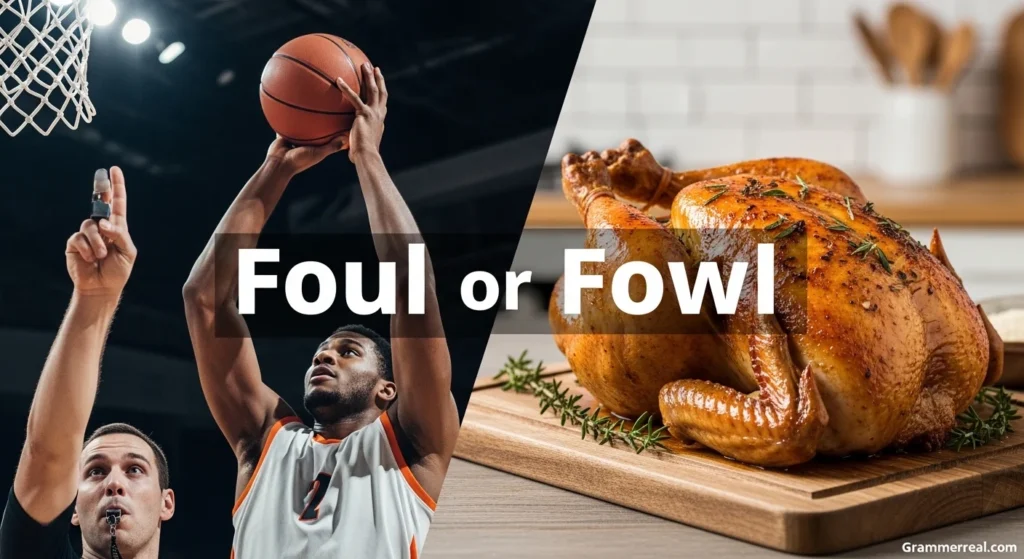
The phrase foul or fowl confuses many learners because the two words sound the same, but they have different meanings. They are examples of homophones, which are words that share pronunciation but differ in spelling and meaning.
If you choose the wrong one, your sentence may look strange or funny. For example, “The chicken was foul” means it was bad or rotten, while “The chicken was fowl” means it was a bird. This small spelling change creates a very different message. Learning foul or fowl helps improve spelling, grammar, and reading accuracy. It also builds confidence when writing emails, essays, school tasks, or daily messages. In simple terms, foul usually relates to something bad, unfair, dirty, or unpleasant, while fowl usually refers to birds such as chickens, ducks, or turkeys. Once you understand the context, choosing the correct word becomes much easier. This guide explains everything in clear and simple language so you can use both words correctly.
What Does Foul Mean?
The word foul usually describes something negative. It can mean dirty, unfair, offensive, unpleasant, or rotten. It is often used in sports, daily speech, and descriptive writing.
Common meanings of foul:
- Unfair in sports A foul happens when a player breaks the rules.
- The referee called a foul.
- He committed a foul during the match.
- The player received a warning for a foul tackle.
- Bad smell or taste Foul can describe something disgusting.
- The milk had a foul smell.
- Garbage created a foul odor.
- The water tasted foul.
- Offensive language or behavior It can describe rude or abusive actions.
- He used foul language.
- The crowd shouted foul words.
- Her foul behavior upset everyone.
- Dirty or polluted It may describe something unclean.
- The river became foul after the spill.
- The room smelled foul and damp.
- Wrong or dishonest Sometimes foul suggests cheating or evil behavior.
- They suspected foul play.
- The result came from foul methods.
Easy memory tip for foul:
Think of foul as something bad or wrong.
What Does Fowl Mean?
The word fowl is much more specific. It usually means a bird, especially one kept for food or farming. Chickens, ducks, turkeys, geese, and similar birds are common types of fowl.
Common meanings of fowl:
- Farm birds
- The farmer fed his fowl.
- Chickens and ducks are common fowl.
- Bird meat used as food
- The dish included roasted fowl.
- Wild fowl was once common in old recipes.
- Wild birds
- Hunters watched the waterfowl near the lake.
- The marsh is home to many wild fowl.
Easy memory tip for fowl:
Think of fowl as feathered birds.
foul or fowl: The Main Difference
The easiest way to understand foul or fowl is to focus on meaning.
WordMeaningExamplefoulbad, unfair, dirty, rudeThe player made a foul.fowlbird, poultryThe farmer raised fowl.
If the sentence talks about sports, smell, cheating, or rude language, the correct word is usually foul. If the sentence talks about birds, farms, or poultry, the correct word is usually fowl.
Why People Confuse foul or fowl
Many people confuse foul or fowl because they sound exactly the same. English has many homophones, and these pairs often cause mistakes.
Main reasons for confusion:
- Same pronunciation Both words sound like “foul.”
- Quick typing mistakes People type fast and do not check spelling.
- Weak context reading Some writers focus on sound, not meaning.
- Autocorrect errors Devices may change the word incorrectly.
- Limited vocabulary practice Learners may know one word but not the other.
The good news is that context usually makes the right choice clear.
Contextual Examples of foul or fowl
Examples help you remember correct usage. Read these carefully.
Sentences with foul
- The referee stopped play after a foul.
- There was a foul smell in the kitchen.
- She complained about his foul language.
- The weather turned foul by evening.
- Police found no sign of foul play.
Sentences with fowl
- The market sells fresh fowl.
- Farmers protect their fowl from foxes.
- Roast fowl was served at dinner.
- Many wild fowl gather near the lake.
- The old barn housed several kinds of fowl.
Compare both in one set
- The meat smelled foul, so nobody ate the fowl.
- A foul in basketball stopped the game near the farm where fowl were kept.
- He used foul words while carrying the fowl basket.
These examples show how context changes everything.
Common Mistakes with foul or fowl
Writers often make simple errors with this pair. Here are common mistakes and corrections.
Mistake 1: Using fowl for bad smell
❌ The trash had a fowl odor. ✔ The trash had a foul odor.
Mistake 2: Using foul for birds
❌ The farmer sold foul in the market. ✔ The farmer sold fowl in the market.
Mistake 3: Using the wrong word in sports
❌ The player committed a fowl. ✔ The player committed a foul.
Mistake 4: Ignoring sentence meaning
❌ We ate roasted foul for dinner. ✔ We ate roasted fowl for dinner.
Mistake 5: Guessing by sound only
Because both words sound the same, spelling by sound alone causes errors. Always check meaning.
American vs British English Differences
The meanings of foul or fowl stay mostly the same in both American and British English. However, some usage patterns differ slightly.
Foul in American English
- Common in basketball, football, baseball, and daily speech.
- Often used for bad smells and rude language.
Examples:
- Personal foul
- Foul ball
- Foul language
Foul in British English
- Very common in football (soccer), rugby, and cricket discussion.
- Also used for weather and unpleasant conditions.
Examples:
- Dangerous foul
- Foul weather
- Foul temper
Fowl in American English
- Less common in daily speech than “chicken” or “poultry.”
- Seen in cooking, farming, hunting, or formal writing.
Fowl in British English
- Also less common in casual speech.
- More common in traditional food writing or rural settings.
Key point
Whether you use American or British English, foul still means bad or unfair, and fowl still means birds.
Idiomatic Expressions with Foul
The word foul appears in many common expressions. The word fowl appears less often in idioms.
Common expressions with foul
- Foul play Wrongdoing or crime.
- Detectives suspected foul play.
- Cry foul To complain that something is unfair.
- The team cried foul after the decision.
- Foul mood Very bad mood.
- He woke in a foul mood.
- Foul weather Bad weather.
- Ships stayed in port during foul weather.
- Foul mouth Someone who uses rude language.
- The coach warned the foul-mouthed player.
Expressions with fowl
The word fowl is more literal than idiomatic. It often appears in food or hunting language:
- waterfowl
- game fowl
- domestic fowl
Grammar Focus: How foul and fowl Work in Sentences
Understanding grammar helps you use foul or fowl correctly.
foul as an adjective
It often describes a noun.
- foul smell
- foul language
- foul weather
foul as a noun
It can name a rule break in sports.
- The referee called a foul.
foul as a verb
Less common, but possible.
- Smoke fouled the air.
- Mud fouled the machine.
fowl as a noun
It usually names birds.
- The fowl escaped the pen.
- Several fowl crossed the yard.
Subject-verb agreement examples
- The fowl is in the cage.
- The fowl are in the yard. (when meaning several birds)
- His language was foul.
- Their actions were foul.
Correct agreement makes writing clear and professional.
Practical Tips to Remember foul or fowl
Here are simple tricks to remember the difference.
Think of the letter “u” in foul
Use foul for ugly, unfair, unpleasant.
Think of “owl” inside fowl
An owl is a bird, so fowl connects to birds.
Check the topic
Ask yourself:
- Is this about sports, smell, or bad behavior? → foul
- Is this about birds or food? → fowl
Read the sentence aloud with meaning
Sound alone will not help because both words sound the same.
Practice short pairs
- foul odor / farm fowl
- foul language / roasted fowl
- foul tackle / wild fowl
Mini Practice Section
Choose the correct word.
- The referee called a ___ . Answer: foul
- The farmer kept ducks and other ___ . Answer: fowl
- There was a ___ smell in the room. Answer: foul
- We ate roasted ___ at dinner. Answer: fowl
- They suspected ___ play. Answer: foul
Practice builds memory quickly.
Writing Techniques Used in This Guide
This guide uses clear grammar and easy wording to make learning simple. Sentences vary in length so the text feels natural and smooth. Active voice appears in direct statements such as “The farmer fed his fowl,” while passive voice appears where useful, such as “Roast fowl was served at dinner.” Correct verb tense keeps time clear. Articles such as a, an, and the are used carefully for accuracy. Prepositions such as in, on, after, and during help connect ideas. Examples appear often because examples improve understanding. Repetition of the keyword is natural and controlled so reading stays comfortable. Simple structure supports readability and helps learners remember the difference.
How Learning foul or fowl Improves Writing
Studying pairs like foul or fowl improves writing in many ways.
- It increases vocabulary.
- It sharpens spelling skills.
- It teaches context reading.
- It reduces embarrassing mistakes.
- It improves grammar awareness.
- It builds confidence in essays and exams.
- It helps readers trust your writing.
- It trains you to proofread carefully.
Small word choices often create a big difference in quality.
Conclusion
Understanding foul or fowl is easier than it first appears. Foul usually means bad, unfair, dirty, rude, or unpleasant. Fowl usually means birds such as chickens, ducks, geese, or turkeys. Since both words sound the same, many people confuse them, but context quickly shows the correct choice. If the sentence is about sports, smell, cheating, or bad language, choose foul. If the sentence is about birds, farms, hunting, or poultry, choose fowl. Regular practice, careful proofreading, and attention to meaning will help you use both words correctly every time.
FAQs
1. What is the difference between foul or fowl?
Foul means bad, unfair, dirty, or unpleasant. Fowl means birds, especially poultry.
2. Are foul and fowl pronounced the same?
Yes. They are pronounced the same, which is why many people confuse them.
3. Is a basketball rule break called foul or fowl?
It is called a foul.
4. Which word relates to chickens and ducks?
The correct word is fowl.
5. What does foul smell mean?
It means a very bad or unpleasant smell.
6. What does foul play mean?
It means dishonest action, crime, or wrongdoing.
7. Can fowl mean cooked bird meat?
Yes. In formal or traditional use, fowl can mean bird meat served as food.
8. Is fowl common in daily speech?
Not always. Many people say chicken, poultry, or bird instead.



