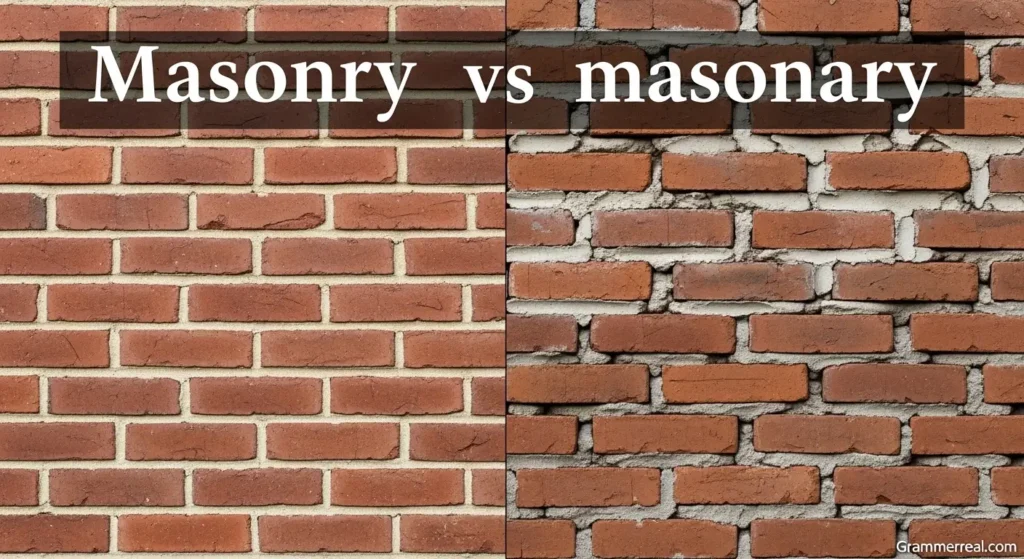
When people search for masonry vs masonary, they usually want to know which spelling is correct and why both forms appear online. This is a common question because the two words look very similar. One form is standard English, while the other is usually a spelling mistake.
Many students, writers, business owners, and job seekers want to use the right version in emails, school work, websites, and daily writing. Understanding masonry vs masonary can improve your spelling and make your writing look more professional. It can also help you avoid confusion when reading signs, ads, or social media posts. In simple terms, masonry is the correct spelling in modern English. Masonary is generally incorrect, although some people still use it by mistake. In this guide, you will learn the meaning, usage, grammar points, examples, and easy memory tips for mastering masonry vs masonary.
What Does Masonry Mean?
Masonry is a noun. It refers to the work of building with materials such as brick, stone, concrete blocks, and similar items. It can also describe the finished structure made from those materials.
Examples:
- The house has beautiful brick masonry.
- He studied masonry at a trade school.
- Strong masonry walls can last for many years.
- The old church shows fine stone masonry.
The word often appears in construction, architecture, engineering, home repair, and history.
Is Masonary a Real Word?
In most cases, masonary is not the accepted spelling. It is usually a misspelling of masonry. Many people type it because the sound of the word can be confusing. English spelling does not always match pronunciation, so errors happen often.
Examples of mistakes:
- Wrong: We need a masonary contractor.
- Correct: We need a masonry contractor.
- Wrong: The wall needs masonary repair.
- Correct: The wall needs masonry repair.
So, when comparing masonry vs masonary, remember this clear rule: masonry is the correct spelling.
Why Do People Confuse Masonry and Masonary?
There are several reasons why this spelling mistake is common.
1. Sound Confusion
Some people pronounce the word in a way that sounds like “may-son-air-ee” or “may-son-er-ee.” Because of that, they add an extra “a.”
2. Similar Word Patterns
English has many words ending in -ary, such as:
- library
- primary
- ordinary
- necessary
Because these words are common, people may assume masonary follows the same pattern.
3. Fast Typing
Typing quickly often causes spelling errors. People may not notice the mistake before posting.
4. Spellcheck Dependence
Some writers depend too much on automatic tools. If they do not review carefully, mistakes remain.
The Correct Spelling Rule
The correct word comes from mason + -ry.
- mason = a worker who builds with stone or brick
- -ry = a suffix used in some nouns
This forms masonry, not masonary.
Think of it this way:
- mason → masonry
- not mason → masonary
That simple pattern helps many learners remember the correct form.
Contextual Examples of Masonry in Daily Use
Seeing words in real sentences helps memory. Here are common ways to use masonry.
Construction Work
- The company offers masonry services for homes and offices.
- Good masonry improves the strength of a building.
- They repaired the damaged masonry after the storm.
Education and Training
- He joined a masonry course last year.
- Students learned bricklaying and basic masonry skills.
Home Design
- The garden wall features decorative masonry.
- Stone masonry gives the house a classic look.
History
- Ancient cities often had strong masonry walls.
- Roman masonry techniques influenced later builders.
Common Mistakes in Writing
When learning masonry vs masonary, people often make other writing mistakes too. Here are some examples.
Articles
- Wrong: He is a expert in masonry.
- Correct: He is an expert in masonry.
Verb Agreement
- Wrong: The masonry walls is strong.
- Correct: The masonry walls are strong.
Tense
- Wrong: Yesterday they repair the masonry.
- Correct: Yesterday they repaired the masonry.
Preposition
- Wrong: He works in masonry repairs for years.
- Correct: He has worked in masonry repairs for years.
Modifier Placement
- Awkward: They built quickly a masonry wall.
- Better: They quickly built a masonry wall.
These examples show how spelling and grammar work together.
Masonry vs Masonary in American and British English
Many users ask if one spelling is American and the other is British. The answer is simple: masonry is the accepted spelling in both American English and British English.
American English
- masonry contractor
- masonry repair
- brick masonry
British English
- masonry wall
- stone masonry
- historic masonry building
There is no standard regional rule that makes masonary correct. In both systems, masonry remains the proper choice.
Idiomatic and Related Expressions
The word appears in some useful expressions and related phrases.
Build on Solid Foundations
This phrase means to start with a strong base. It connects well with masonry because stone and brick need solid support.
Example:
- Good habits build on solid foundations.
Brick by Brick
This means progress happens step by step.
Example:
- She improved her business brick by brick.
Set in Stone
This means fixed or unlikely to change.
Example:
- The schedule is not set in stone yet.
Related Job Terms
- mason
- bricklayer
- stoneworker
- contractor
- builder
These words often appear near masonry.
Practical Tips to Remember the Correct Spelling
If you often forget masonry vs masonary, these tips can help.
1. Remember the Base Word
Think of mason first. Then add -ry.
mason + ry = masonry
2. Notice There Is No Extra A
The wrong form adds an extra “a” after “n.” The correct word does not.
3. Use It in Sentences
Write five sentences using masonry. Practice builds memory.
4. Read Construction Content
When you read books, signs, or articles about building work, notice the spelling.
5. Say It Slowly
Break it into parts:
ma-son-ry
This helps many learners.
Why Correct Spelling Matters
Some people think one small spelling error does not matter. In many cases, it does matter.
Professional Image
A business ad that says “masonary services” may look careless.
Better Trust
Correct writing often creates trust with readers and clients.
Easier Search Results
Using the correct word helps people find accurate information.
Better School Grades
Students earn better marks when spelling is correct.
Clear Communication
Readers understand your message faster when words are standard.
Grammar Lessons Learned from This Topic
The topic masonry vs masonary also teaches useful grammar and writing habits.
Subject-Verb Agreement
- The wall is strong.
- The walls are strong.
Correct Tense Use
- They build walls every week.
- They built the wall yesterday.
- They have built many walls.
Proper Articles
- a mason
- an old masonry building
- the masonry wall
Clear Sentence Structure
Avoid fragments:
- Wrong: Because the wall damaged.
- Correct: Because the wall was damaged, they repaired it.
Avoid run-on sentences:
- Wrong: The wall cracked they fixed it quickly.
- Correct: The wall cracked, so they fixed it quickly.
These rules improve all writing, not only spelling.
Writing Style Techniques Used Here
Simple and clear writing helps readers of every level. Good style often includes:
Short and Long Sentences Mixed Together
Short sentences create clarity. Longer sentences add detail.
Active Voice
- The workers repaired the wall.
Passive Voice
- The wall was repaired yesterday.
Both forms are useful when used carefully.
Logical Order
The article moves from meaning, to mistakes, to tips, to grammar. This makes reading easier.
Repetition with Purpose
Important points are repeated in a natural way so readers remember them.
Real-Life Situations Where This Confusion Happens
Job Applications
A worker applying for construction jobs should write masonry skills, not masonary skills.
Business Signs
Correct spelling helps companies appear reliable.
Student Essays
A student writing about ancient buildings should use masonry.
Social Media Posts
Even casual posts look better with correct spelling.
Home Repair Requests
When asking for services, use terms like:
- masonry repair
- masonry contractor
- masonry wall repair
Easy Memory Trick
Use this sentence:
A mason does masonry.
Because the worker is a mason, the work is masonry. This quick link helps many learners remember the right spelling.
Mini Comparison Table
FormCorrect?MeaningMasonryYesBuilding work with brick, stone, or blockMasonaryNo (usually)Common misspelling of masonry
How This Exercise Improves Writing Skills
Learning masonry vs masonary does more than fix one spelling error. It improves many language skills.
Better Attention to Detail
You begin to notice small differences in words.
Stronger Editing Habits
You learn to reread your work before sending it.
Better Vocabulary
You understand construction terms and related words.
Cleaner Grammar
You practice agreement, tense, and sentence flow.
Clearer Communication
Correct spelling helps readers trust your message.
Conclusion
The debate around masonry vs masonary is simple once you know the rule. Masonry is the correct and accepted spelling in modern English. It refers to building work done with brick, stone, concrete block, or similar materials. Masonary is usually a misspelling caused by sound confusion, typing habits, or lack of review. This rule stays the same in American English and British English. By learning the base word mason, checking grammar, and practicing correct usage, you can avoid this mistake easily. Good spelling improves school work, job writing, business messages, and daily communication. Keep it simple: a mason does masonry.
FAQs
1. Which spelling is correct: masonry or masonary?
Masonry is correct. Masonary is usually incorrect.
2. What does masonry mean?
It means building work using brick, stone, concrete block, or similar materials.
3. Is masonary ever acceptable?
In standard modern English, it is generally treated as a misspelling.
4. Is masonry used in American English?
Yes. Masonry is standard in American English.
5. Is masonry used in British English?
Yes. Masonry is also standard in British English.
6. Why do people write masonary?
They often spell it by sound or type too quickly.
7. What is a mason?
A mason is a worker who builds with stone, brick, or similar materials.
8. How can I remember the right spelling?
Think: A mason does masonry.