
The room hums before you notice it. A distant fan spins, its breath brushing the air like a sleepy whisper. Somewhere, a spoon taps a cup—light, bright, almost shy. Then a voice enters, warm and steady, and your ears lean in as if they had a will of their own. Sound does not just arrive; it paints, it nudges, it lingers. In that quiet theater of listening, your ears become more than organs—they become storytellers.
Metaphors for ears help us capture this invisible magic. They turn hearing into something we can see, feel, and share. Whether you write stories, craft social posts, or simply want to express yourself better in daily life, these metaphors give your words texture and life. They help you move from plain description to vivid expression. And that shift matters. Because when language sings, people listen.
Why Metaphors for Ears Matter in Writing and Expression
Ears appear in writing more often than we realize, because listening is central to being human. Metaphors for ears can help writers and speakers describe:
- Attention and care
- Curiosity and awareness
- Silence and intimacy
- The way sound shapes emotion
Instead of saying “he listened carefully,” a metaphor can make it vivid: “His ears were lanterns in the dark, catching every whisper.”
Metaphors transform ears into symbols of understanding, vulnerability, and connection.
Ears as More Than Body Parts

Ears are not only physical structures. In human life, they represent:
- The ability to listen
- The openness to learn
- The tenderness of hearing someone’s truth
- The act of receiving the world
When someone says, “I’m all ears,” they are offering more than hearing—they are offering presence.
So ears often symbolize empathy itself.
How Metaphors Help Describe Listening and Sound
Sound is invisible. Listening is intangible. That is exactly why metaphor becomes powerful.
Metaphors help us describe things like:
- A voice that comforts
- Silence that speaks
- Words that echo inside us
- The way music moves through memory
Ears are the bridge between the outer world and our inner world, and metaphors make that bridge feel real.
Ears in Literature, Culture, and Everyday Speech
Across cultures, ears have always carried symbolic meaning.
We say:
- “Music to my ears”
- “Walls have ears”
- “Turn a deaf ear”
- “Her words fell on listening ears”
In myths, heroes hear secret prophecies. In poetry, lovers recognize each other by voice alone. Even in everyday life, ears become the quiet witnesses of everything unsaid.
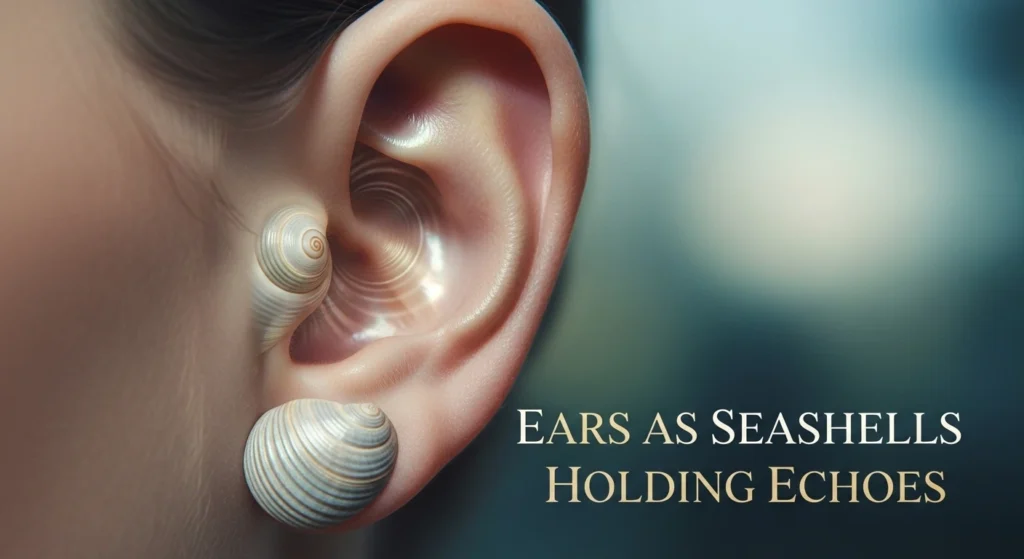
Ears as Seashells Holding Echoes
Meaning & Explanation
Ears can be compared to seashells because they seem to collect sound the way shells collect ocean whispers.
This metaphor suggests:
- Sound as something carried and stored
- Listening as gentle and intimate
- Voices echoing long after they’re spoken
Example Sentence
“Her ears were seashells, holding the echoes of every story her grandmother ever told.”
Alternative Ways to Express It
- “Ears like shells filled with sound”
- “Echo chambers of memory”
- “Small oceans of listening”
Sensory or Emotional Detail
Imagine lifting a shell to your ear, hearing that soft rushing sound. Listening can feel like that—quiet, mysterious, full of hidden depth.
Mini Storytelling Touch
A child sits by the sea, holding a shell, convinced the ocean lives inside it. In the same way, our ears hold entire worlds inside the smallest spaces.
Using Seashell Metaphors for Memory and Emotion
This metaphor works beautifully when writing about nostalgia:
- “His ears carried echoes of the past.”
- “Every voice became a wave inside her.”
- “Listening felt like holding the sea close.”
Bonus tip: Pair this metaphor with imagery of water, tides, or whispers for poetic softness.
Ears as Antennas Reaching for Meaning
Meaning & Explanation
Ears can be seen as antennas because they are always searching, picking up signals from the world.
This metaphor represents:
- Awareness
- Curiosity
- Sensitivity to tone and emotion
Example Sentence
“His ears were antennas, catching the smallest tremor of sadness in her voice.”
Alternative Ways to Express It
- “Receivers of hidden messages”
- “Signals of attention”
- “Tuned instruments of listening”
Sensory or Emotional Detail
Antennas suggest alertness, the sense of being tuned in. Sometimes ears don’t just hear words—they hear what is underneath them.
Cultural Reference
In stories of spies or secret agents, ears are always alert, catching coded messages. But in real life, empathy is the deepest kind of antenna.
Tune Your Antennas

Exercise: Imagine your ears as antennas today.
Ask yourself:
- What emotional “signals” do you notice in others?
Sample Answers:
- “I notice when someone’s laughter sounds forced.”
- “I hear tiredness in my friend’s quiet voice.”
- “I sense joy when someone speaks faster and brighter.”
Example Sentence: “My ears became antennas, receiving not just sound, but feeling.”
Ears as Doors to the Inner World
Meaning & Explanation
Ears can be described as doors because they allow the outside world to enter the mind.
This metaphor symbolizes:
- Openness
- Vulnerability
- Connection through sound
Example Sentence
“Her ears were doors, and every song she heard walked straight into her heart.”
Alternative Ways to Express It
- “Gateways of sound”
- “Open entrances to emotion”
- “Portals where voices arrive”
Sensory or Emotional Detail
Doors can open gently or slam harshly. In the same way, sound can comfort or overwhelm.
Real-Life Resonance
Think about how one kind word can enter through the ears and stay in the soul for years. That is the power of these “doors.”
Metaphors for Ears in Communication and Empathy
Ears are often symbols of care:
- “A safe place to be heard”
- “A shelter for someone’s truth”
- “Hands of listening”
Example: “Her ears were a refuge, a place where others could finally speak freely.”
This shows listening as emotional support, not just hearing.
Metaphors for Ears in Silence and Secrets
Ears also appear in darker metaphors:
- “Walls have ears”
- “Secrets whispered into the dark”
- “Silence filled with listening”
Mini scenario: Two friends share a secret at midnight, voices low, trusting the night itself to listen. Ears become guardians of intimacy.
Create Your Own Metaphors for Ears
Try this creative pattern:
Ears are like ___ because ___
Examples with answers:
- Ears are like seashells because they hold echoes of sound and memory.
- Ears are like antennas because they catch signals beyond words.
- Ears are like doors because they let voices enter the heart.
Now readers can try their own:
Example Answer: “Ears are like gardens because they collect sounds like seeds, growing understanding.”
Bonus Tips for Using Ear Metaphors in Writing and Daily Life
Metaphors for ears are wonderful in:
- Poetry about music
- Stories about secrets
- Writing about empathy
- Social media captions
Caption ideas:
- “Listening like a seashell holds the sea.”
- “Tuning my antennas to kindness.”
- “Keeping my doors open for the voices that matter.”
Writing tip: Combine ear metaphors with sensory details—whispers, echoes, warmth, silence.
Ears as Symbols in Art, Music, and Myth
In myths, hearing is often linked to wisdom. Prophets hear divine messages. Musicians hear beauty others cannot.
Across cultures:
- Ears symbolize attention
- Listening symbolizes respect
- Sound symbolizes life itself
Even the simple act of hearing birdsong at dawn can feel sacred—a reminder that ears are our connection to the world’s music.
Conclusion
Metaphors for ears transform ordinary language into something vivid and expressive. They allow you to show attention, emotion, and atmosphere in ways that simple words cannot. By using images like open doors, satellites, and hungry cups, you create deeper meaning and stronger connections with your audience. Furthermore, these metaphors enhance storytelling, improve communication, and make everyday speech more engaging. When you practice regularly and use them thoughtfully, your writing becomes more dynamic and memorable. In the end, learning to describe how we hear helps us better express how we feel, understand, and connect with the world around us.
FAQs
1. Why are metaphors for ears useful in writing?
Because they make listening and sound more vivid, emotional, and symbolic.
2. What is a beautiful metaphor for ears and memory?
Ears as seashells holding echoes is a powerful image of sound lingering in the heart.
3. Can ear metaphors represent empathy?
Yes. Ears often symbolize care, attention, and emotional presence.
4. How do metaphors improve descriptions of listening?
They transform simple actions into sensory, poetic experiences readers can feel.
5. How can I create my own metaphor for ears?
Think about what ears do—receive, hold, open, catch—and compare them to something familiar like shells, doors, or antennas.



