The room is quiet, but not empty. A faint hum lingers in the air, like the last note of a song that refuses to fade. Sunlight stretches across the floor in slow, golden fingers, touching the edge of a still hand, warming it gently, as if trying to hold it here just a little longer. Outside, the wind brushes past the trees, and leaves fall—not with noise, but with a soft surrender. Everything feels suspended, as though time itself is pausing to witness a crossing.
Death, in its simplest form, marks the end of life. Yet language rarely allows it to remain simple. We wrap it in metaphors, soften its edges, and give it shapes we can understand. We say someone “passed away,” “went to sleep,” or “crossed over.” These phrases do more than replace a difficult word—they help us face something vast, emotional, and often overwhelming.
Metaphors for dying matter because they give us a way to speak about loss without breaking under its weight. They allow writers, speakers, and everyday people to express grief, acceptance, peace, or even mystery. More importantly, they help us connect—with others, with our emotions, and with the quiet truths we often avoid.
Why Metaphors for Dying Matter in Writing and Life
Death is one of the hardest realities to speak about directly. Metaphors help because they:
- Offer comfort in sorrow
- Create gentle ways to express loss
- Help writers approach death with beauty and respect
- Give emotional language to something universal
Metaphors don’t erase grief, but they can wrap it in softness.
Dying as a Natural Part of the Human Story
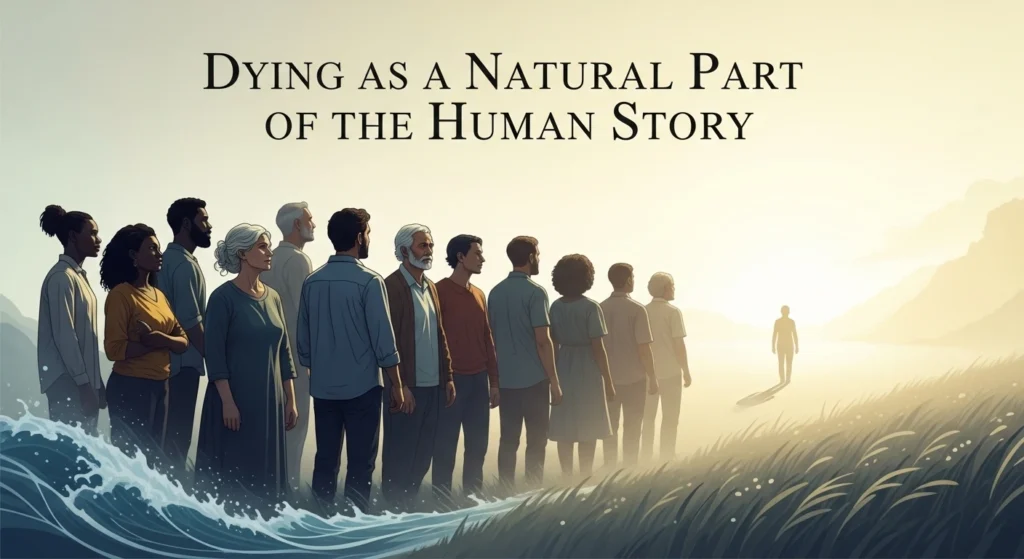
Every life has seasons. Just as winter follows autumn, death follows life. Many traditions see dying not as punishment, but as part of nature’s rhythm.
Dying is:
- A closing chapter
- A quiet transition
- A return to stillness
Metaphors help us understand it as part of the larger circle.
How Metaphors Help Us Speak About Loss Gently
When people are grieving, blunt words can feel too heavy. Metaphors offer tenderness:
- “They passed away”
- “They went home”
- “They are at rest”
These expressions are not meant to avoid truth, but to hold it with care.
Metaphors for Dying in Poetry, Faith, and Culture
Throughout history, writers have described dying with gentle imagery:
- Shakespeare compared life to a fading candle
- Poets describe death as sleep
- Spiritual traditions speak of returning to the source
Across cultures, metaphor becomes a bridge between sorrow and meaning.
Dying as Falling Asleep After a Long Day

Meaning & Explanation
This metaphor suggests death is rest—peaceful, quiet, and free of struggle.
It symbolizes:
- Release
- Calm
- Comfort after exhaustion
Example Sentence
“She died as if she were simply falling asleep, finally resting after a long and weary day.”
Alternative Ways to Express It
- “Drifting into gentle sleep”
- “Closing one’s eyes in peace”
- “A soft surrender to rest”
Sensory or Emotional Detail
Imagine warm blankets, dim light, the slow easing of breath. This metaphor makes dying feel tender rather than frightening.
Mini Storytelling Touch
An elderly man, surrounded by family, slips away quietly, like someone dozing off while listening to soft music. The room holds both sadness and peace.
Using Sleep Metaphors for Comfort
Sleep metaphors are often used in condolences:
- “May they rest peacefully.”
- “They are finally at ease.”
- “No more pain, only rest.”
Bonus tip: Use this metaphor carefully, especially with grief, because it can feel deeply personal.
Dying as a Journey Into the Horizon
Meaning & Explanation
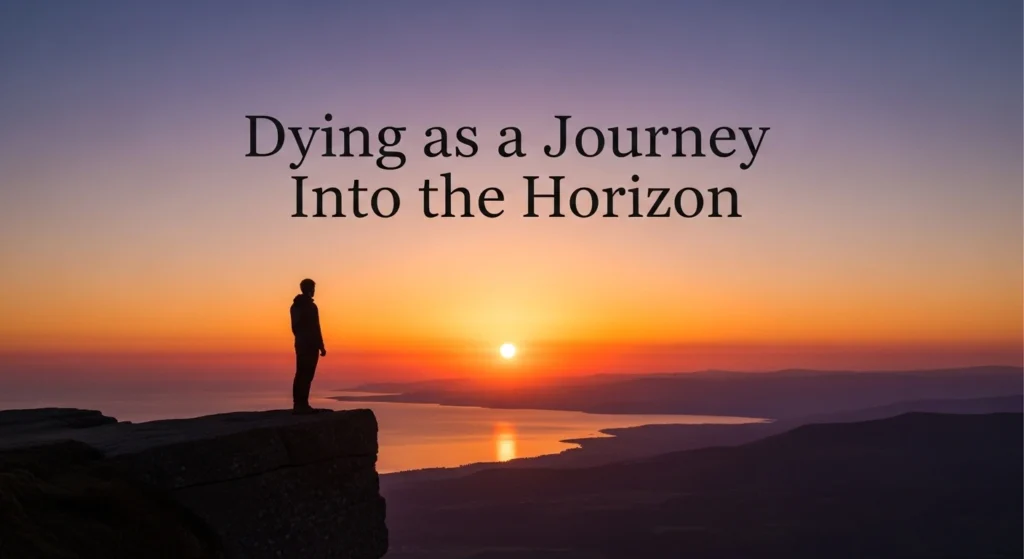
Death is compared to a journey—crossing from the known into the unknown.
It represents:
- Transition
- Mystery
- Movement beyond life
Example Sentence
“He passed like a traveler walking toward the horizon, disappearing gently into the light.”
Alternative Ways to Express It
- “Crossing into the beyond”
- “A final voyage”
- “Stepping onto another shore”
Sensory or Emotional Detail
The horizon is soft, distant, endless. This metaphor suggests dying is not abrupt, but gradual—like sailing away.
Cultural Reference
Many myths speak of crossing rivers or seas after death, showing how deeply humanity imagines dying as travel.
The Journey Metaphor
Exercise: Imagine dying as a journey.
Ask:
- What does the horizon look like in your imagination?
Sample Answers:
- “A peaceful sunrise beyond the sea.”
- “A quiet meadow of stillness.”
- “A gentle light where fear dissolves.”
Example Sentence: “Death felt like walking toward a horizon that promised peace.”
Dying as Returning to the Earth
Meaning & Explanation
This metaphor frames death as reunion with nature—becoming part of the soil, the trees, the sky.
It symbolizes:
- Continuity
- Belonging
- The circle of life
Example Sentence
“She returned to the earth like rain sinking back into the ground, becoming part of what she came from.”
Alternative Ways to Express It
- “Returning to the soil”
- “Becoming one with nature”
- “Folding back into the world”
Sensory or Emotional Detail
Earth smells rich and steady. This metaphor can feel grounding, reminding us that life continues through nature’s cycles.
Real-Life Resonance
Many people find comfort in thinking of loved ones as part of the wind, the flowers, the stars—still present in another form.
Metaphors for Dying in Times of Peace
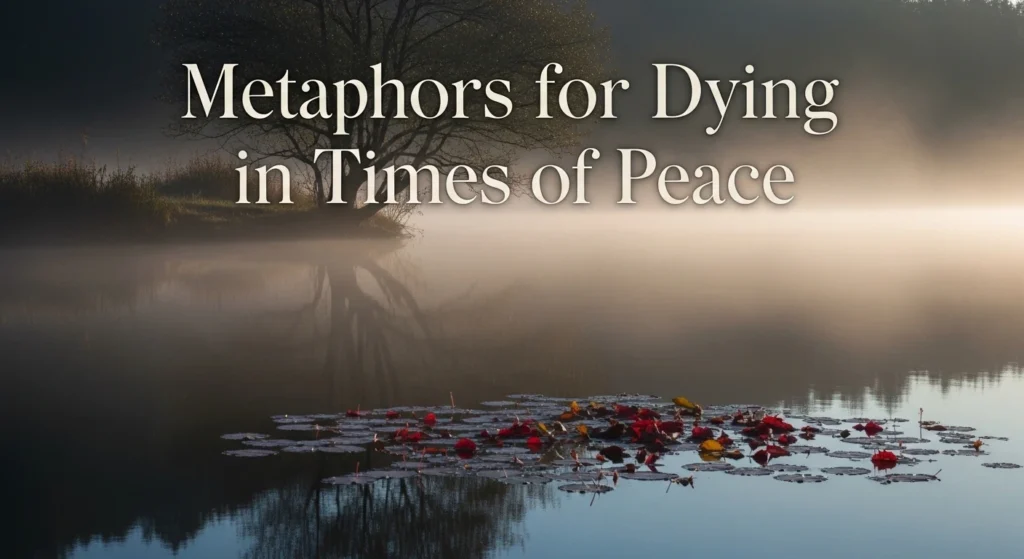
When death comes gently, metaphors often include:
- “A candle flickering out”
- “A sunset ending the day”
- “A song fading into silence”
Example: “His life was a song, and death was the final note, soft and complete.”
These metaphors highlight beauty, not violence.
Metaphors for Dying in Grief and Love
Death is painful because love remains.
Metaphors for loss often sound like:
- “They live in our hearts”
- “Their voice echoes in memory”
- “Love does not disappear, only changes shape”
Mini scenario: A woman hears her mother’s favorite song years later, and it feels like her mother is near. Metaphor becomes a way love survives.
Create Your Own Gentle Metaphor
Try: Dying is like ___ because ___
Examples with answers:
- Dying is like falling asleep because it brings rest after struggle.
- Dying is like a journey because it is a crossing into mystery.
- Dying is like returning to earth because life becomes part of nature again.
Reader example answer: “Dying is like a sunset because it ends the day with quiet beauty.”
Bonus Tips for Using Metaphors About Death in Writing and Daily Life
These metaphors work best when used with sensitivity.
They can be used in:
- Poetry
- Memorial speeches
- Journals
- Comforting messages
Caption ideas (gentle and respectful):
- “Like a candle’s soft farewell.”
- “Resting beyond the horizon.”
- “Returned to the earth, forever part of life.”
Writing tip: Avoid making death sound trivial—keep metaphors tender, not casual.
Metaphors for Dying Across Cultures and Literature
Across cultures, death is often symbolized as:
- Sleep
- A voyage
- A return
- A door opening
- A homecoming
From ancient epics to modern poems, metaphors help humans face mortality with grace.
Even the idea of an “afterlife” is often shaped through metaphor: gardens, light, peace, reunion.
Conclusion
Metaphors for dying do more than decorate language—they transform it. They turn silence into expression, fear into understanding, and endings into something we can gently hold. When we describe death as a journey, a fading light, or a quiet return, we do not change the reality itself. However, we change how we face it.
In writing, these metaphors add depth and emotion. In daily life, they offer comfort and connection. They allow us to speak when words feel too heavy, and they help us listen when others struggle to express their grief.
Ultimately, metaphors remind us that even in endings, there is meaning, beauty, and a quiet sense of continuity.
FAQs
1. Why do people use metaphors for dying?
Because death is emotionally difficult, metaphors offer gentle, comforting ways to express it.
2. What is a peaceful metaphor for death?
Death as falling asleep is one of the most common peaceful metaphors, symbolizing rest.
3. Are metaphors about death appropriate in writing?
Yes, especially in poetry or reflective writing, but they should always be used with sensitivity.
4. How do metaphors help with grief?
They give emotional language to loss and can provide comfort through softer imagery.
5. How can I create my own metaphor for dying?
Think of death as transition—rest, journey, return—and compare it to something gentle and familiar.



