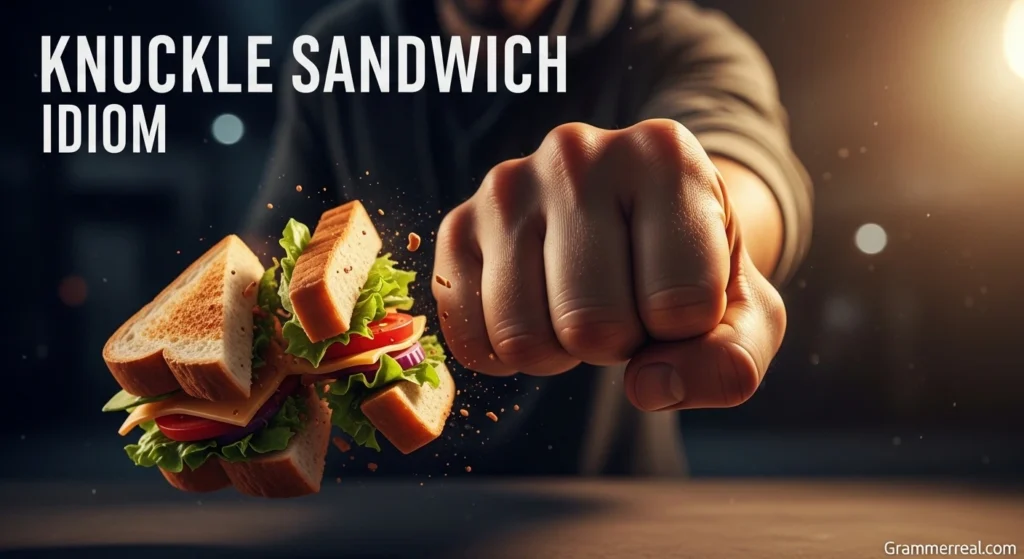
The knuckle sandwich idiom is a common English expression that many people hear in movies, books, and casual speech. It does not mean a real sandwich made with food. Instead, it is a humorous or threatening phrase that means a punch in the face.
People often use the knuckle sandwich idiom to show anger, warn someone, or joke with friends. The phrase sounds funny because it mixes a violent action with the idea of a normal meal. This contrast makes the expression memorable and easy to recognize. Many learners of English become confused when they first hear it because the words do not match the real meaning. That is why learning idioms like this one is important for better understanding spoken English. The knuckle sandwich idiom also helps students learn how culture shapes language. In this article, you will learn the meaning, history, usage, examples, mistakes, and helpful writing tips in simple language.
What Does knuckle sandwich idiom Mean?
The knuckle sandwich idiom means a punch, especially a punch to the mouth or face. It is usually said as a threat, but it is often not serious. In many cases, people use it jokingly.
For example:
- “Keep talking like that, and I’ll give you a knuckle sandwich.”
- “The cartoon bully threatened the hero with a knuckle sandwich.”
- “My brother joked that he wanted to give me a knuckle sandwich after I ate his fries.”
The phrase should not be understood literally. No one is offering food. The word knuckle refers to the joints of the fingers. A sandwich is used in a playful way to describe getting hit.
Why Is It Called knuckle sandwich idiom?
This idiom combines two very different ideas:
- Knuckle = the hard joints of the fingers used in a fist
- Sandwich = a common meal with bread and filling
When someone punches another person, the fist touches the face. The phrase humorously compares the face being hit to receiving a sandwich. The unusual image makes the idiom funny, sharp, and memorable.
English often creates expressions by combining serious ideas with silly images. That is one reason idioms can be difficult but interesting.
History and Background of knuckle sandwich idiom
The exact first use of the knuckle sandwich idiom is unclear, but it became popular in American English during the early 20th century. It appeared in comics, crime stories, radio shows, and later in films. Tough characters, boxers, and street fighters often used it.
Because the phrase sounds dramatic and playful, it fit well in entertainment. Over time, people recognized it as an old-fashioned but colorful expression.
Today, the idiom is less common in formal speech, but many people still understand it. It appears in:
- Comedy shows
- Cartoons
- Old detective stories
- Action films
- Casual jokes
How to Use knuckle sandwich idiom in Sentences
You can use the knuckle sandwich idiom in speech or informal writing. It usually appears when someone is angry, pretending to be angry, or joking.
Common Sentence Patterns
- give someone a knuckle sandwich
- serve someone a knuckle sandwich
- threaten someone with a knuckle sandwich
Examples
- “He said the rude customer needed a knuckle sandwich.”
- “The villain promised to give the hero a knuckle sandwich.”
- “My friend laughed and said he would serve me a knuckle sandwich if I spoiled the game ending.”
- “The older brother jokingly threatened a knuckle sandwich.”
- “In the movie, the gangster used the phrase before a fight.”
Tone Matters
This idiom can sound funny or aggressive depending on tone. A smile may make it playful. A serious voice may make it threatening.
Key Points About knuckle sandwich idiom
Here are the most important facts:
- It means a punch, not food.
- It is informal language.
- It is often humorous.
- It can also sound threatening.
- It is common in American popular culture.
- It should not be used in formal business writing.
- Many native speakers know it, even if they do not use it often.
Contextual Examples in Daily Life
Understanding context helps you know when an idiom is serious or playful.
Friendly Joke
Two brothers are playing games.
- Brother 1: “I beat you again.”
- Brother 2: “Say that again, and you’ll get a knuckle sandwich!”
This is likely a joke.
Movie Scene
A villain blocks the hero’s path.
- “Take one more step, and I’ll give you a knuckle sandwich.”
This sounds like a threat.
Classroom Discussion
A teacher explains idioms.
- “The knuckle sandwich idiom means a punch.”
This is educational use.
Sports Talk
Fans discuss an old boxing film.
- “The fighter talked tough and promised a knuckle sandwich.”
This is descriptive use.
Common Mistakes With knuckle sandwich idiom
Many learners make small errors when using idioms. Here are common mistakes and corrections.
1. Taking It Literally
Wrong idea: It means a real sandwich. Correct idea: It means a punch.
2. Using It in Formal Writing
Weak example: “The manager offered a knuckle sandwich to competitors.” This sounds strange and unprofessional.
Use it only in informal or creative settings.
3. Wrong Grammar
Incorrect: He give me a knuckle sandwich. Correct: He gave me a knuckle sandwich.
Incorrect: She threaten me with a knuckle sandwich. Correct: She threatened me with a knuckle sandwich.
4. Using It in Serious Conflict
Because the phrase refers to violence, avoid using it in real arguments. It may be misunderstood.
5. Overusing the Phrase
Using the idiom too often can sound unnatural. Use it only when it fits the moment.
American vs British English Differences
The knuckle sandwich idiom is much more common in American English than in British English.
In American English
People usually recognize the phrase from films, cartoons, and old slang. It may be used for humor or nostalgia.
In British English
Many people understand it because of media influence, but it is less natural in daily speech. British speakers may use other expressions for threats or punches.
Style Difference
- American tone: bold, comic, dramatic
- British tone: less common, more imported from media
Still, English speakers in many countries can understand it.
Similar Idiomatic Expressions
Learning related phrases helps expand vocabulary.
1. Punch Someone’s Lights Out
Means to hit someone hard enough to knock them out.
2. Throw Hands
Means to start fighting physically.
3. Hit the Deck
Means to fall or drop quickly, often to avoid danger.
4. Blow Off Steam
Means to release anger or stress.
5. Bad Blood
Means anger or dislike between people.
These phrases may appear in stories, films, or casual talk.
Is knuckle sandwich idiom Funny or Offensive?
It depends on the situation.
Funny Use
Among close friends, the phrase may be playful and silly.
Example:
- “Touch my fries again, and you get a knuckle sandwich.”
Offensive Use
In a tense situation, it may sound like a real threat.
Example:
- “Say one more word, and I’ll give you a knuckle sandwich.”
Because tone matters, speakers should be careful.
Practical Tips for Learners
Listen to Tone
Always notice the speaker’s voice, face, and setting.
Learn the Meaning, Not Just Words
Idioms often have hidden meanings. Memorize the full phrase.
Use It Carefully
Use the phrase only with people who understand humor.
Avoid Formal Situations
Do not use it in work emails, school essays, or official messages.
Watch Movies and Shows
Entertainment often teaches how idioms sound in real speech.
Practice With Safe Examples
Try simple practice sentences:
- “The cartoon bully wanted to give a knuckle sandwich.”
- “My friend joked about a knuckle sandwich.”
How Writers Can Use knuckle sandwich idiom
Writers use idioms to create voice and personality. The knuckle sandwich idiom can make dialogue feel lively.
In Fiction
A rough or comic character may say it.
Example:
- “Move aside, pal, unless you want a knuckle sandwich.”
In Comedy
The phrase sounds exaggerated, so it works well in jokes.
In Character Building
It can show that a speaker is:
- old-fashioned
- tough
- dramatic
- playful
- childish
Safer Alternatives to knuckle sandwich idiom
If you want humor without violent language, use softer phrases.
- “I’ll get you back for that.”
- “You are in trouble now.”
- “Watch yourself.”
- “Nice try.”
- “You asked for it.”
These phrases may sound friendlier.
Why Idioms Like knuckle sandwich idiom Matter
Idioms are important because they show real language use. Textbooks teach grammar, but daily speech uses phrases with special meanings.
By learning the knuckle sandwich idiom, students improve:
- listening skills
- reading skills
- cultural understanding
- humor recognition
- natural vocabulary
Idioms also make conversations richer and more expressive.
Grammar and Writing Lessons From This Topic
This topic also teaches strong writing habits.
Correct Verb Tense
Use past tense for past actions:
- He threatened me.
Use present tense for facts:
- The idiom means a punch.
Subject-Verb Agreement
- He says it often.
- They say it often.
Clear Sentence Structure
Use complete sentences with subject and verb.
- Correct: She used the idiom in class.
- Incorrect: Used the idiom in class.
Better Word Choice
Simple and direct words improve clarity.
- Good: The phrase sounds funny.
- Weak: The phrase demonstrates humorous auditory characteristics.
Flow and Variety
Mix short and long sentences. This keeps reading smooth and interesting.
How This Exercise Improves Writing Skills
Studying one phrase deeply can improve writing in many ways.
Better Vocabulary
You learn meaning, tone, and context.
Stronger Grammar
You practice tense, agreement, punctuation, and sentence order.
Clearer Style
You learn to explain difficult ideas in simple words.
Better Readability
Short paragraphs, headings, and examples help readers understand quickly.
Natural Keyword Use
Repeating the main topic only where it fits makes writing smooth and clear.
Conclusion
The knuckle sandwich idiom is a colorful English phrase that means a punch, especially to the face. It is not about food, even though the words may sound funny together. The expression is usually informal and often used in jokes, cartoons, movies, and playful threats. It is more common in American English, but many people in other places understand it as well. Learners should focus on tone and context before using it. It should be avoided in formal writing or serious conflict. Learning this idiom builds vocabulary, cultural knowledge, and reading confidence. It also helps students practice grammar, sentence flow, and clear expression. When used carefully, the knuckle sandwich idiom is a fun example of how creative English can be.
FAQs
1. What does knuckle sandwich idiom mean?
It means a punch, usually to the face.
2. Is knuckle sandwich idiom a real sandwich?
No. It is an idiom, not real food.
3. Is the phrase serious or funny?
It can be either. Tone and context decide the meaning.
4. Where is the phrase most common?
It is most common in American English.
5. Can I use it in formal writing?
No. It is informal and not suitable for formal use.
6. Is knuckle sandwich idiom old-fashioned?
Yes, many people see it as an older slang phrase, but it is still understood.
7. Can children hear this phrase in cartoons?
Yes. It often appears in older cartoons and comic-style media.
8. Why is it called a sandwich?
The phrase uses humor by comparing a punch to serving food.