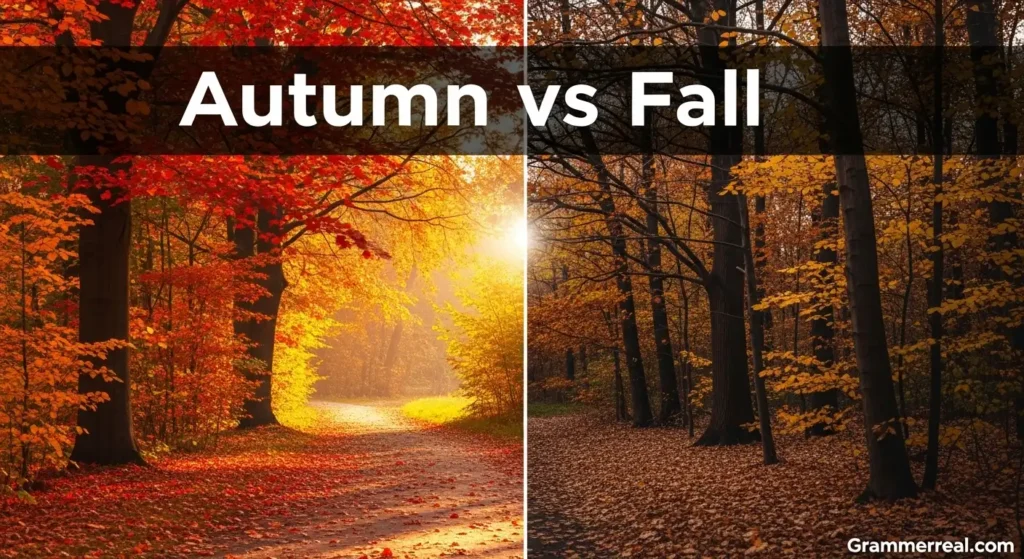
Many English learners ask about autumn vs fall because both words describe the same season. This season comes after summer and before winter.
It is the time when weather becomes cooler and many leaves change color. Some people say autumn, while others say fall, and both are correct. The choice often depends on region, style, and habit. In some places, one word sounds more formal, while the other sounds more casual. Writers, students, and travelers often want to know which word they should use. Understanding autumn vs fall can help you speak and write more clearly. It can also help you understand movies, books, news, and daily conversations. This guide explains the meaning, history, grammar use, and practical tips in very simple language.
What Do Autumn and Fall Mean?
Both autumn and fall mean the same season of the year. It is the season between summer and winter. In many countries, it begins around September and ends around November or December, depending on the calendar system used.
During this season:
- Days become shorter
- Nights become cooler
- Leaves often turn red, orange, and yellow
- Harvest time happens for many crops
- People start wearing warmer clothes
So, when people discuss autumn vs fall, they are not discussing two different seasons. They are discussing two different words for one season.
The Short Answer to Autumn vs Fall
If you need a quick answer, here it is:
- Autumn is more common in British English and many other parts of the world.
- Fall is more common in American English.
Both words are correct. Native speakers understand both terms.
The History of Autumn and Fall
The story of autumn vs fall is interesting. Long ago, English speakers used different names for seasons. In earlier English, people often used phrases like “harvest” for the season when crops were collected.
Later, the word fall became popular because leaves fall from trees during that season. It came from the phrase “fall of the leaf.”
The word autumn came into English from French and Latin roots. Over time, it became a common and elegant term.
Later still:
- Britain used autumn more often
- America continued using fall more often
That is why both words still exist today.
American vs British English Differences
This is one of the main parts of the autumn vs fall question.
In American English
People in the United States usually say fall.
Examples:
- Fall starts next week.
- I love fall weather.
- We will travel in the fall.
In British English
People in the United Kingdom usually say autumn.
Examples:
- Autumn is my favorite season.
- The autumn leaves are beautiful.
- School starts in autumn.
In Other Countries
Countries such as Canada, Australia, New Zealand, and others may use both words. One may be more common depending on region, speaker age, or style.
Which Word Sounds More Formal?
In many cases:
- Autumn sounds a little more formal or literary.
- Fall sounds more natural and everyday in American speech.
Examples:
Formal style:
- The garden looks beautiful in autumn.
Casual style:
- I love fall colors.
This does not mean one word is better. It only means the tone may feel different.
Contextual Examples of Autumn vs Fall
Seeing words in sentences helps learning.
Daily Conversation
- I need a new jacket for fall.
- Autumn is coming soon.
- We visited the park last fall.
School Writing
- Many animals prepare for winter during autumn.
- Autumn weather often changes quickly.
Travel Writing
- Japan is famous for autumn leaves.
- New England is popular in the fall.
Poetry or Creative Writing
- The quiet air of autumn filled the valley.
- Golden fall leaves covered the road.
Common Mistakes in Autumn vs Fall
Many learners make small mistakes. Here are common ones.
Mistake 1: Thinking They Mean Different Seasons
Wrong idea:
- Autumn is one season and fall is another season.
Correct idea:
- They are the same season.
Mistake 2: Using the Wrong Preposition
Correct:
- in autumn
- in the fall
Examples:
- Flowers fade in autumn.
- We travel in the fall.
Mistake 3: Wrong Capitalization
Seasons are usually lowercase unless they begin a sentence.
Correct:
- I love autumn.
- Fall is coming soon.
Wrong:
- I love Autumn.
Mistake 4: Forcing One Word Everywhere
If you write for American readers, fall may sound more natural. If you write for British readers, autumn may fit better.
Mistake 5: Repeating the Same Word Too Much
Use variety when needed.
Example:
- Autumn brings cool air. This season also brings colorful leaves.
Grammar Tips for Using Autumn and Fall
Good grammar makes your writing clearer.
Use with Correct Articles
Usually, no article is needed when speaking generally.
Correct:
- Autumn is short here.
- Fall is warm this year.
Use the when speaking about a specific time.
- The fall of 2025 was dry.
- The autumn we spent there was lovely.
Subject-Verb Agreement
Singular subjects take singular verbs.
- Autumn is beautiful.
- Fall brings cooler days.
Not:
- Autumn are beautiful.
Verb Tense Accuracy
Past:
- Last fall was rainy.
Present:
- Autumn is mild this year.
Future:
- Fall will begin soon.
Clear Modifiers
Better:
- Cool autumn mornings feel fresh.
Less clear:
- Autumn cool mornings fresh feel.
Idiomatic Expressions Related to Fall
The word fall has many meanings in English, so some idioms use it. These idioms do not always mean the season.
Fall for Someone
Meaning: begin to love someone.
- He fell for her quickly.
Fall Apart
Meaning: break down emotionally or physically.
- The old chair fell apart.
Fall Behind
Meaning: fail to stay current.
- She fell behind in class.
Fall Into Place
Meaning: begin to work well.
- After planning, everything fell into place.
Fall Flat
Meaning: fail to succeed.
- The joke fell flat.
These expressions use fall as a verb, not as the season.
Expressions Related to Autumn
There are fewer common idioms with autumn, but the word appears in descriptive phrases.
Examples:
- autumn years (later years of life)
- autumn colors
- autumn breeze
- autumn sunlight
These phrases often sound poetic or thoughtful.
Why Do Leaves Fall in Autumn?
Many learners ask this because it connects to autumn vs fall.
During this season, trees prepare for winter. They stop making as much food from sunlight. Chlorophyll decreases, so green color fades. Other colors become visible. Leaves then dry and fall.
That is one reason the word fall feels natural to many speakers.
Culture and Traditions in This Season
The season is important in many cultures.
Common Activities
- Harvest festivals
- Pumpkin picking
- Apple picking
- Nature walks
- Family dinners
- School starting again
Popular Feelings
Many people enjoy:
- Cooler air
- Warm drinks
- Sweaters
- Colorful trees
- Calm evenings
Whether people say autumn or fall, they often love the season.
Practical Tips: Which Word Should You Use?
If you are unsure about autumn vs fall, use these easy tips.
Tip 1: Know Your Audience
Use fall for most American readers. Use autumn for most British readers.
Tip 2: Stay Consistent
Choose one word in a school paper or article and keep using it.
Tip 3: Match the Tone
Use autumn for elegant or formal writing. Use fall for simple daily writing.
Tip 4: Listen to Native Speakers
Movies, shows, podcasts, and books help you notice natural use.
Tip 5: Do Not Overthink It
Both words are correct. People will understand you.
Autumn vs Fall in Literature and Media
Writers often choose words for feeling.
Why Writers Choose Autumn
- softer sound
- classic tone
- elegant style
Example:
- The autumn wind moved through the trees.
Why Writers Choose Fall
- simple tone
- warm everyday feeling
- strong connection to leaves falling
Example:
- We drove through the hills in fall.
Sound and Style Comparison
Some learners care about sound.
Autumn
- Two syllables: aw-tum
- Smooth and soft sound
Fall
- One syllable
- Short and strong sound
Because of sound, a poet may choose one word over the other.
Seasonal Vocabulary You Can Use
To improve your writing, learn related words.
Nature Words
- leaves
- forest
- wind
- harvest
- rain
- frost
Clothing Words
- coat
- sweater
- scarf
- boots
Feeling Words
- cozy
- cool
- calm
- bright
- fresh
Example sentence:
- The cool autumn wind moved through the bright forest.
Mini Writing Lesson from This Topic
Learning autumn vs fall also improves writing skills.
Word Choice
You learn that two correct words may have different tones.
Audience Awareness
You learn to choose language for readers.
Grammar Control
You practice:
- verb tense
- articles
- prepositions
- sentence variety
Clear Structure
You learn to explain one topic with examples and headings.
These skills help in all kinds of writing.
Frequent Confusions Between Fall the Season and Fall the Verb
Because fall can be a noun or verb, context matters.
Season
- Fall is beautiful here.
Verb
- Be careful or you may fall.
Another Example
- We travel in the fall.
- Leaves fall in October.
The sentence meaning becomes clear from grammar and context.
How This Topic Improves Better Writing
This exercise teaches useful habits.
Precision
You choose the best word for place and style.
Simplicity
You explain clearly without hard language.
Variety
You use different sentence lengths and structures.
Accuracy
You check grammar carefully.
Readability
You organize ideas with headings and examples.
These habits make writing stronger and easier to read.
Conclusion
The debate about autumn vs fall is simple once you understand it. Both words name the same season between summer and winter. Fall is more common in American English, while autumn is more common in British English and many other regions. Autumn often sounds more formal, while fall often sounds more casual. Neither word is wrong, and both are widely understood. The best choice depends on audience, tone, and consistency. By learning this topic, you also improve grammar, vocabulary, and word choice. You become more confident in speaking and writing. In the end, whether you say autumn or fall, you are talking about the same beautiful season.
FAQs
Are autumn and fall the same thing?
Yes. Both words mean the same season between summer and winter.
Is fall only used in America?
It is most common in America, but people in other countries may use it too.
Is autumn more correct than fall?
No. Both are correct English words.
Which word is older?
Both have long histories, but they entered common use at different times.
Which word should students use?
Use the word that matches your teacher, school style, or audience.
Why do Americans say fall?
The word became common in America and remained popular there.
Why do British people say autumn?
British English gradually favored autumn over time.
Can I use both words in one essay?
You can, but using one consistently is usually better.



