The phrase too many irons in the fire is a common English idiom. People use this phrase when someone tries to do many tasks at the same time. When a person has too many responsibilities, work may become difficult to manage.
In that situation, people may say that the person has too many irons in the fire. The expression shows that the person may be busy, stressed, or unable to focus on one task. Sometimes the phrase describes ambition and energy, but at other times it shows poor planning. Because the idiom appears in daily conversation, it is useful for English learners to understand it clearly. The phrase also appears in books, workplace conversations, and casual discussions among friends. When people understand this idiom, they can communicate ideas about workload and balance more easily. This article explains the meaning, origin, examples, grammar, and practical use of the expression too many irons in the fire in simple language.
Meaning of Too Many Irons in the Fire
The idiom too many irons in the fire means that a person is trying to handle too many tasks at the same time.
In simple words, it describes a situation where someone is busy with many different things. Because of this, the person may not complete tasks properly.
For example, imagine a student who studies for exams, works a part-time job, plays sports, and also volunteers in a club. That student may feel overwhelmed. In that case, someone might say the student has too many irons in the fire.
The phrase does not always mean something negative. Sometimes it simply describes a busy life. However, it often suggests that the person may struggle to manage everything.
Why People Use This Idiom
People use this idiom to describe situations with too many responsibilities.
First, the phrase explains a busy schedule. Second, it warns that someone may lose focus. Third, it helps people understand why a task is delayed or unfinished.
For example, a manager may say an employee has too many irons in the fire if the employee is handling several projects at once. In daily life, a friend might use the phrase when another friend tries to do too many activities.
Because of this, the idiom helps explain workload and stress in a simple way.
The Origin of the Phrase
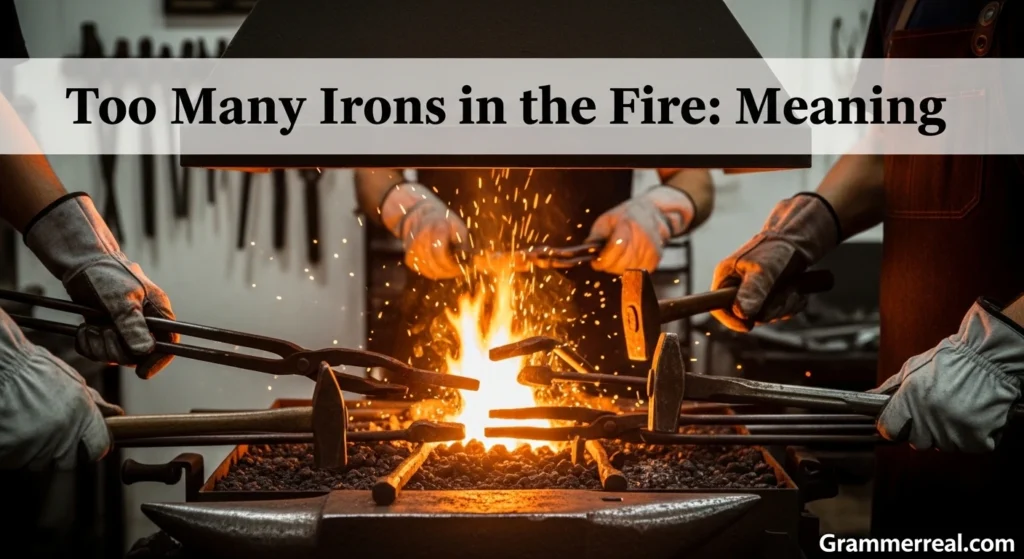
The phrase comes from old blacksmith work. A blacksmith used iron rods and heated them in a fire to shape them.
A blacksmith could only work with a few pieces of iron at one time. If the blacksmith placed too many irons in the fire, the work became difficult. Some irons might burn while others cooled too quickly.
Because of this situation, the phrase too many irons in the fire began to describe doing too many tasks at once.
Over time, people started using the phrase in everyday language instead of only in metalworking.
Literal Meaning Versus Figurative Meaning
The literal meaning of the phrase relates to metalwork and fire.
However, the figurative meaning is much more common today. When people use the idiom, they are not talking about real irons or real fire.
Instead, they are talking about responsibilities, projects, or plans.
For example, if a person manages several businesses at once, someone may say that person has too many irons in the fire. The speaker is not describing metalwork but a busy life.
Understanding this difference helps learners use the phrase correctly.
Using the Phrase in Daily Conversation
People often use this idiom in spoken English.
For example:
“John cannot finish the report today. He has too many irons in the fire.”
In another situation, a friend may say:
“You should focus on one project. You already have too many irons in the fire.”
In both cases, the phrase explains why someone feels busy or stressed.
Because the idiom sounds natural in conversation, it appears often in informal speech.
Examples in Everyday Life
This idiom can describe many situations in daily life.
A business owner may manage several projects at once. If those projects become difficult to control, people may say the owner has too many irons in the fire.
Students may also experience this situation. For example, a student may study, work part time, and join several clubs.
Parents may also face this challenge. A parent may care for children, work a job, and manage household tasks.
These examples show how common the idiom is in daily situations.
When the Phrase Has a Positive Meaning
Sometimes the idiom has a positive meaning.
In some cases, people admire someone who manages many tasks successfully. A person with strong skills may handle many responsibilities without problems.
For example, an entrepreneur may work on several ideas at once. Friends might say the entrepreneur has too many irons in the fire, but they may also respect that person’s ambition.
In this situation, the phrase describes energy and motivation.
When the Phrase Has a Negative Meaning
In other situations, the idiom carries a negative meaning.
If someone tries to do too many things, mistakes may happen. Work quality may decrease. The person may feel stress or exhaustion.
For example, an employee who handles many assignments may miss deadlines. In that case, a manager may say the employee has too many irons in the fire.
Here the phrase acts as a warning. It suggests that the person should reduce responsibilities.
Common Contexts Where the Idiom Appears
The phrase appears in many different contexts.
One common context is the workplace. Employees and managers use the idiom when discussing workload.
Another context is education. Teachers may describe students who participate in too many activities.
The phrase also appears in casual conversations among friends or family.
Because the idiom fits many situations, it remains common in everyday English.
Grammar Structure of the Expression
The phrase too many irons in the fire often appears inside a sentence rather than as a command.
For example:
“She has too many irons in the fire.”
“He decided to reduce his work because he had too many irons in the fire.”
The structure usually follows this pattern:
Subject + verb + too many irons in the fire
Because the phrase works as a descriptive expression, it usually appears after the verb.
Similar Idioms in English
English contains many idioms with similar meanings.
For example:
“Spread too thin” means a person tries to do too many things.
“Have a lot on your plate” describes having many responsibilities.
“Bite off more than you can chew” means accepting more work than you can manage.
Although these expressions differ slightly, they all describe a busy or overloaded situation.
Difference Between Being Busy and Having Too Many Irons in the Fire
Being busy is normal in modern life. Many people manage several responsibilities each day.
However, too many irons in the fire suggests something more serious. It implies that a person has more tasks than they can manage properly.
For example, a worker may handle three tasks without difficulty. That worker is simply busy.
But if the same worker handles ten tasks and begins missing deadlines, people may say the worker has too many irons in the fire.
The difference lies in balance and control.
American and British English Usage
Both American and British English use this idiom.
The meaning remains the same in both forms of English.
However, the phrase may appear slightly more often in American conversations. In British English, speakers may sometimes use similar expressions such as “having too much on your plate.”
Even so, the idiom too many irons in the fire is widely understood in both language varieties.
Common Mistakes Learners Make
Learners sometimes make mistakes when using this idiom.
One mistake involves changing the structure of the phrase.
Incorrect example: “Too many iron in the fire.”
Correct example: “Too many irons in the fire.”
Another mistake occurs when learners use the phrase in very formal writing. Because idioms are informal, they work better in casual speech and relaxed writing.
Understanding these small details helps learners use the expression correctly.
Simple Writing Tips for Using the Idiom
Writers can follow several tips when using this phrase.
First, use the idiom in situations involving many tasks.
Second, place the phrase naturally inside a sentence.
Third, avoid repeating the idiom too many times in a short paragraph.
Fourth, make sure the sentence clearly explains the situation.
These simple steps make writing clear and natural.
Practical Tips for Managing Too Many Tasks
If someone has too many irons in the fire, a few practical steps can help.
First, list all tasks and responsibilities.
Second, choose the most important tasks.
Third, delay or remove less important activities.
Fourth, focus on completing one task before starting another.
These steps help reduce stress and improve productivity.
Why Understanding Idioms Improves Communication
Idioms add color and meaning to language.
When people understand idioms, conversations become easier and more natural. Learners can also understand movies, books, and everyday discussions more clearly.
The phrase too many irons in the fire helps people talk about workload and balance in a simple way.
Learning idioms also improves listening skills and vocabulary.
Grammar and Writing Reflection
This article uses simple language and clear sentences. Short sentences improve readability. Longer sentences add explanation and detail.
Transition words such as however, for example, and because help connect ideas. These words guide readers through the explanation.
Active voice appears in many sentences because it sounds direct and clear. Passive voice appears occasionally to add variety.
The writing also avoids fragments and run-on sentences. Careful sentence structure helps readers understand the topic easily.
Conclusion
The idiom too many irons in the fire describes a situation where someone tries to handle too many tasks at the same time. The phrase comes from the work of blacksmiths who heated iron in a fire to shape it. If a blacksmith placed too many irons in the fire, the work became difficult. Over time, this idea became a common expression in everyday English.
Today, people use the phrase to talk about busy schedules and heavy workloads. Sometimes the idiom shows ambition and energy. At other times, it warns that a person may become overwhelmed. Because of this, understanding the phrase helps people explain stress, responsibility, and balance.
When used carefully, the idiom helps speakers describe complex situations in a simple way. It also improves communication in daily conversations.
FAQs
1. What does “too many irons in the fire” mean?
The phrase means a person is trying to handle too many tasks or responsibilities at the same time.
2. Is the phrase positive or negative?
It can be both. Sometimes it describes ambition, but often it suggests a person has too much work.
3. Where does the phrase come from?
The phrase comes from blacksmith work. A blacksmith heated iron in a fire to shape it, and too many pieces made the work difficult.
4. Is the idiom used in both American and British English?
Yes, speakers in both American and British English understand and use this expression.
5. When should someone avoid using this idiom?
People usually avoid using idioms in very formal writing. The phrase works best in conversation and casual writing.