The first light of morning slips through the window like soft gold. You hear birds singing in small bursts, like tiny bells. The air feels cool on your skin. You take a deep breath, and it fills your chest slowly, gently, like water filling a calm lake. Your body wakes up piece by piece. Your eyes open and your hands stretch and your heart beats steady and strong.
In that quiet moment, health feels real. It feels alive. It feels like something you can touch, even if you cannot see it.
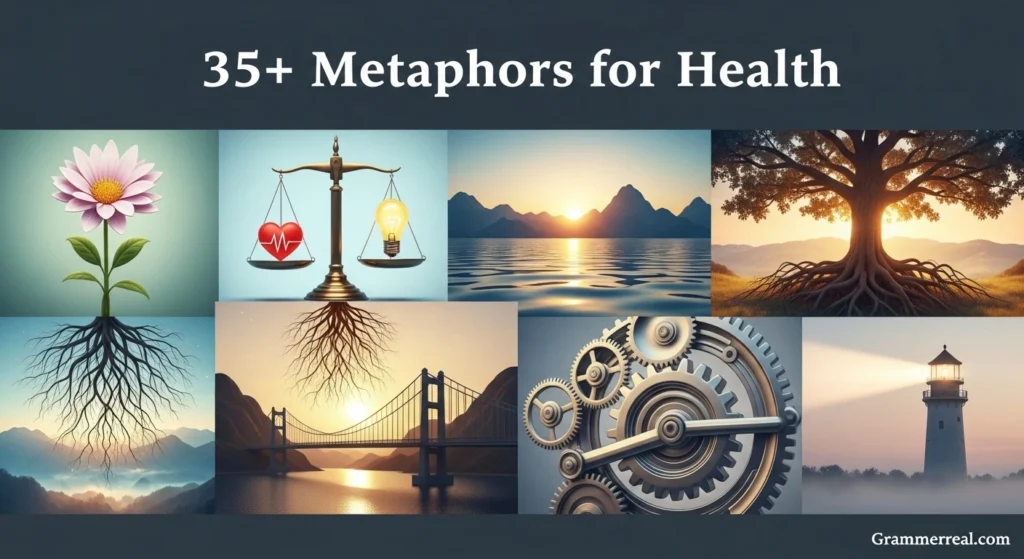
Health is not just numbers on a report. It is not only about diet charts or gym plans. Instead, it is a living thing. It moves. It grows and it changes with you. And that is where metaphors come in. They help us understand health in a deeper and simpler way.
So, in this article, we will explore metaphors for health—simple, clear, and powerful ways to see your body and mind. These ideas will help you care for yourself better. They will also help you explain health in writing, in speech, and even in daily life.
Why Metaphors for Health Matter in Everyday Life
Health is not just a medical word—it’s an experience. Metaphors help us talk about it with clarity and emotion.
They help us:
- Describe wellness beyond numbers
- Encourage healthier habits gently
- Write about healing in vivid ways
- Understand health as a journey, not a switch
Metaphors make health feel alive rather than clinical.
Health as More Than the Absence of Illness

True health is not simply “not being sick.” It includes:
- Physical strength
- Mental calm
- Emotional steadiness
- Rest and recovery
- Connection with others
Health is a living system, always moving, always adjusting—like seasons in nature.
How Metaphors Help Us Understand Wellness and Healing
Sometimes health can’t be explained directly. But metaphors let us say:
- “I’m rebuilding.”
- “I’m finding balance again.”
- “Healing is a slow sunrise.”
These images bring comfort and meaning to the process of wellness.
Metaphors for Health in Writing and Conversation
Metaphors for health appear everywhere:
- “I’m back on my feet.”
- “I’m running on empty.”
- “I need to recharge.”
They shape how we think about our bodies and our care.
Health as a Garden You Tend

Meaning & Explanation
Health is like a garden—something that needs patience, care, and consistency. It grows slowly through daily habits.
Just as gardens need water and sunlight, health needs:
- Nourishment
- Movement
- Rest
- Kindness
Example Sentence
“My health is a garden, and every small good choice is a seed I plant.”
Alternative Ways to Express It
- “Wellness is something you cultivate”
- “Healing is slow blooming”
- “The body is soil for care”
Sensory or Emotional Detail
Imagine the smell of rain on fresh earth, the quiet joy of new leaves appearing. Health often grows that way—softly, steadily.
Mini Storytelling Touch
Even after storms, gardens return. Likewise, bodies recover, rebuild, and bloom again.
Using Garden Metaphors for Motivation
This metaphor reminds us to be patient with ourselves.
Try phrases like:
- “I’m tending to myself today.”
- “Small care adds up.”
- “Healing takes seasons.”
Bonus tip: Gardens don’t grow faster with pressure—they grow with gentleness.
Health as a Strong Foundation
Meaning & Explanation
Health is the foundation beneath life. Everything else—dreams, work, relationships—rests on it.
A strong foundation keeps life steady. When it weakens, everything feels shakier.
Example Sentence
“Health is the foundation under my life; when it’s strong, everything stands taller.”
Alternative Ways to Express It
- “Wellness is the base of everything”
- “The body is the home you live in”
- “Strength begins underneath”
Sensory or Emotional Detail
Foundations are quiet and unseen, yet essential. Health is the same: often unnoticed until it needs attention.
Cultural Reference
Many traditions describe wellness as harmony—like architecture of the self, balanced and grounded.
Build Your Inner House
Exercise: Imagine your life as a house.
Ask:
- What does your foundation need right now?
Sample Answers:
- Rest → “My foundation needs deeper sleep and calm evenings.”
- Movement → “My foundation needs daily walks to feel stronger.”
- Peace → “My foundation needs less stress and more breathing space.”
Example Sentence: “My health is the foundation, and today I strengthen it by drinking more water and taking a slow walk.”
Health as a River in Flow

Meaning & Explanation
Health is like a river—moving, changing, never perfectly still. Some days it flows smoothly, other days it slows.
Healing is not linear, just like water’s path.
Example Sentence
“My health is a river, and I’m learning to move with its currents instead of fighting them.”
Alternative Ways to Express It
- “Wellness is a rhythm”
- “The body has tides”
- “Healing is movement”
Sensory or Emotional Detail
Picture cool water over stones, steady and patient. Health works quietly like that, carrying you forward.
Real-Life Resonance
Recovery often bends and pauses, but it continues—like a river finding its way.
Metaphors for Mental and Emotional Health
Health includes the mind too. Emotional wellness is often described as:
- “Clearing fog”
- “Finding balance”
- “Carrying lighter weight”
- “Learning to breathe again”
Example: “Peace returned like sunlight breaking through clouds.”
Metaphors for Strength, Energy, and Vitality
When we feel healthy, we often say:
- “I’m fully charged.”
- “I have fuel in the tank.”
- “I feel steady again.”
Mini scenario: That moment after good sleep when your body feels like it belongs to you—that is health as renewal.
Interactive Exercise: Create Your Own Metaphors for Health
Try: Health is like ___ because ___
Examples with answers:
- Health is like sunlight because it quietly powers everything.
- Wellness is like music because it needs rhythm and balance.
- Healing is like a sunrise because it arrives slowly, then fills the whole sky.
Now readers can create their own, but these examples guide them clearly.
Bonus Tips for Using Health Metaphors in Writing and Daily Life
Metaphors work beautifully in:
- Journals
- Captions
- Motivational writing
- Conversations
Caption ideas:
- “Tending my garden today.”
- “Rebuilding my foundation.”
- “Letting my river flow gently.”
Writing tip: Add sensory details—warmth, breath, light, water—to make health feel real.
Metaphors for Health Across Cultures and Traditions
Different cultures imagine wellness as:
- Balance of energies
- Harmony with nature
- The body as a temple
- Life as a rhythm of seasons
Health is rarely seen as perfection—it is alignment, steadiness, and care.
Conclusion
Health is not just rules and numbers. It is a living experience. It grows, moves, and changes every day.
Metaphors give you a new way to see it. They turn simple habits into meaningful actions. They make health feel close, warm, and real.
When you water your “garden,” you care with love. When you walk your “journey,” you move with hope and when you build your “bank,” you act with purpose.
So, choose your metaphor. Use it daily. Let it guide your choices. Over time, you will not only understand health better—you will feel it in every breath, every step, and every moment.
FAQs
1. Why do metaphors help us talk about health?
Because health is complex, metaphors make it easier to describe in emotional and relatable ways.
2. What is a strong metaphor for wellness?
Health as a garden is powerful because it reflects care, patience, and growth.
3. Can metaphors improve writing about healing?
Yes, metaphors add imagery and depth, helping readers feel the experience.
4. How can I create my own metaphor for health?
Think about what health feels like—energy, balance, flow—and compare it to something familiar.
5. How can metaphors motivate healthier habits?
They reframe wellness as a journey, making small daily actions feel meaningful.



