Fighting has a sound. Sometimes it’s loud—shouting, crashing, the sharp spark of conflict. Other times it’s quiet, hidden behind clenched jaws and unspoken tension. A fight can happen in a ring, in a hallway, in a relationship, or inside your own mind at three in the morning.
We often think of fighting as simply aggression, but it’s much more complex. Fighting can mean struggle, resistance, courage, survival, or the determination to protect what matters. That’s why metaphors for fighting are so powerful. They help us describe conflict in richer, more human ways—turning it into storms, battles, dances, or fires. Metaphors can reveal what a fight really feels like beneath the surface.
In this article, we’ll explore creative metaphors for fighting, complete with examples, storytelling touches, and exercises you can use in writing, reflection, or everyday conversation.
Why Metaphors for Fighting Matter in Writing and Life
Fighting is one of the oldest human experiences, yet it’s rarely simple. Metaphors help us express the emotional layers beneath conflict.
They help us:
- Describe struggle vividly
- Add depth to storytelling and dialogue
- Understand conflict beyond violence
- Express inner battles with honesty
Metaphors turn fighting into something more than fists—they turn it into meaning.
Fighting as More Than Physical Conflict
Not all fights are physical. People fight:
- For their dreams
- Against injustice
- With anxiety or grief
- For love and respect
- To survive difficult seasons
Sometimes the fiercest battles are invisible.
How Metaphors Help Us Understand Struggle and Resistance
Metaphors allow us to say:
- “I’m fighting a storm inside.”
- “This is a war of patience.”
- “We’re sparring with our own fears.”
These images make conflict feel real, relatable, and emotionally textured.
Metaphors for Fighting in Stories, Poetry, and Conversation
Metaphors for fighting show up everywhere:
- “We went to battle over it.”
- “He fought like a lion.”
- “She’s wrestling with her thoughts.”
They shape how we see conflict—sometimes as destruction, sometimes as courage.
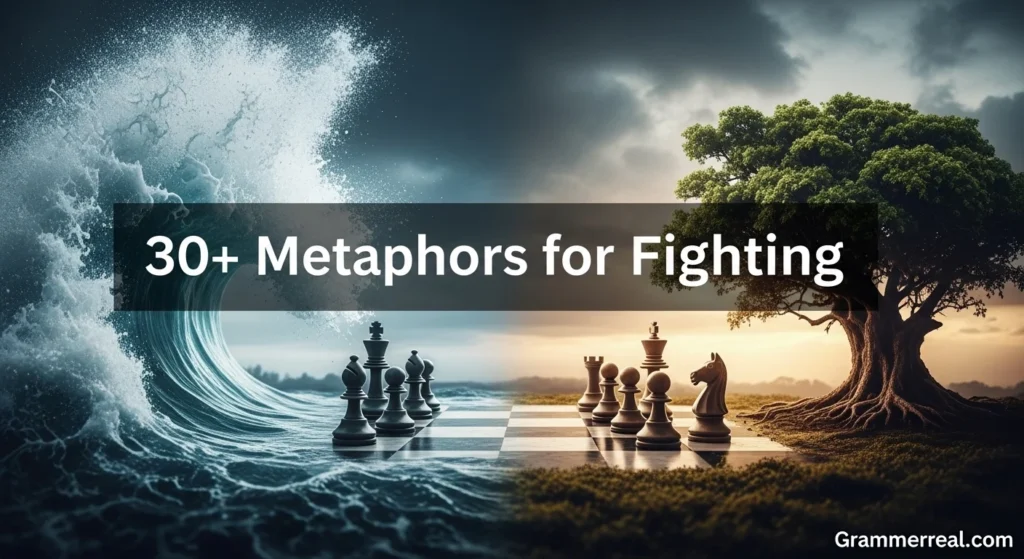
Fighting as a Storm Colliding With the Sea
Meaning & Explanation
This metaphor compares fighting to a storm—wild, emotional, uncontrollable. It captures the chaos of arguments or intense struggles.
Storms symbolize:
- Anger
- Turbulence
- Sudden emotional force
Example Sentence
“Their argument rose like a storm crashing into the shore, loud and impossible to ignore.”
Alternative Ways to Express It
- “A hurricane of words”
- “Thunder between hearts”
- “Waves of conflict”
Sensory or Emotional Detail
You can almost hear it: the roar, the sharp lightning of accusations, the salty air of regret afterward.
Mini Storytelling Touch
Like storms, fights often pass, leaving silence behind—calm, but changed.
Using Storm Metaphors to Show Emotional Conflict
Storm metaphors work beautifully in writing when you want intensity.
Try phrases like:
- “Tension gathered like dark clouds.”
- “Her anger struck like lightning.”
- “The fight left wreckage in its wake.”
Bonus tip: Show the “after-storm” quiet to deepen emotional impact.
Fighting as a Chess Game of Strategy
Meaning & Explanation
Not all fights are loud. Some are calculated, slow, and strategic—like chess.
This metaphor reflects:
- Psychological conflict
- Careful power struggles
- Silent competition
Example Sentence
“Their rivalry was a chess match, every move measured, every smile hiding a plan.”
Alternative Ways to Express It
- “A game of minds”
- “A battlefield of strategy”
- “A silent war of moves”
Sensory or Emotional Detail
Chess has stillness, but also tension—the feeling that something decisive is always one step away.
Cultural Reference
In literature, clever conflicts often resemble chess: minds battling rather than bodies, like in political dramas or classic tragedies.
Creative Prompt: Turn a Fight Into a Chess Scene (With Answers)
Exercise: Imagine an argument as a chess match.
Ask:
- Who makes the first move?
- What is the “checkmate” moment?
Sample Answer: “She began with a quiet accusation, like moving a pawn forward. He responded with defense, sliding his knight into place. The checkmate came when silence admitted what words could not.”
This exercise helps writers show conflict without shouting.
Fighting as Dancing With Fire
Meaning & Explanation
This metaphor compares fighting to dancing with fire—dangerous, intense, almost beautiful, but risky.
It suggests:
- Passionate conflict
- Volatile relationships
- The thrill and harm of confrontation
Example Sentence
“They fought like people dancing with fire, drawn close even as it burned them.”
Alternative Ways to Express It
- “A dangerous tango of anger”
- “Flames between them”
- “Heat that couldn’t be controlled”
Sensory or Emotional Detail
Fire crackles, glows, consumes. Fighting can feel like that—hot, alive, destructive.
Real-Life Resonance
Some conflicts repeat because they are fueled by emotion, pride, love, and fear all at once.
Metaphors for Fighting in Inner Battles
Many fights happen inside:
- Anxiety as a shadow opponent
- Depression as a heavy war
- Self-doubt as constant sparring
Example: “She fought her thoughts like a boxer in the dark, swinging at fears she couldn’t see.”
These metaphors validate invisible struggles.
Metaphors for Fighting in Relationships and Love
Relationship fights are often described as:
- “War between hearts”
- “A tug-of-war of needs”
- “Broken bridges of communication”
Mini scenario: Two people argue, not because they hate each other, but because they are scared of being unheard. The fight becomes a storm over something tender.
Interactive Exercise: Create Your Own Metaphors for Fighting (With Answers)
Try: Fighting is like ___ because ___
Examples with answers:
- Fighting is like a storm because emotions crash uncontrollably.
- Fighting is like chess because every move carries hidden meaning.
- Fighting is like fire because it can warm or destroy depending on control.
These examples guide readers clearly before they make their own.
Bonus Tips for Using Fighting Metaphors in Writing and Daily Life
Metaphors for fighting can sharpen dialogue, captions, and storytelling.
Caption ideas:
- “Some battles are silent.”
- “Storms don’t last forever.”
- “Learning to fight with grace.”
Writing tip: Balance metaphor with realism—show what the fight costs emotionally.
Metaphors for Fighting Across Cultures and Stories
Across cultures, fighting is often symbolic:
- Heroes battling dragons (fear, evil)
- Warriors fighting for justice
- Inner battles in spiritual traditions
Conflict becomes a metaphor for growth.
In myths, fighting is rarely only violence—it is transformation.
Conclusion
Fighting is not always about harm. Sometimes it is about endurance, it is about protecting what matters and sometimes it is the struggle to become whole.
Metaphors help us see fighting clearly:
- A storm of emotion
- A chess match of strategy
- A dance with fire
They remind us that every fight carries a story beneath it—fear, love, pride, pain, hope.
So whether you are writing conflict or living through it, remember: fighting is not just noise. It is meaning in motion.
FAQs
1. Why do metaphors help describe fighting?
Because fighting is emotionally complex, metaphors add depth and vivid imagery beyond literal conflict.
2. What is a strong metaphor for emotional fighting?
Fighting as a storm is powerful because it captures chaos, intensity, and aftermath.
3. Can fighting metaphors apply to inner struggles?
Yes. Many metaphors describe mental battles, anxiety, grief, or self-doubt as fights.
4. How do metaphors improve writing fight scenes or arguments?
They create atmosphere, symbolism, and emotional weight, making conflict more engaging.
5. How can I create my own metaphor for fighting?
Think about what the fight feels like—hot, strategic, chaotic, exhausting—and compare it to something vivid and familiar.