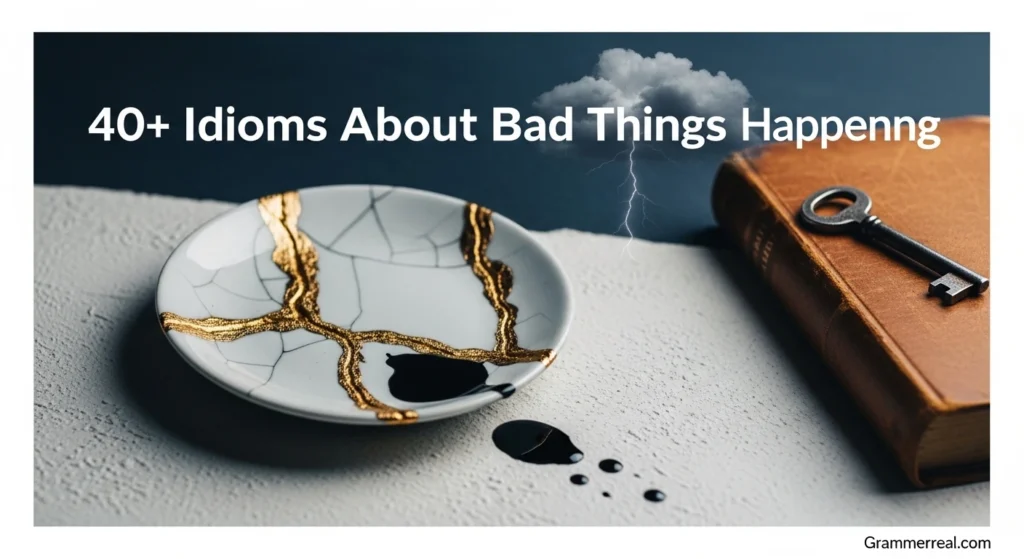
The sky darkens without warning. A cold wind moves through the trees. You hear a sudden crack, like something breaking far away. Then rain falls—fast, heavy, and loud. In moments like these, the world feels out of control. Life can shift quickly, and bad things can happen when we least expect them. Yet, even in these stormy moments, language gives us a way to understand and express what we feel.
Idioms about bad things happening are special phrases. They do not mean exactly what the words say. Instead, they carry deeper meanings. People use them to talk about trouble, danger, bad luck, or unexpected problems. These idioms help us speak in a colorful and emotional way. They make our stories stronger. They also help us connect with others, because many people understand these expressions.
In this article, we will explore idioms about bad things happening. You will learn their meanings, see real-life examples, and discover how to use them in your daily life. We will also include fun exercises and creative ideas so you can practice. By the end, you will not just know these idioms—you will feel them.
Why Idioms About Bad Things Matter in Daily Life
Life is not always smooth. Sometimes things go wrong. Sometimes plans fail and sometimes we feel stuck. During these moments, simple words may not be enough. That is where idioms help.
Idioms make language richer. They allow us to describe bad situations in a vivid way. Instead of saying “something bad happened,” you can say “everything fell apart.” This sounds stronger and more emotional.
Also, idioms help us connect with others. When someone says, “I hit rock bottom,” we understand they are going through a hard time. We feel their pain more clearly.
Moreover, idioms can even make bad situations feel lighter. A little humor or creativity in language can reduce stress. It gives us a new way to see problems—not just as pain, but as part of life’s story.
What Are Idioms About Bad Things Happening
Idioms are phrases that have meanings different from their literal words. For example, “the sky is falling” does not mean the sky is really falling. It means something feels very wrong or chaotic.
Idioms about bad things often describe:
- Sudden problems
- Ongoing struggles
- Bad luck
- Emotional pain
- Unexpected failure
These idioms often come from nature, stories, or daily life. They use images like storms, fire, falling, or breaking. These images help us understand difficult situations better.
How Idioms Paint Pictures of Trouble and Chaos
When we use idioms, we create pictures in the mind. These pictures help us feel the meaning.
For example:
- “A storm is coming” makes us imagine danger.
- “Everything crashed” makes us think of destruction.
- “Walking on thin ice” shows risk and fear.
Because of these strong images, idioms stay in memory. They also make speech more interesting. Instead of plain words, we tell a story in one short phrase.
When It Rains, It Pours
This idiom means that bad things do not come alone. They come together, one after another.
Meaning and Explanation
“When it rains, it pours” describes a situation where multiple problems happen at the same time. First one issue starts, then more follow quickly.
Example Scenario
Ali loses his job. Then his car breaks down. Then he gets sick. He says, “When it rains, it pours.”
Alternative Ways to Say It
- Problems come in waves
- Everything is going wrong
- Bad luck keeps coming
Sensory Detail
Imagine heavy rain hitting the ground. It does not stop. It gets stronger. That is how problems feel—fast and overwhelming.
Mini Story
A small shop owner once shared his story. One day, his shop flooded. Then his supplier canceled orders. Then his phone stopped working. He laughed and said, “It felt like the sky opened just for me.”
Hit Rock Bottom
This idiom shows the lowest point in life.
Meaning and Explanation
To “hit rock bottom” means reaching the worst possible situation. There is no lower point.
Example Sentence
After losing everything, she felt she had hit rock bottom.
Alternative Expressions
- At the lowest point
- Completely broken
- At the end of the road
Emotional Detail
It feels like standing in darkness with no way out. However, it also means there is only one way left—to go up.
Real-Life Reflection
Many successful people say they once hit rock bottom. That moment became their turning point. So, even this idiom carries a hidden hope.
A Blessing in Disguise
Not all bad things stay bad.
Meaning and Explanation
A “blessing in disguise” is something that seems bad at first but later turns out to be good.
Example Scenario
You miss a bus, but later you avoid an accident. That missed bus becomes a blessing in disguise.
Alternative Ways
- Hidden good
- Unexpected benefit
- Good behind the bad
Emotional Touch
At first, there is sadness. Later, there is relief. This idiom reminds us to wait and see.
Common Idioms About Bad Luck and Misfortune
Bad luck is part of life. Idioms help us talk about it.
Some common ones include:
- “Down on your luck” – having bad luck
- “Out of the blue” – something unexpected
- “Bad apple” – a bad person causing trouble
Each of these idioms gives a simple way to describe complex situations.
Using Idioms to Express Sudden Problems
Sudden problems often shock us. Idioms help us explain that shock.
Examples:
- “Out of nowhere”
- “Like a bolt from the blue”
- “Everything crashed”
These phrases show how quickly life can change. They also help listeners understand the surprise.
Idioms That Show Ongoing Struggles
Not all problems happen suddenly. Some stay for a long time.
Examples:
- “Stuck in a rut”
- “Carrying a heavy burden”
- “Going through a storm”
These idioms show long struggles. They also express patience and endurance.
How to Use These Idioms in Speaking
Using idioms in speaking can make your words more natural.
First, listen carefully. Notice how others use idioms. Then, start small. Use one idiom in a simple sentence. After that, try using them in stories.
For example: Instead of saying, “I had many problems,” say, “When it rains, it pours.”
Practice makes it easier. Over time, idioms will feel natural.
How to Use Idioms in Writing and Storytelling
Idioms add color to writing. They make stories more alive.
Use them to:
- Show emotions
- Describe situations
- Create strong images
However, do not overuse them. Too many idioms can confuse readers. Balance is important.
For example, a story about failure can include: “He felt like everything fell apart. He had hit rock bottom. Still, he hoped this was a blessing in disguise.”
Cultural and Literary Touches of Bad Luck Idioms
Many idioms come from history and culture. Stories, poems, and daily life shape them.
For example, storms often represent trouble. Fire often represents danger. Falling often represents failure.
Because of this, idioms feel universal. People from different places understand them easily.
Interactive Exercise: Practice Idioms About Bad Things Happening
Let’s practice together.
Exercise 1: Fill in the Blank
- After losing his job and home, he felt he had ________.
- First the car broke, then the phone died—________.
Exercise 2: Create Your Own Sentence
Write a sentence using:
- “A blessing in disguise”
- “Out of the blue”
Exercise 3: Short Story Prompt
Write a short story about a bad day. Use at least two idioms. Try to describe feelings and events.
Creative Prompts to Master These Idioms
Try these ideas:
- Write about a storm as a symbol of problems
- Describe a character who faces bad luck
- Turn a bad event into a positive ending
These exercises help you understand idioms deeply.
Bonus Tips for Using Idioms in Social Media and Daily Life
Idioms work great in daily communication.
You can:
- Use them in captions
- Add them in messages
- Share them in stories
For example: “Today felt like when it rains, it pours—but I’m still standing.”
Short, emotional, and powerful.
Building Confidence Through Expressive Language
When you use idioms, your confidence grows. You feel more expressive. You speak with style.
At first, it may feel hard. However, with practice, it becomes easy. Soon, idioms will become part of your natural voice.
Final Thoughts: Turning Bad Moments Into Better Stories
Every bad moment can become a story. Every struggle can become a lesson. Idioms help us shape these stories in a meaningful way.
So next time something goes wrong, try using an idiom. Describe it. Feel it. Share it. You may discover that even bad things can lead to growth, strength, and understanding.
Conclusion
Life will always have difficult moments. Problems will come. Plans will fail. Yet, the way we talk about these moments matters.
Idioms about bad things happening help us express pain, struggle, and even hope. They turn simple words into powerful images. They connect us with others and they remind us that we are not alone.
Even in the darkest moments, language gives us light. It helps us understand what we feel. It helps us move forward.
FAQs
1. What are idioms about bad things happening?
They are phrases that describe problems, bad luck, or difficult situations in a creative way. They do not mean exactly what the words say but carry deeper meanings.
2. Why should I learn these idioms?
They improve your speaking and writing. They help you express emotions clearly and make your language more interesting.
3. Can idioms make communication easier?
Yes, they can. Idioms quickly explain complex feelings. People understand them easily because they create strong images.
4. How can I practice these idioms daily?
You can use them in sentences, write short stories, or include them in conversations and social media posts.
5. Are idioms only for advanced learners?
No, anyone can learn them. Start with simple ones. Practice regularly. Over time, they will become natural for you.



