The words enamor and enamour often confuse writers because they look almost the same and carry the same meaning. Both words describe a feeling of strong liking, attraction, or being deeply impressed by someone or something.
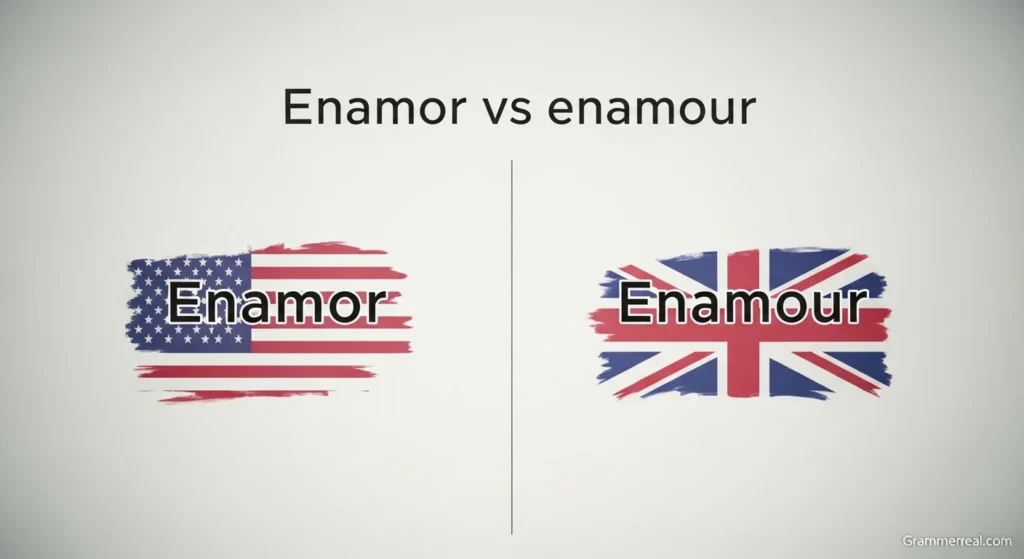
The main difference between them is not in meaning but in spelling and usage in different varieties of English. Enamor is commonly used in American English, while enamour is preferred in British English. Despite this difference, both forms are correct and accepted in formal writing depending on the region. Many learners of English get confused when they see both versions in books, articles, or online content. This confusion can lead to hesitation in writing and speaking, especially when trying to follow correct grammar rules. Understanding these two words helps improve clarity and confidence in communication. In this article, we will explore their meanings, origins, differences, usage rules, and practical examples in simple language.
Meaning of Enamor vs Enamour
Both enamor and enamour have the same meaning: to attract someone strongly or to fill someone with love, admiration, or interest. When a person is enamored or enamoured, they feel emotionally drawn to something or someone. This attraction can be romantic, emotional, or even intellectual.
For example:
- She was enamored by his kind nature.
- He became enamoured with the beauty of the old city.
In both sentences, the feeling is one of deep attraction or admiration. The difference lies only in spelling, not in meaning or usage. This makes the words interchangeable depending on the form of English being used.
Origin and History of the Words
The words enamor and enamour come from the Old French word enamourer, which means “to fall in love.” This French word itself comes from Latin roots where “in” means “into” and “amor” means “love.” Over time, the word entered Middle English and developed into two different spellings.
As English evolved, spelling differences began to appear between regions. American English simplified many spellings, while British English often kept older forms. This is why enamor became standard in the United States, while enamour remained common in the United Kingdom and other Commonwealth countries.
Even though spelling changed, the meaning stayed exactly the same. This shows how language evolves naturally while preserving core ideas.
American vs British English Usage
One of the main reasons for confusion is regional spelling differences.
American English
In American English, the spelling enamor is preferred. It follows a simpler and more direct spelling style.
Example:
- The music completely enamored the audience.
British English
In British English, the spelling enamour is commonly used. It reflects older traditional spelling patterns.
Example:
- The music completely enamoured the audience.
Both sentences are correct. The only difference is spelling preference. Writers should choose based on the audience they are writing for.
Grammar and Usage Rules
The grammatical behavior of enamor/enamour is also important to understand. It is usually used as a verb and often appears in passive form.
Common structure:
- Subject + be + enamored/enamoured + by/with + object
Examples:
- She is enamored with classical music.
- They were enamoured by the scenery.
It can also be used in active voice:
- The story enamored the readers.
- The novel enamoured critics across Europe.
Both active and passive forms are correct, but passive form is more common in modern writing.
Practical Examples in Sentences
Here are some simple examples to understand usage clearly:
- He was enamored with her smile.
- The tourists were enamoured by the mountain view.
- I became enamored with cooking after watching a show.
- She is enamoured of vintage fashion.
- The child was enamored by the colorful lights.
These examples show that the word is flexible and can be used in different emotional contexts. It is not limited to romantic love; it can also describe admiration for objects, places, or experiences.
Common Mistakes People Make
Many learners make small but important mistakes when using these words.
1. Mixing spellings in one text
Some writers use both enamor and enamour in the same article. This creates inconsistency.
2. Incorrect prepositions
Wrong: He is enamored for music. Correct: He is enamored with music.
3. Overuse in sentences
Using the word too often can make writing repetitive and unnatural.
4. Confusing meaning with “love”
While similar, enamor/enamour does not always mean romantic love. It often means admiration or strong interest.
Avoiding these mistakes helps improve clarity and correctness in writing.
Idiomatic and Literary Usage
The word enamor/enamour is often found in literature and poetic writing. It adds emotional depth and elegance to sentences.
Common literary-style expressions include:
- Enamored by beauty
- Enamoured of life
- Deeply enamored soul
Writers use it to express strong emotional reactions in a refined way. In modern casual speech, however, simpler words like “like” or “love” are more common.
Example in literature style:
- He was completely enamoured of the mysterious forest that seemed alive at night.
Such usage is more expressive and dramatic than everyday speech.
Practical Tips for Using Enamor vs Enamour
To use these words correctly, keep the following tips in mind:
- Choose enamor for American English writing.
- Choose enamour for British English writing.
- Always use correct prepositions like “with” or “by.”
- Prefer passive form in formal writing.
- Do not mix both spellings in the same document.
- Use it for admiration, not just romantic love.
- Avoid overusing it in simple sentences.
These tips help maintain consistency and clarity in writing.
Contexts Where These Words Are Used
The words enamor/enamour are used in different contexts:
1. Literature
Writers use them to describe deep emotions and admiration.
2. Daily Speech (Less Common)
In modern conversation, they are less common but still understood.
3. Academic Writing
Used in essays or formal descriptions when expressing strong appreciation.
4. Travel Writing
Often used to describe attraction to places:
- The travelers were enamored with the peaceful village.
5. Reviews
Used when describing strong positive impressions:
- Customers were enamoured by the service quality.
These contexts show the flexibility of the word in different forms of writing.
Summary of Key Differences
- Meaning: Same for both words
- Spelling: American vs British difference
- Usage: Formal and literary contexts
- Grammar: Works mainly as a verb
- Prepositions: with, by, of
Understanding these points removes confusion and improves writing accuracy.
Reflection on Writing and Grammar Improvements
In this exercise, careful attention was given to grammar rules such as subject-verb agreement, correct use of prepositions, and proper sentence structure. Sentence flow was varied to avoid repetition and maintain readability. Both active and passive voice structures were used to create balance and clarity. The vocabulary was kept simple to ensure easy understanding while still maintaining accuracy. Each section was organized with clear headings to improve structure and readability. The keyword was used naturally without overloading the text, helping maintain a smooth reading experience. This approach improves writing skills by encouraging clarity, consistency, and precision. It also strengthens the ability to explain similar concepts in different ways, which is useful for effective communication.
Conclusion
The difference between enamor and enamour is simple once understood. Both words express strong admiration or attraction, and neither is incorrect. The only real difference lies in regional spelling preferences, with American English favoring enamor and British English favoring enamour. Their grammar usage, meaning, and emotional expression remain the same. By learning correct prepositions, sentence structures, and context usage, writers can use both forms confidently. This knowledge helps improve clarity and prevents common writing mistakes. Whether you choose enamor or enamour, consistency is the most important rule in writing.
FAQs
1. What is the difference between enamor and enamour?
There is no difference in meaning. The difference is only in spelling: American English uses enamor, while British English uses enamour.
2. Are both words correct?
Yes, both are correct depending on the type of English you are using.
3. Can I use enamor in British English writing?
It is better to use enamour in British English, but enamor is still understandable.
4. What does enamored mean?
It means being strongly attracted to or deeply impressed by someone or something.
5. Is enamor only used for romantic feelings?
No, it can also describe admiration for objects, places, ideas, or experiences.
6. What prepositions are used with enamor?
Common prepositions are “with,” “by,” and sometimes “of.”
7. Is enamour outdated?
No, it is still actively used in British English and formal writing.
8. Can I use it in daily conversation?
Yes, but simpler words like “like” or “love” are more common in everyday speech.