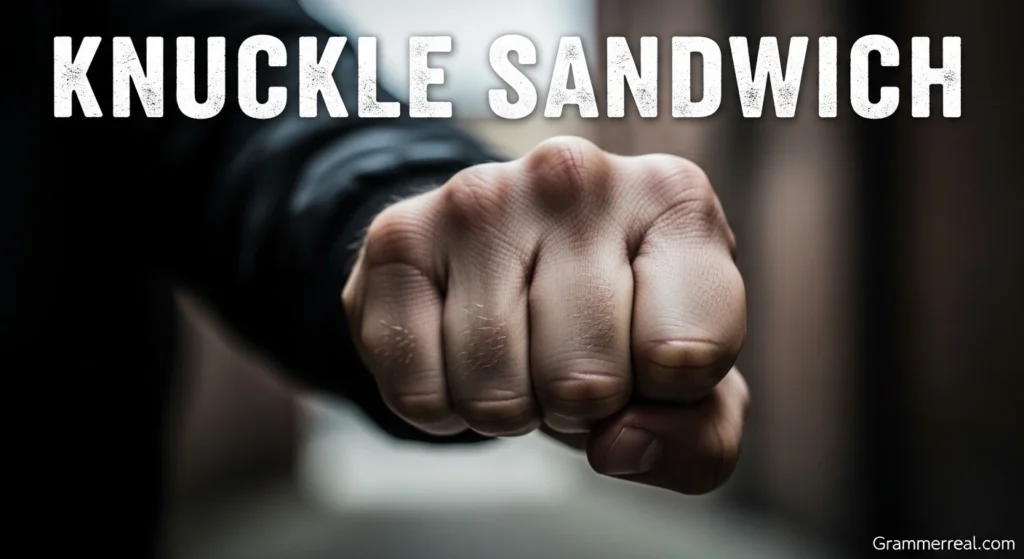
The phrase knuckle sandwich is a well-known informal expression in English. It does not usually mean real food, even though it sounds like something you could eat. Instead, a knuckle sandwich is a joking or threatening way to say a punch in the face.
People often hear this phrase in old movies, comics, cartoons, and playful arguments. Today, it is mostly used for humor rather than serious threats. The term combines two simple words, which makes it easy to remember. Because of that, the phrase has stayed popular for many years. Many learners of English feel confused when they first hear knuckle sandwich, since the words seem unrelated to fighting. Understanding this expression helps improve reading, listening, and speaking skills. It also shows how creative and funny idioms can be in everyday language.
What Does knuckle sandwich Mean?
A knuckle sandwich means a punch, usually to the face. It is an idiom, so the meaning is different from the literal words.
- Knuckle = the joints of the fingers on a closed fist
- Sandwich = food with bread and filling
When combined, the phrase becomes humorous slang for being hit by a fist.
Simple Example Sentences
- If you keep teasing him, he may threaten you with a knuckle sandwich.
- The cartoon bully shouted that he would give someone a knuckle sandwich.
- My grandfather used the phrase as a joke, not a real threat.
In modern speech, many people use it in a playful way. Still, because it refers to violence, it should be used carefully.
The Origin of knuckle sandwich
The exact origin is uncertain, but the phrase became common in American English in the early twentieth century. It appeared in comic strips, movies, and street slang. Writers often used it because it sounded funny and strong at the same time.
The image is simple:
- A fist has knuckles.
- A punch lands on a face.
- The word sandwich adds humor and surprise.
This creative combination helped the phrase become memorable.
Why the Phrase Sounds Funny
Many idioms are funny because they mix unrelated ideas. A sandwich is soft and tasty. Knuckles are hard and linked to fighting. Putting them together creates a strange picture.
That contrast makes people smile. It also softens the harsh meaning. Instead of saying “I will punch you,” someone may jokingly say “I will give you a knuckle sandwich.”
Key Points About knuckle sandwich
1. It Is Usually Informal
You should not use this phrase in formal writing, school essays, or business emails.
2. It Often Sounds Old-Fashioned
Many people connect it with older movies, classic cartoons, or comic books.
3. It Can Be Joking or Threatening
Tone of voice matters. A smile may show humor. Angry body language may show danger.
4. Context Is Important
Friends joking around may use it lightly. Strangers arguing may create a different meaning.
Contextual Examples in Daily Life
In Cartoons
A large character says, “Come here and get your knuckle sandwich!”
This is usually exaggerated and meant to be funny.
In Family Talk
A parent may jokingly say to noisy children, “Settle down before I give you a knuckle sandwich.” In healthy families, this is often playful old-fashioned speech, though many people now avoid such jokes.
Among Friends
One friend may say, “Keep stealing my fries and you’ll get a knuckle sandwich.”
The speaker often means nothing serious.
In Books and Stories
Writers use the phrase to show a rough or comic character.
Common Mistakes People Make
Mistake 1: Thinking It Is Real Food
Because of the word sandwich, learners may imagine a meal. It is not food.
Mistake 2: Using It in Formal Situations
Do not write:
- Dear Manager, he threatened me with a knuckle sandwich.
A clearer phrase would be:
- Dear Manager, he threatened to hit me.
Mistake 3: Using It Without Understanding Tone
If you use the phrase with the wrong person, it may sound rude or aggressive.
Mistake 4: Overusing the Phrase
Because it is colorful language, repeated use sounds unnatural.
Mistake 5: Saying It Means Any Fight
It usually refers to a punch, not every kind of fight.
American vs British English Differences
In American English
The phrase knuckle sandwich is more widely recognized. It appears often in old films, comics, and slang collections.
In British English
Many British speakers understand the phrase because of media exposure, but it may feel more American in style. British English has many of its own slang expressions for threats or punches.
Spelling Notes
The phrase itself uses the same spelling in both varieties:
- knuckle sandwich
Usage Tone
In both American and British English, the phrase sounds informal and somewhat old-fashioned.
Similar Idiomatic Expressions
English has many playful expressions linked to anger or conflict.
1. Punch someone’s lights out
Means to hit someone very hard.
2. Throw hands
Means to start fighting.
3. Hit below the belt
Means to act unfairly, often not physically.
4. Put up your dukes
An old phrase meaning prepare to fight.
5. knuckle sandwich
Means a punch, often said jokingly.
These examples show how English uses creative imagery.
When to Avoid Using knuckle sandwich
Although the phrase can be funny, it is not always wise to use it.
At Work
It may sound unprofessional or threatening.
At School
Teachers or students may misunderstand the joke.
Online
Written text has no voice tone, so humor may be lost.
During Real Conflict
If emotions are high, the phrase may increase tension.
Practical Tips for Using the Phrase Correctly
Tip 1: Know Your Audience
Use it only with people who understand playful language.
Tip 2: Watch the Situation
A calm setting is safer than a heated argument.
Tip 3: Use Light Tone
If your voice sounds angry, the phrase may seem serious.
Tip 4: Learn Safer Alternatives
Instead of threatening language, say:
- Please stop.
- That is annoying.
- Let’s calm down.
- I do not like that joke.
Tip 5: Understand Culture
Some people know the phrase well. Others may never have heard it.
knuckle sandwich in Popular Culture
The phrase appears in:
- Classic cartoons
- Detective stories
- Old action films
- Comic books
- Humorous TV dialogue
Writers like it because it quickly shows character type. A rough, funny, or dramatic character may use it.
Why Language Learners Should Study This Phrase
Learning idioms helps learners understand real English. If you know only literal meanings, many jokes and stories become confusing.
For example:
- Literal meaning: sandwich made of knuckles
- Real meaning: a punch
Studying phrases like knuckle sandwich improves:
- Listening skills
- Reading skills
- Vocabulary depth
- Cultural knowledge
- Sense of humor in language
Grammar Focus Using knuckle sandwich
This topic is also useful for grammar practice.
Singular Form
- A knuckle sandwich is an old slang term.
Plural Form
- Knuckle sandwiches are common in old cartoons.
Present Tense
- He jokes about giving a knuckle sandwich.
Past Tense
- The actor said it in the movie.
Future Tense
- You will hear the phrase in classic comedy shows.
Correct Articles
- a knuckle sandwich
- the knuckle sandwich joke
Using correct articles makes sentences smoother and clearer.
Sentence Style and Clarity Lessons
This exercise also shows strong writing habits.
Short Sentences Add Power
- He laughed.
- She understood the joke.
Longer Sentences Add Detail
The phrase sounds playful because it combines a body part with a common food word, creating a surprising image.
Variety Improves Flow
Mixing short and long sentences keeps reading interesting.
Clear Modifiers Matter
Better:
- an old humorous phrase
Weaker:
- a phrase old funny thing
Correct word order improves clarity.
Safer Modern Alternatives
Because some people dislike violent language, you can choose softer expressions.
- Stop bothering me.
- Give me space.
- Please be respectful.
- That joke is enough now.
- Let’s move on.
These options communicate clearly without threats.
knuckle sandwich and Humor
Humor often comes from surprise. Nobody expects food words in a threat. That is why the phrase remains memorable.
Funny language can reduce tension when used kindly. However, humor fails when people feel unsafe or insulted. Good judgment is important.
How This Exercise Improves Writing Skills
Studying and writing about knuckle sandwich can improve language skills in several ways.
Vocabulary Growth
You learn slang, idioms, tone, and context.
Grammar Accuracy
You practice verbs, articles, and sentence structure.
Better Word Choice
You learn when informal words fit and when formal words are better.
Stronger Readability
Simple wording helps readers understand quickly.
Natural Keyword Use
Repeating the main phrase only when needed keeps writing smooth and clear.
Quick Summary Table
TopicMeaningknuckle sandwichA punch, usually jokingly describedToneInformal, humorous, sometimes threateningCommon UseCartoons, jokes, old slangBest AdviceUse carefully and know the context
Conclusion
The phrase knuckle sandwich is a colorful English idiom that means a punch, not real food. It became popular through American slang, cartoons, films, and comic stories. Today, it is usually heard as humor or playful old-fashioned speech, though it can still sound aggressive in the wrong setting. Understanding the phrase helps learners recognize idioms and avoid confusion. It also teaches the importance of tone, audience, and context. Clear grammar, simple wording, and varied sentence structure make explanations easier to read. Learning expressions like knuckle sandwich builds vocabulary and cultural knowledge. Used carefully, it can be an interesting example of how creative English can be.
FAQs
1. What does knuckle sandwich mean?
It means a punch, usually said in a joking or slang way.
2. Is knuckle sandwich real food?
No. It is an idiom, not an actual sandwich.
3. Is knuckle sandwich rude?
It can be rude or threatening depending on tone and situation.
4. Is the phrase still common today?
It is less common than before, but many people still recognize it.
5. Is knuckle sandwich American or British?
It is more strongly linked to American English, though many British speakers understand it.
6. Can I use knuckle sandwich in school writing?
No. It is informal slang, so formal wording is better.
7. Why is the phrase funny?
It mixes fighting language with food language, which sounds unexpected.
8. Can friends use knuckle sandwich as a joke?
Yes, some friends do, but only when everyone understands the humor.



