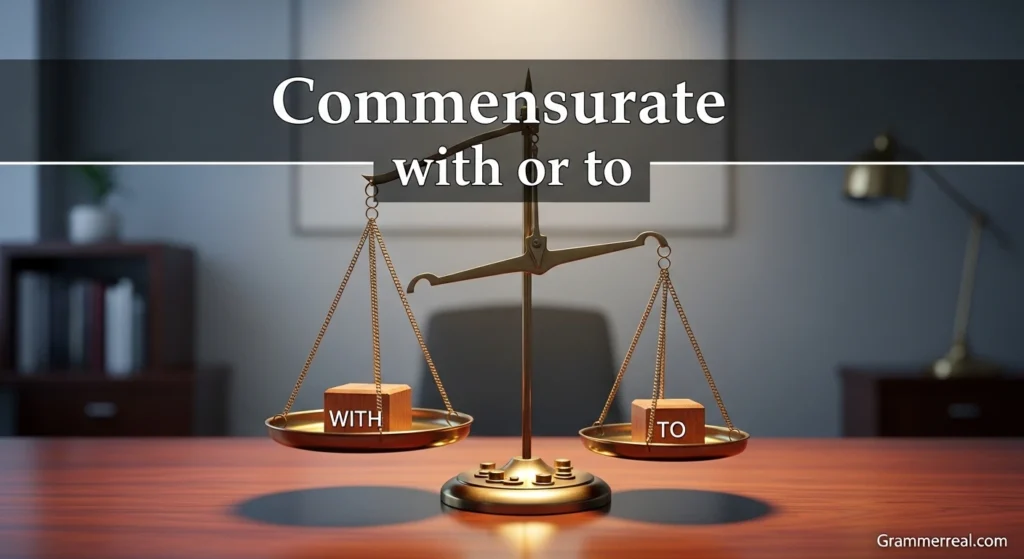
Many English learners and even fluent speakers feel unsure when they must choose between commensurate with or to. Both forms appear in writing, but one is far more common and widely accepted in modern English.
This topic matters because the wrong preposition can make formal writing sound unnatural or outdated. The word commensurate often appears in business, law, education, and everyday discussions about fairness and balance. It usually describes something that matches value, effort, size, skill, or reward. When people ask about commensurate with or to, they usually want to know which phrase sounds correct and natural. In most cases, commensurate with is the preferred choice in current English. However, understanding why this is true helps you write with more confidence. This guide explains the meaning, correct usage, common mistakes, regional differences, examples, and simple tips so you can use the phrase clearly and correctly.
What Does Commensurate Mean?
The adjective commensurate means equal in measure, matching in degree, or proportional to something else. It is used when two things should be balanced or fairly related.
For example:
- Salary should be commensurate with experience.
- Rewards must be commensurate with effort.
- Punishment should be commensurate with the crime.
- Growth needs to be commensurate with demand.
In each example, one thing matches another thing in size, value, or level.
This word often appears in formal writing because it expresses fairness and proportion in one clear term. Instead of saying “equal to the level of” or “matching the amount of,” writers may choose commensurate.
Commensurate With or To: Which One Is Correct?
The best and most accepted form is commensurate with.
Examples:
- Her pay is commensurate with her skills.
- The budget should be commensurate with the project size.
- Success was commensurate with hard work.
Although some writers use commensurate to, it is much less common and often sounds awkward to modern readers.
Examples of less common use:
- Her pay is commensurate to her skills.
- The reward was commensurate to the risk.
These sentences may be understood, but most editors, teachers, and style guides prefer with.
So, if you are unsure about commensurate with or to, choose commensurate with in almost every case.
Why “With” Is Preferred
The preposition with often shows comparison, relationship, or agreement between two things. That meaning fits the word commensurate very well.
When we say:
- Salary is commensurate with experience.
We mean salary matches experience.
The word to often points toward direction, movement, or connection. While it can work with many adjectives, it does not sound as natural after commensurate in current usage.
Because language changes over time, some older texts may contain commensurate to, but modern usage strongly favors with.
Key Grammar Rule for This Phrase
Use this pattern:
commensurate + with + noun / noun phrase
Examples:
- commensurate with ability
- commensurate with market rates
- commensurate with performance
- commensurate with responsibility
- commensurate with qualifications
You can also use a clause after a noun phrase:
- The raise was commensurate with what she contributed.
- The result was commensurate with how much effort they gave.
This structure keeps your sentence smooth and correct.
Contextual Examples in Daily Use
Work and Salary
This is one of the most common uses.
- Employees expect pay commensurate with experience.
- Managers received bonuses commensurate with results.
- Her new role came with compensation commensurate with added duties.
Education
- Students should receive support commensurate with their needs.
- Marks were commensurate with the quality of the work.
- Advanced learners need tasks commensurate with their level.
Law and Justice
- Punishment must be commensurate with the offense.
- Fines should be commensurate with the damage caused.
- Responsibility should be commensurate with authority.
Business and Growth
- Investment should be commensurate with expected returns.
- Staff numbers must be commensurate with demand.
- Costs increased at a rate commensurate with expansion.
Personal Life
- Respect should be commensurate with kindness.
- Freedom should be commensurate with maturity.
- Rewards at home may be commensurate with effort.
Common Mistakes with Commensurate With or To
1. Using the Wrong Preposition
Incorrect or less natural:
- Pay is commensurate to experience.
Better:
- Pay is commensurate with experience.
2. Using It Without a Comparison
Incorrect:
- Her salary is commensurate.
This feels incomplete because we need to know what it matches.
Better:
- Her salary is commensurate with her experience.
3. Using It in Casual Situations Where Simpler Words Work Better
Very formal:
- Your reward is commensurate with your chores.
Simpler:
- Your reward matches your chores.
4. Repeating It Too Often
Poor style:
- Pay is commensurate with experience, and duties are commensurate with pay, and hours are commensurate with duties.
Better:
- Pay matches experience, duties match pay, and hours fit the role.
5. Wrong Subject-Verb Agreement
Incorrect:
- The wages is commensurate with skill.
Correct:
- The wages are commensurate with skill.
American vs British English Differences
When discussing commensurate with or to, both American and British English generally prefer commensurate with.
American English
In American writing, especially in business and hiring language, you often see:
- Salary commensurate with experience.
- Benefits commensurate with position level.
This phrase is common in job ads and corporate writing.
British English
British English also strongly prefers with:
- Pay commensurate with qualifications.
- Action commensurate with the problem.
Is “Commensurate To” Regional?
Not really in a strong modern sense. It appears sometimes in different places, but it is still much less common than with. It is better seen as an occasional variant than a standard preferred form.
Formal and Informal Alternatives
Sometimes commensurate sounds too formal. You may want a simpler option.
Use these alternatives:
- equal to
- matching
- suitable for
- in line with
- proportional to
- fair for
- based on
Examples:
- Pay matching experience
- Reward equal to effort
- Growth in line with demand
- Punishment proportional to harm
These options can make your writing easier to read.
Idiomatic Expressions Related to the Idea
English has many common expressions that share the same meaning of fairness or balance.
You Get What You Pay For
This means quality often matches cost.
Fair’s Fair
This means treatment should be equal and just.
Worth One’s Salt
This means someone deserves pay because of skill and work.
Pull Your Weight
This means contribute your fair share.
Reap What You Sow
Results often match effort or actions.
These phrases are more conversational than commensurate, but they express related ideas.
Practical Tips for Correct Usage
1. Choose “With” Automatically
If you pause between commensurate with or to, choose with.
2. Ask “What Is Matching What?”
This helps complete the sentence.
- Pay is commensurate with experience.
- Reward is commensurate with effort.
3. Use It in Formal Writing
Good places:
- reports
- academic writing
- business emails
- job descriptions
- legal discussions
4. Use Simpler Words in Casual Speech
Instead of saying:
- My allowance should be commensurate with my chores.
Say:
- My allowance should match my chores.
5. Keep Sentences Clear
Good:
- The increase was commensurate with inflation.
Too heavy:
- The increase, in a manner considered economically balanced, was commensurate with inflationary movement.
Sentence Patterns You Can Copy
These ready-made patterns help you write better.
Pattern 1
Something is commensurate with something.
- The fee is commensurate with service quality.
Pattern 2
Something should be commensurate with something.
- Support should be commensurate with need.
Pattern 3
Something was commensurate with something.
- Their reward was commensurate with effort.
Pattern 4
Something remains commensurate with something.
- Output remains commensurate with demand.
Pattern 5
Need for something commensurate with something else
- We need staffing levels commensurate with customer traffic.
Why Writers Confuse With and To
Many English words use to, so learners naturally expect it here.
Examples:
- similar to
- equal to
- related to
- connected to
Because of that pattern, people may guess commensurate to. This is understandable. However, English often depends on fixed word partnerships. In this case, the natural pairing is commensurate with.
Learning these common pairings improves accuracy and fluency.
Simple Editing Check for Your Writing
When you finish writing, review each sentence:
- Did I use commensurate with?
- Is there a clear comparison?
- Does the verb match the subject?
- Is the sentence too long?
- Can I replace formal wording with simpler wording if needed?
- Did I avoid repeating the phrase too many times?
- Is the meaning clear to a general reader?
This short review greatly improves sentence quality.
Mini Rewrite Examples for Better Style
Weak
- The pay is commensurate with experience and it is good and nice for workers.
Better
- The pay is commensurate with experience, which feels fair to workers.
Weak
- The punishment was commensurate to the crime.
Better
- The punishment was commensurate with the crime.
Weak
- Staffing is commensurate with demand because demand is high and many people come.
Better
- Staffing is commensurate with demand, so customers receive faster service.
How This Topic Improves Writing Skills
Learning commensurate with or to teaches more than one phrase. It builds several useful writing habits.
Better Word Choice
You learn when to use formal vocabulary and when simpler words are better.
Better Grammar
You practice adjective + preposition combinations, which are common in English.
Better Clarity
You learn to compare two things clearly.
Better Style
You avoid awkward wording and choose natural phrases.
Better Readability
Shorter, cleaner sentences help readers understand faster.
Better Confidence
When you know the right form, you write without hesitation.
Quick Summary Table
QuestionBest Answercommensurate with or to?commensurate withIs “to” always wrong?Not always, but uncommonIs the phrase formal?YesCommon topic areas?Pay, effort, fairness, law, businessCasual alternative?matches, equal to, fair for
Conclusion
If you often wonder about commensurate with or to, the safest and most natural choice is commensurate with. This form is strongly preferred in modern English and appears often in professional, academic, and formal writing. The word means matching in value, level, size, or degree. It is commonly used for salary, responsibility, effort, punishment, growth, and rewards. While commensurate to may appear sometimes, it is much less common and may sound awkward to many readers. Use clear sentence patterns, keep comparisons direct, and choose simpler alternatives when the situation is casual. By learning this phrase carefully, you improve grammar, style, and confidence in writing. Strong writing often depends on small choices like the right preposition, and this is one of those important choices.
FAQs
Is it commensurate with or to?
The preferred and standard modern form is commensurate with.
Is commensurate to wrong?
Not always completely wrong, but it is uncommon and less natural than with.
What does commensurate mean?
It means matching in size, value, degree, or level.
Can I say salary commensurate with experience?
Yes. This is one of the most common uses.
Is commensurate a formal word?
Yes. It is more formal than words like match or equal.
What is a simple replacement for commensurate?
You can use matching, equal to, fair for, or in line with.
Can I use commensurate in daily conversation?
Yes, but it may sound formal. Simpler words are often better in casual speech.
What preposition follows commensurate?
Usually with.