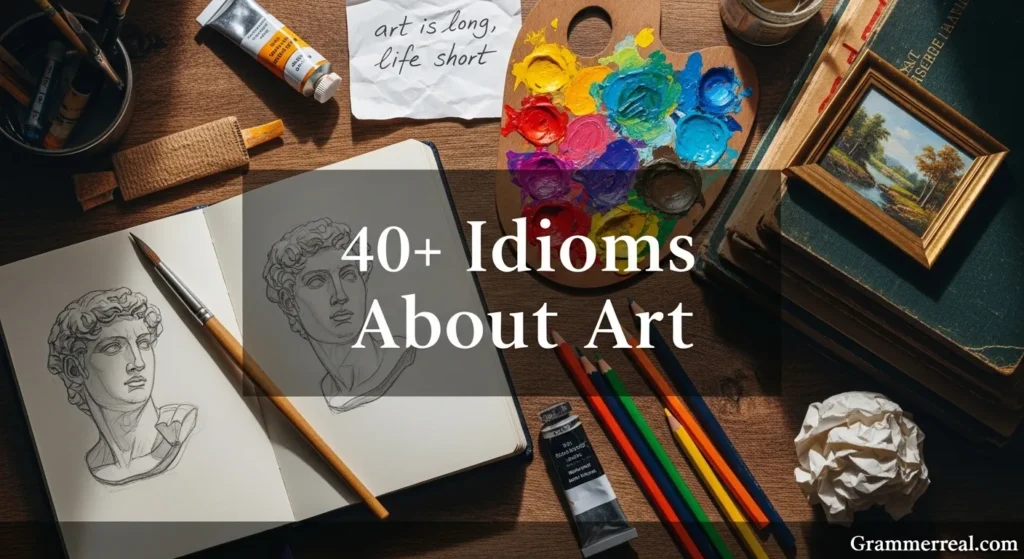
The smell of fresh paint floats in the air, sharp yet comforting. A brush glides across a canvas, leaving behind bold strokes of color—reds that burn like sunsets, blues that whisper like quiet oceans. Somewhere nearby, charcoal scratches softly against paper, sketching a face that seems almost alive. In this world of color, texture, and imagination, language also becomes art. Words, like paint, can shape pictures in our minds. And this is where idioms about art come in—phrases that turn simple speech into something vivid, expressive, and unforgettable.
Idioms about art are not just decorative phrases. They carry meaning beyond their literal words. They help us express creativity, describe emotions, and make communication more engaging. Whether you are writing a story, speaking in daily life, or posting on social media, these idioms give your language a creative edge. They make your ideas stand out, just like a masterpiece in a gallery.
In this article, we will explore the beauty of idioms about art in a simple, friendly, and slightly poetic way. You will learn what they mean, how to use them, and how to bring them into your own writing and speech. Along the way, you will also find stories, examples, exercises, and tips that help you practice and enjoy the process.
What Are Idioms About Art
Idioms about art are expressions that come from the world of creativity—painting, drawing, music, and performance—but people use them in everyday language. These phrases often do not mean exactly what the words say. Instead, they carry a deeper or symbolic meaning.
For example, when someone says “paint the town red,” they are not talking about actual paint. They mean going out and having fun, often in a lively and exciting way.
These idioms work like small pieces of art themselves. They compress meaning, emotion, and imagery into just a few words. As a result, they make communication richer and more colorful.
Why Idioms About Art Matter in Everyday Language
Language can sometimes feel plain or repetitive. However, idioms add flavor and personality. They make your speech more engaging and easier to remember.
Moreover, idioms about art connect creativity with communication. They allow you to describe feelings, actions, and situations in a way that feels alive.
For instance, instead of saying “He is very creative,” you can say “He thinks outside the box.” The second sentence feels more vivid and interesting.
Therefore, learning these idioms helps you:
- Speak more naturally
- Write more creatively
- Understand others better
- Express emotions more clearly
The Creative Power of Figurative Language
Idioms are a type of figurative language. That means they create images in the mind rather than stating facts directly.
When you hear “a blank canvas,” you might imagine a white surface waiting for color. At the same time, you understand it means a fresh start or a new opportunity.
This dual meaning makes idioms powerful. They engage both imagination and understanding. As a result, they make communication more memorable.
How Art Idioms Reflect Human Expression
Art has always been a way for people to express emotions, ideas, and stories. Similarly, idioms reflect how people think and feel.
For example, phrases like “draw a line” or “sketch out a plan” show how artistic actions become part of daily speech.
These idioms reveal how deeply art connects to human life. Even people who do not paint or draw still use artistic language every day.
Paint the Town Red
This idiom feels energetic and lively, like splashes of bright red across a dull surface.
Meaning: To go out and enjoy yourself in a lively way, often with friends.
Example: After finishing exams, we decided to paint the town red and celebrate all night.
Alternative Ways to Say It:
- Have a great time
- Party hard
- Celebrate wildly
Sensory Detail: You can almost hear laughter, music, and the clinking of glasses.
Mini Story: Ali had worked hard for months. When he finally got the job, he called his friends. That night, the city lights seemed brighter, and their laughter echoed through the streets—they truly painted the town red.
A Blank Canvas
This idiom feels calm and full of possibility, like standing in front of an untouched painting.
Meaning: A new beginning or opportunity where anything is possible.
Example: Moving to a new city felt like starting with a blank canvas.
Alternative Ways to Say It:
- Fresh start
- New beginning
- Clean slate
Emotional Detail: It brings a mix of excitement and uncertainty.
Draw a Line
This idiom suggests control and boundaries, like marking a clear edge in a drawing.
Meaning: To set a limit or boundary.
Example: I can help you, but I draw the line at doing your entire project.
Alternative Ways to Say It:
- Set boundaries
- Say no
- Establish limits
How to Use Art Idioms in Daily Conversations
You do not need to be an artist to use these idioms. You can use them in simple conversations.
For example:
- Talking about plans → “Let’s paint the town red tonight.”
- Talking about goals → “This job is a blank canvas for me.”
Start small. Use one idiom at a time. Gradually, your speech will feel more natural and expressive.
Using Art Idioms in Writing
Writing becomes more engaging when you use idioms carefully.
Instead of saying: “The project was unfinished,” you can say: “The project was still a rough sketch.”
This small change adds depth and imagery.
However, balance is important. Too many idioms can feel heavy. Use them where they add value.
Common Mistakes When Using Idioms
Sometimes learners use idioms incorrectly. This can confuse the listener.
Here are a few tips:
- Do not translate idioms word-for-word
- Learn their meanings in context
- Practice using them in sentences
For example, saying “paint the house red” instead of “paint the town red” changes the meaning completely.
Mini Story: The Artist Who Found His Voice
A young artist once struggled to express himself. His paintings felt empty, like colors without meaning.
One day, his teacher said, “Your life is a blank canvas. Fill it with your truth.”
Those words changed everything. Slowly, he began to paint with emotion. His work improved, and so did his confidence.
This story shows how idioms can inspire real change.
Practice Exercise: Fill in the Blanks
Try completing these sentences:
- After graduation, life feels like a ________.
- We decided to ________ and celebrate.
- I ________ when people disrespect my time.
Think about your answers. Then try using these idioms in your own sentences.
Turn Your Life Into Art
Imagine your life as a painting.
- What colors would you use?
- What would the background look like?
- What emotions would it show?
Now write a short paragraph using at least one idiom.
Use Idioms in Social Media
Idioms can make your posts more engaging.
For example:
- “New month, new goals. Life is a blank canvas”
- “Weekend vibes—ready to paint the town red!”
These phrases attract attention and feel relatable.
Expanding Your Idiom Vocabulary
The more idioms you learn, the more expressive you become.
You can:
- Read books and notice idioms
- Watch movies and listen carefully
- Practice writing daily
Over time, these phrases will become natural.
The Emotional Impact of Art Idioms
Idioms often carry emotion.
For example:
- “Blank canvas” → hope
- “Draw a line” → control
- “Paint the town red” → excitement
Because of this, they connect deeply with people.
How Idioms Improve Storytelling
Stories become more vivid with idioms.
Instead of saying: “He started over,” you can say: “He faced life like a blank canvas.”
This small change makes the story more powerful.
Mix Idioms with Imagery
You can combine idioms with descriptive language.
Example: “The night was young, and we were ready to paint the town red, our laughter echoing like music through the streets.”
This creates a strong visual and emotional effect.
Idioms in Movies and Culture
Movies often use idioms to create impact.
Characters speak in expressive ways that feel natural and memorable. This helps the audience connect with the story.
You can learn a lot just by listening carefully.
Building Confidence with Idioms
At first, using idioms may feel difficult. However, practice makes it easier.
Start with simple phrases. Use them in daily conversation. Gradually, your confidence will grow.
Remember, language is like art—it improves with practice.
Conclusion
Language, like art, thrives on creativity, color, and expression. Idioms about art bring these elements into everyday communication, turning simple sentences into vivid experiences. They help you express emotions, describe situations, and connect with others in a deeper way.
As you have seen, even a single idiom can transform your words. Whether you are painting the town red, starting with a blank canvas, or drawing a line, you are using language as an artist uses paint—carefully, creatively, and meaningfully.
So keep practicing. Experiment with these idioms. Use them in your conversations, your writing, and your thoughts. Over time, your language will become richer, more expressive, and truly your own masterpiece.
FAQs
1. What are idioms about art?
Idioms about art are expressions inspired by creativity and artistic activities. They carry meanings that go beyond their literal words.
2. Why should I learn art-related idioms?
They make your language more expressive, engaging, and natural in both speaking and writing.
3. Can beginners use idioms easily?
Yes, beginners can start with simple idioms and practice using them in daily conversations.
4. How can I remember idioms better?
Use them in sentences, read regularly, and connect them with real-life situations.
5. Are idioms useful for writing?
Yes, idioms add color and depth to writing, making it more interesting and memorable.