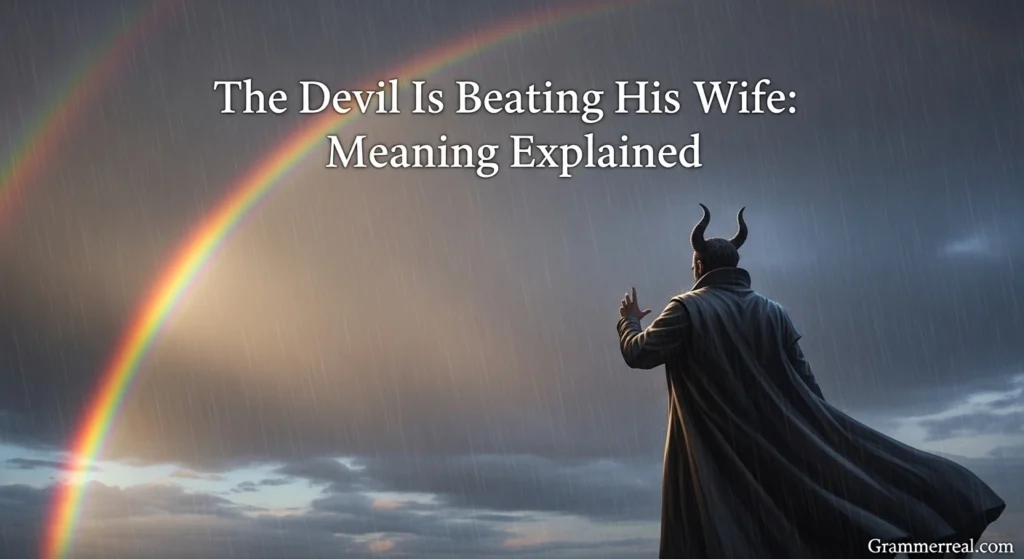
The sky cracks open with a soft drizzle, yet the sun refuses to leave. Golden light spills across wet streets, bouncing off puddles like shattered glass. The air smells of warm dust and fresh rain at the same time. Children pause mid-play, confused but delighted. Old windows glow. Leaves shimmer. It feels like two worlds touching—one bright, one gray—both alive in the same breath.
And in that strange, beautiful moment, someone might smile and say, “The devil is beating his wife.”
At first, the phrase sounds shocking, even unsettling. Yet behind its harsh imagery lies a long-standing idiom used in many cultures to describe a rare and curious event: rain falling while the sun is shining. It captures contradiction. It paints a picture and it turns weather into story.
Meaning of The Devil Is Beating His Wife

The idiom the devil is beating his wife means it is raining while the sun is shining.
In simple words, it describes sunny rain.
Example:
- Look outside. The devil is beating his wife.
- It is raining, but the sun is bright. The devil is beating his wife.
The phrase creates a strong image. It makes the unusual weather feel dramatic.
Origin of the Phrase
The exact origin of this idiom is not clear. However, people have used it in parts of the United States and other regions for many years.
Different cultures have similar expressions for sunny rain. Some places say the fox is getting married. Others use different playful images.
The phrase reflects old storytelling traditions. People often explained strange weather with myths or stories.
Today, many people see it as a folk saying.
Grammar Structure

The basic structure is:
The devil + is + beating + his wife
It is a full sentence in present continuous tense.
Breakdown:
- The devil = subject
- is = helping verb
- beating = main verb (continuous form)
- his wife = object
Examples:
- The devil is beating his wife again today.
- When the sun shines during rain, people say the devil is beating his wife.
You can also report it:
- People say the devil is beating his wife.
Incorrect examples:
- The devil beating his wife.
- Devil is beating his wife.
Correct example:
- The devil is beating his wife.
Always include the helping verb is.
Contextual Examples
Weather Talk:
It started raining while the sun stayed bright. My grandmother laughed and said the devil is beating his wife.
Storytelling:
In the story, children ran outside when they saw sunny rain. They joked that the devil is beating his wife.
Casual Conversation:
“It’s raining and sunny!” “Yes, the devil is beating his wife.”
These examples show informal use.
Tone and Cultural Sensitivity
This idiom sounds dramatic and old-fashioned. However, it includes violent imagery. Because of this, some people feel uncomfortable using it.
In modern speech, many people prefer neutral phrases like:
- It is a sunshower.
- It is sunny rain.
If you choose to use the devil is beating his wife, be aware of your audience. It is better for informal conversation or historical discussion.
American and British English Usage
The phrase appears more often in American regional speech. It is not common in modern British English.
In both varieties, people understand sunshower more easily.
Example:
- We are having a sunshower.
Sunshower is safer and more neutral.
Common Mistakes
Learners sometimes make grammar errors.
- Forgetting the helping verb Incorrect: The devil beating his wife. Correct: The devil is beating his wife.
- Changing verb tense incorrectly Incorrect: The devil beats his wife. Correct: The devil is beating his wife.
- Using it in formal writing This idiom is informal and cultural. Avoid it in academic or professional writing.
Always use it carefully.
Practical Tips for Use
Use the phrase only for sunny rain.
Keep the structure fixed.
Use present continuous tense.
Avoid using it in serious or formal contexts.
Consider using sunshower instead.
Example with tense control:
Yesterday, the devil was beating his wife during the picnic. Today, the devil is beating his wife again.
Notice how the verb changes with time.
Sentence Structure and Clarity

Short sentence:
The devil is beating his wife.
Longer sentence:
When rain falls while the sun shines brightly, some people say the devil is beating his wife.
Avoid fragments.
Incorrect: Because the devil is beating his wife. Correct: We stayed inside because the devil is beating his wife.
Avoid run-on sentences.
Incorrect: The devil is beating his wife the sun is shining. Correct: The devil is beating his wife, and the sun is shining.
Clear punctuation improves readability.
Similar Expressions
Here are similar expressions:
- Sunshower
- Sunny rain
- Fox’s wedding (in some cultures)
- Monkey’s wedding (in other regions)
Sunshower is the most neutral and widely accepted term.
Writing Practice
Try these exercises:
- Write a sentence using sunshower.
- Change this sentence to past tense: The devil is beating his wife.
- Write a short dialogue about sunny rain.
Practice helps you control grammar.
Reflection on Grammar and Writing Technique
In this article, we used simple vocabulary and short sentences. Most sentences use active voice. We explained the grammar structure clearly.
We showed correct and incorrect examples. Avoided fragments and run-on sentences. We repeated the idiom carefully without overusing it.
We also discussed tone and cultural awareness. Clear structure and careful language improve writing quality.
Conclusion
The phrase “the devil is beating his wife” may sound unusual at first, yet it carries a deep sense of wonder, contradiction, and creativity. It reminds us that language has the power to transform even the simplest natural event into something vivid and unforgettable. Through its imagery, it teaches us how contrast can enrich expression, how storytelling can shape meaning, and how words can hold both beauty and surprise at the same time.
Moreover, when we explore such idioms, we do more than learn phrases—we learn perspectives. We discover how people across time have tried to explain the unexplained, using imagination as their guide. Therefore, whether you use this idiom in writing, conversation, or creative expression, remember its true value lies in its ability to make people feel, pause, and picture something beyond the ordinary.
FAQs
1. What does the devil is beating his wife mean?
It means it is raining while the sun is shining.
2. Is this phrase literal?
No, it is an idiom.
3. Is it formal or informal?
It is informal and cultural.
4. Is it common in British English?
No, it is more common in American regional speech.
5. What is a safer alternative?
Sunshower.



