
The page glows under a soft yellow lamp. Ink flows across paper, each letter rising like a tiny building—some tall and proud, others small and quiet. A capital letter stands at the start of a sentence like a gate opening into a new world. It signals importance. It sets tone and it whispers, “Pay attention. Something begins here.”
English capitalization rules may seem simple at first glance, yet they carry a quiet power. They shape clarity, guide readers, and bring structure to language. Without them, writing feels flat, confusing, and sometimes even careless. With them, words gain rhythm, meaning, and confidence.
So, mastering English capitalization rules is not just about grammar. It is about control. It is about respect for language. And most importantly, it is about making your message shine clearly in a crowded world of words.
Why Capitalization Is Important
Capitalization helps readers understand your message.
It shows:
- The beginning of a sentence
- Names of people and places
- Titles and special words
Correct capitalization makes writing clear. Wrong capitalization can make writing look careless.
Example:
- Incorrect: I live in pakistan.
- Correct: I live in Pakistan.
The second sentence looks correct and professional.
Capitalize the First Word of a Sentence
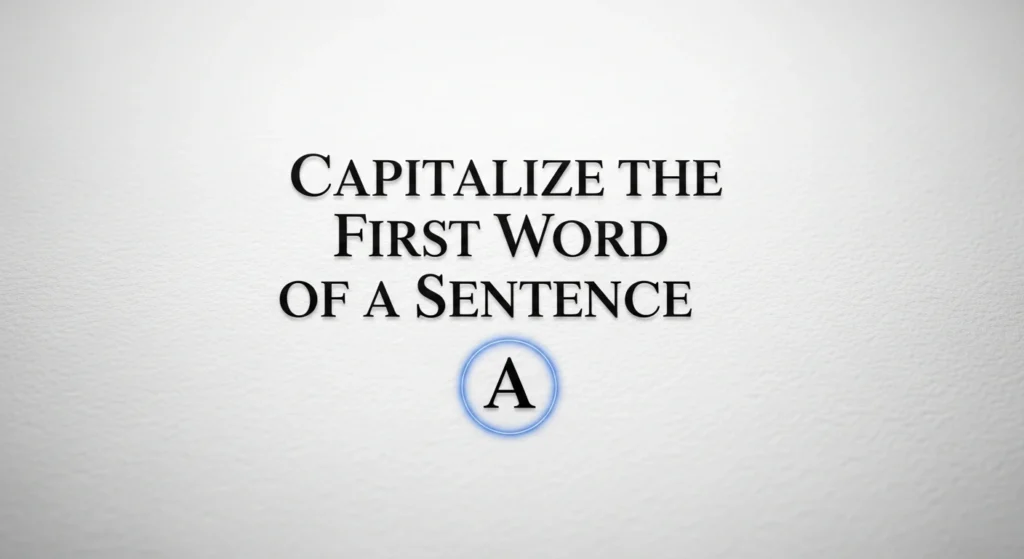
Always use a capital letter at the start of a sentence.
Examples:
- She likes to read.
- We are learning English.
- It is a sunny day.
Do not forget to capitalize after a period.
Incorrect:
- She likes to read. she reads every day.
Correct:
- She likes to read. She reads every day.
Capitalize the Pronoun “I”
The pronoun I is always capitalized.
Examples:
- I am happy.
- My brother and I went to school.
- I think this rule is simple.
Incorrect:
- i am ready.
Correct:
- I am ready.
This rule is very important.
Capitalize Proper Nouns
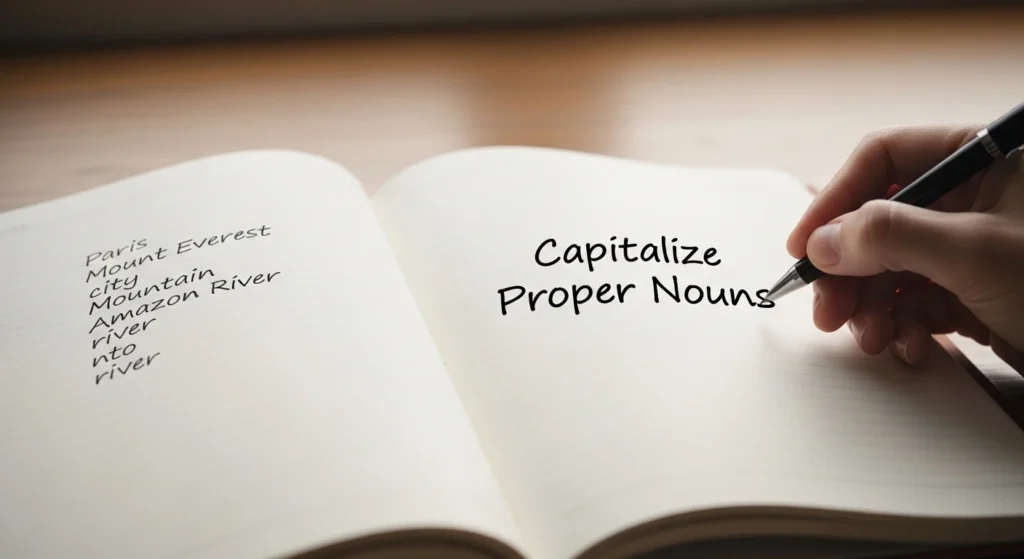
Proper nouns are special names. They include names of people, places, and organizations.
Examples:
- Ali
- London
- Asia
- Friday
Sentence examples:
- Sara lives in Canada.
- We visited Lahore last year.
Do not capitalize common nouns.
Incorrect:
- I bought a Car.
Correct:
- I bought a car.
Car is common. Toyota is proper.
Capitalize Days, Months, and Holidays
Days of the week and months always start with a capital letter.
Examples:
- Monday
- January
- Eid
- Christmas
Sentence examples:
- We will meet on Sunday.
- School starts in August.
Do not capitalize seasons unless they are part of a title.
Correct:
- I love summer.
- I love Winter Festival.
Capitalize Titles Before Names
Capitalize titles when they come before a name.
Examples:
- Doctor Ahmed
- President Khan
- Professor Ali
Sentence example:
- President Ahmed gave a speech.
However, do not capitalize titles when they are general.
Correct:
- The president gave a speech.
Capitalize the First Word in a Title

In book or article titles, capitalize the main words.
Example:
- English Grammar Guide
- Learn Capitalization Rules
Small words like and, of, the are not always capitalized unless they start the title.
Example:
- The Power of Words
Common Mistakes
Learners often make these errors:
- Capitalizing common nouns Incorrect: I saw a Dog. Correct: I saw a dog.
- Forgetting capital letters for names Incorrect: we visited karachi. Correct: We visited Karachi.
- Overusing capital letters Incorrect: I Love Reading Books. Correct: I love reading books.
- Not capitalizing “I” Incorrect: my friend and i went home. Correct: My friend and I went home.
Check each sentence carefully.
Capitalization in Emails and Messages
In formal emails, use correct capitalization.
Example:
- Dear Mr. Ali,
- Thank you for your time.
Avoid writing everything in capital letters.
Incorrect:
- PLEASE SEND THE FILE.
It looks like shouting.
Correct:
- Please send the file.
Practical Tips for Mastering English Capitalization Rules
Start every sentence with a capital letter.
Always capitalize I.
Learn common proper nouns.
Check days and months carefully.
Do not use capital letters for emphasis.
Read your writing again before sending it.
Example with tense control:
Last year, I studied English in March. This year, I am studying in April. Next year, I will study in June.
Notice how months start with capital letters.
Sentence Structure and Clarity
Short sentence:
Capital letters matter.
Longer sentence:
When you use capital letters correctly, your writing becomes clearer and easier to read.
Avoid fragments.
Incorrect: Because capitalization is important. Correct: Capitalization is important because it improves clarity.
Avoid run-on sentences.
Incorrect: I like English it is interesting. Correct: I like English because it is interesting.
Clear grammar supports correct capitalization.
Similar Writing Rules
Here are related writing rules:
- Punctuation rules
- Comma usage
- Sentence structure
- Spelling rules
- Grammar agreement
All these rules work together to improve writing.
Writing Practice
Try these exercises:
- Correct this sentence: i went to islamabad in july.
- Write a sentence with the month December.
- Write a short title and capitalize it correctly.
Practice helps you remember the rules.
Reflection on Grammar and Writing Technique
In this article, we used simple words and short sentences. Most sentences use active voice. We gave clear examples of correct and incorrect forms.
We avoided fragments and run-on sentences. And we repeated key rules naturally without overusing them. Clear headings improved structure. Simple explanations made the topic easy to understand.
Good capitalization and good grammar work together.
Conclusion
A capital letter may seem small, yet it carries quiet strength. It begins sentences with confidence. It honors names with respect and it guides readers with clarity.
As you continue writing, remember this: every capital letter is a signal. It tells your reader, “This matters.”
So let your words stand tall. Let them shine with purpose. And most importantly, let your writing speak clearly, boldly, and beautifully.
FAQs
1. Why are capital letters important?
They make writing clear and correct.
2. Do I always capitalize “I”?
Yes, the pronoun I is always capitalized.
3. Should I capitalize common nouns?
No, only proper nouns need capital letters.
4. Do days and months need capital letters?
Yes, always.
5. Can I write full sentences in capital letters?
No, it looks like shouting and is not professional.



