The morning light spills softly across a crowded street. Shoes of every kind—polished leather, worn sandals, bright sneakers—move in rhythm over the same pavement. Voices rise in different tones, languages, and laughter, yet they blend into one living sound. There is no single color, no single story, yet everything belongs. In that quiet moment, as sunlight touches every face without choosing, you feel it—an invisible truth. Equality lives not as a rule written on paper, but as a feeling shared in space, in breath, in presence.
Equality means fairness, balance, and respect for every person, no matter who they are. It is simple to define, yet complex to practice. That’s why metaphors help. They turn big ideas into something we can see, feel, and understand. A strong metaphor doesn’t just explain equality—it lets you experience it.
In this article, we will explore metaphors for equality that bring this powerful idea to life. You will learn how to use them in writing, speech, and everyday conversations. More importantly, you will discover how these metaphors can shape the way you think, feel, and act.
Why Metaphors for Equality Matter in Writing and Life
Equality is a powerful idea, but it can feel abstract. Metaphors help translate it into something we can picture and feel.
They help us:
- Explain fairness with clarity
- Write about justice with emotional depth
- Inspire empathy and understanding
- Make social values more relatable
Metaphors turn equality into something human, not distant.
Equality as More Than Sameness
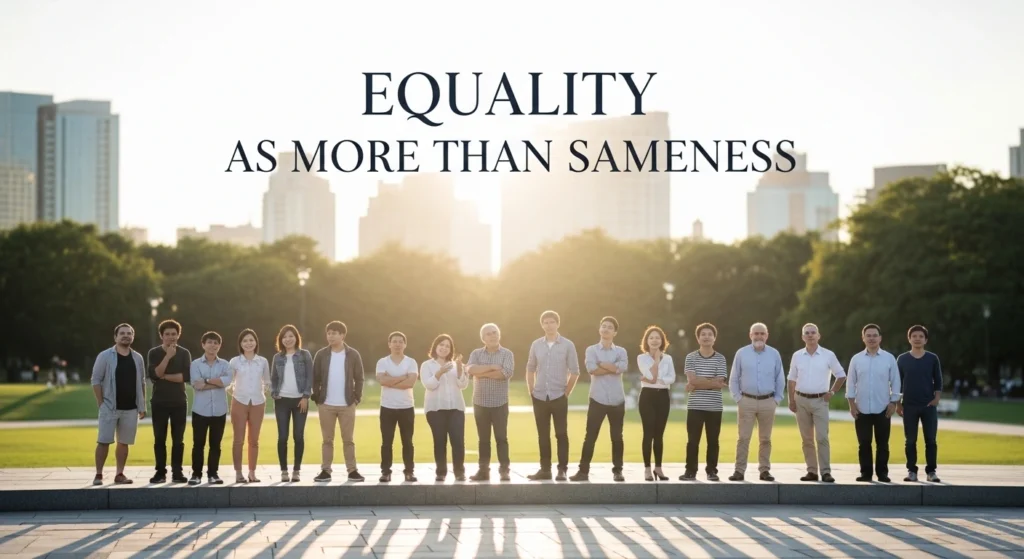
Equality does not mean everyone is identical. It means everyone deserves:
- Equal dignity
- Equal opportunity
- Equal respect
- Equal voice
Equality is not about erasing differences—it is about honoring worth.
How Metaphors Help Us Understand Fairness and Justice
Metaphors allow us to say:
- “Equality is a level playing field.”
- “Justice is a scale held steady.”
- “Fairness is sunlight shared by all.”
These images make the concept tangible.
Metaphors for Equality in Stories and Everyday Speech
We often describe equality through familiar phrases:
- “On equal footing”
- “A seat at the table”
- “Level ground”
Writers use these metaphors to show inclusion, balance, and shared humanity.
Equality as a Table With Room for Everyone
Meaning & Explanation
Equality is like a table where everyone has a seat. No one is pushed away, overlooked, or left standing outside.
This metaphor symbolizes:
- Inclusion
- Belonging
- Shared dignity
Example Sentence
“Equality is a table wide enough for every voice, where no one is denied a place.”
Alternative Ways to Express It
- “A circle that leaves no one out”
- “A feast of shared humanity”
- “A room where all belong”
Sensory or Emotional Detail
Imagine warmth, conversation, plates passed freely—an atmosphere where everyone matters.
Mini Storytelling Touch
Think of a child invited to sit with others for the first time. That moment of belonging is equality made real.
Using Table Metaphors for Inclusion
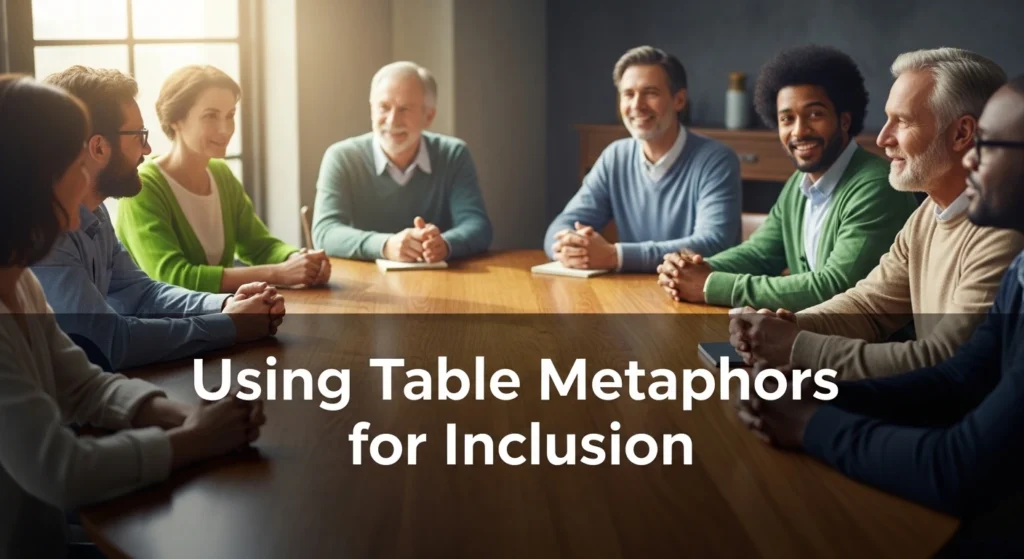
This metaphor works beautifully in social writing:
- “Everyone deserves a seat.”
- “Make the table bigger, not smaller.”
- “Belonging is the beginning of justice.”
Bonus tip: Use this metaphor when talking about community and representation.
Equality as a Scale Balanced in Harmony
Meaning & Explanation
Equality is like a scale held evenly—no side weighed down by privilege, no side lifted by unfairness.
It represents:
- Justice
- Balance
- Fair treatment
Example Sentence
“Equality is the scale of society held steady, where no life is measured as less.”
Alternative Ways to Express It
- “A balance of rights”
- “Fairness in equilibrium”
- “Justice without tilt”
Sensory or Emotional Detail
Balanced scales suggest calm steadiness, the quiet satisfaction of fairness.
Cultural Reference
Scales have long symbolized justice in courts and mythology, reminding us that equality is an ancient human aspiration.
Balance the Scale
Exercise: Imagine equality as a scale.
Ask:
- What makes the scale unbalanced in real life?
Sample Answers:
- “Unequal access to education.”
- “Discrimination based on identity.”
- “Voices being ignored or silenced.”
Example Sentence: “Equality means noticing what tilts the scale, then working to restore balance.”
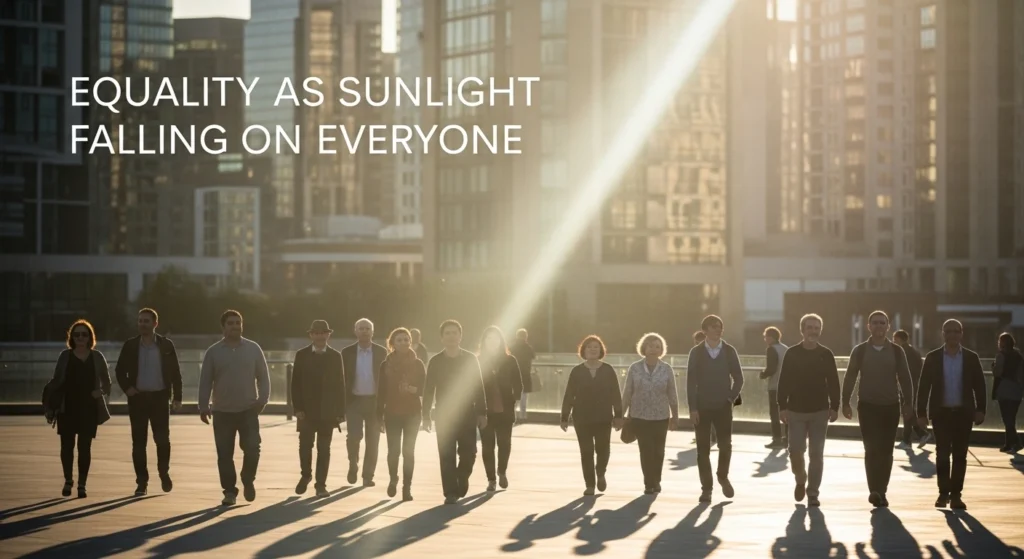
Equality as Sunlight Falling on Everyone
Meaning & Explanation
Equality is like sunlight—freely given, touching every face without choosing favorites.
It symbolizes:
- Shared worth
- Universal dignity
- Natural fairness
Example Sentence
“Equality is sunlight, meant for everyone, not just a chosen few.”
Alternative Ways to Express It
- “The same sky above all”
- “Warmth without discrimination”
- “Light that belongs to everyone”
Sensory or Emotional Detail
Sunlight feels gentle, golden, and open. Equality carries that same sense of simple rightness.
Real-Life Resonance
When fairness exists, it feels natural—like breathing, like light, like something that should never be restricted.
Metaphors for Equality in Social Justice Movements
Equality is often described as:
- “A bridge toward freedom”
- “A door opening for all”
- “A path cleared of obstacles”
Example: “Equality is the bridge that carries society into a fairer future.”
These metaphors show equality as progress and hope.
Metaphors for Equality in Relationships and Community
Equality also lives in daily interactions:
- Listening with respect
- Sharing responsibility
- Honoring each voice
Mini scenario: Two friends walking side by side, neither leading, neither trailing—that quiet companionship is equality in motion.
Create Your Own Metaphors for Equality
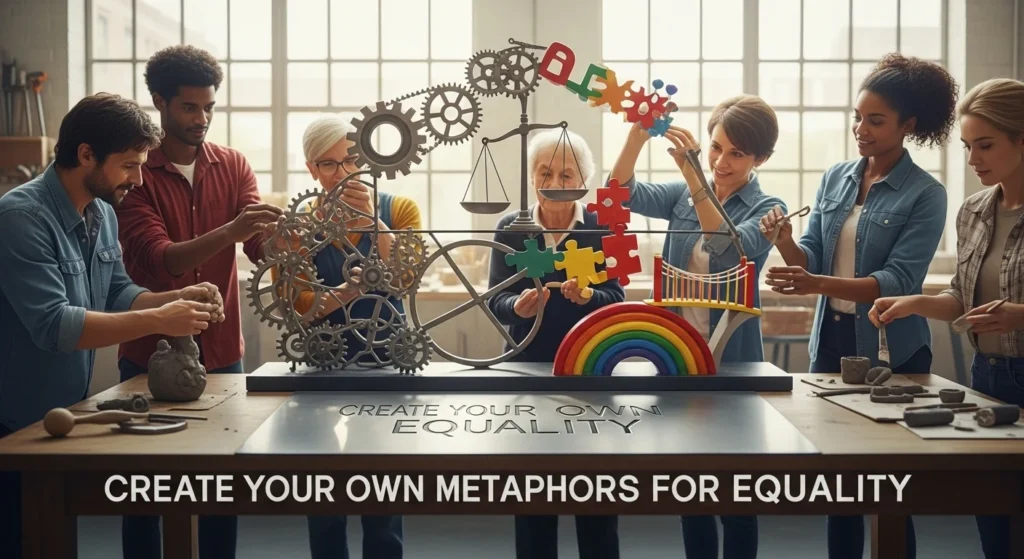
Try: Equality is like ___ because ___
Examples with answers:
- Equality is like a table because everyone deserves a seat.
- Equality is like a scale because fairness requires balance.
- Equality is like sunlight because dignity should touch all people.
Readers can now create their own metaphors with these models.
Bonus Tips for Using Equality Metaphors in Writing and Daily Life
Metaphors for equality work well in:
- Speeches
- Essays
- Captions
- Advocacy writing
Caption ideas:
- “Make room at the table.”
- “Let the sunlight reach everyone.”
- “Keep the scale balanced.”
Writing tip: Pair equality metaphors with real emotions—hope, dignity, belonging.
Equality Metaphors Across Cultures and History
Across cultures, equality has been imagined as:
- Shared ground
- Common sky
- One human family
- Balance in society
From ancient philosophy to modern movements, metaphors help people carry the dream of fairness forward.
Conclusion
Equality begins with understanding, and understanding begins with how we express ideas. Metaphors offer a powerful way to bring clarity and emotion into conversations about fairness. They simplify complex truths, connect diverse perspectives, and inspire meaningful action.
As you move forward, try to notice the metaphors you hear and use. Shape them with care. Share them with purpose. Because sometimes, a single image—a balanced scale, a shared table, a circle without edges—can shift the way someone sees the world.
FAQs
1. Why do metaphors help explain equality?
Because equality is abstract, metaphors make it easier to understand through vivid, relatable images.
2. What is a strong metaphor for inclusion?
Equality as a table with room for everyone is powerful because it symbolizes belonging.
3. Can equality metaphors be used in everyday life?
Yes. They appear in conversations, writing, and social movements to express fairness.
4. How do metaphors improve writing about justice?
They add emotional depth and imagery, helping readers feel the importance of equality.
5. How can I create my own metaphor for equality?
Think about what equality represents—balance, shared space, dignity—and compare it to something familiar and sensory.