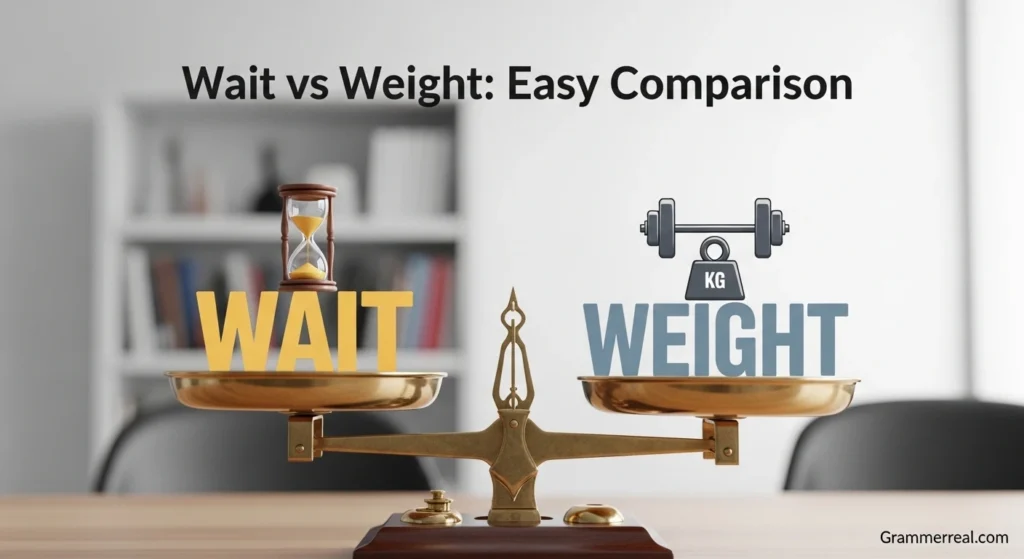
Many English learners often feel confused between wait vs weight because both words sound exactly the same. Although their pronunciation is identical, their meanings, spelling, and usage are completely different.
Therefore, using the wrong word can easily change the meaning of a sentence. This confusion appears frequently in exams, daily writing, spoken English, and online communication. Moreover, beginners usually mix these words because English contains many similar-sounding terms. In this article, we explain wait vs weight using very simple language, clear grammar rules, and easy examples. We focus on correct usage, common mistakes, and practical tips. By the end, you will confidently choose the right word every time.
Main Difference Between Wait and Weight
The main difference between wait vs weight is simple.
Wait is a verb that means to stay or pause until something happens. Weight is a noun that refers to how heavy something is.
Because one word shows an action and the other shows a measurement, context decides which one is correct.
What Does “Wait” Mean?
The word wait means to stay in one place or delay an action until something happens. People mostly use it as a verb.
Simple meaning of wait
- To stay until something happens
- To delay action
- To pause for a short or long time
Examples of wait in sentences
Correct: Please wait here for five minutes.
Correct: We wait every day for the results.
Incorrect: Please weight here for five minutes.
In all correct examples, wait shows an action.
What Does “Weight” Mean?
The word weight refers to how heavy a person or object is. It usually functions as a noun.
Simple meaning of weight
- How heavy something is
- A measurement of heaviness
Examples of weight in sentences
Correct: The weight of the box is heavy.
Correct: He checks his weight every week.
Incorrect: I cannot wait of this package.
Here, weight clearly refers to heaviness, not action.
Grammar Difference Between Wait and Weight
Grammar makes the difference very clear.
- Wait is mainly a verb.
- Weight is mainly a noun.
Sentence structure
Wait: Subject + wait + object or phrase Weight: Subject + weight + linking verb or modifier
Examples
Correct: I wait for my friend every evening. Correct: The weight of the luggage is high.
Using the correct part of speech keeps sentences clear.
Pronunciation: Why Confusion Happens
Both wait and weight sound the same in spoken English. Therefore, learners depend on spelling and context while writing. However, pronunciation alone does not help in choosing the correct word. Because of this, writers must carefully check meaning before using either word.
Contextual Examples of Wait vs Weight
Context always helps you choose the correct word.
Daily Life
Correct: Please wait outside the room. Correct: The doctor measured her weight.
School and Exams
Correct: Students wait for their results. Correct: The question asks about weight and mass.
Work and Office
Correct: We wait for the manager’s approval. Correct: The machine can carry extra weight.
In each case, meaning clearly guides word choice.
Common Mistakes and How to Avoid Them
Using weight instead of wait for actions
Incorrect: Please weight for me. Correct: Please wait for me.
Using wait instead of weight for heaviness
Incorrect: The wait of the bag is too much. Correct: The weight of the bag is too much.
Ignoring sentence meaning
Writers sometimes choose the wrong word without checking meaning. Always ask whether the sentence talks about action or heaviness.
How to Remember the Difference Easily
Use this simple trick.
- Wait contains the word “ait,” which relates to time and delay.
- Weight contains “weigh,” which relates to heaviness.
If the sentence talks about time, choose wait. If it talks about heaviness, choose weight.
Correct and Incorrect Usage Together
Correct: I will wait for the bus. Incorrect: I will weight for the bus.
Correct: The weight of the bag is five kilos. Incorrect: The wait of the bag is five kilos.
Reading such pairs improves accuracy.
Wait as a Verb in Detail
The verb wait can appear in different tenses.
- Present: I wait here.
- Past: I waited for you.
- Future: I will wait tomorrow.
Examples
Correct: She waits patiently every day. Correct: He waited for hours.
The verb form changes with tense, but meaning stays the same.
Weight as a Noun in Detail
The noun weight often appears with measurements.
Examples
Correct: The weight is ten kilograms. Correct: She gained weight last year.
It can also appear in phrases like:
- Body weight
- Heavy weight
- Light weight
American vs British English Usage
Both American and British English use wait and weight in the same way. There is no spelling or meaning difference between these varieties. Therefore, learners can safely apply the same rules everywhere.
Idiomatic and Common Expressions
Common expressions with wait
- Wait a minute
- Wait and see
- Cannot wait
Examples: Correct: I cannot wait to meet you. Correct: Wait and see what happens next.
Common expressions with weight
- Put on weight
- Lose weight
- Heavy weight
Examples: Correct: He wants to lose weight. Correct: This is a heavyweight problem.
Choosing the Right Word in Writing
Before choosing wait or weight, ask one question.
Does the sentence talk about time or action? If yes, use wait.
Does the sentence talk about heaviness or measurement? If yes, use weight.
This simple test solves most errors.
Practical Tips for Learners
- Read the sentence carefully before choosing the word.
- Identify whether it describes an action or a measurement.
- Practice writing short sentences daily.
- Review spelling during proofreading.
- Avoid guessing based on sound alone.
Regular practice makes correct usage automatic.
Grammar Rules Applied
- Correct verb tense for wait
- Correct noun usage for weight
- Proper subject–verb agreement
- Clear sentence structure
- Active voice used mostly for reminders and examples
These rules improve clarity and accuracy.
Writing Techniques Used
This article uses:
- Simple sentences for easy understanding
- Transition words like therefore, however, moreover, and because
- Clear headings and subheadings
- Repetition of key ideas without extra wording
These techniques support learning and reduce confusion.
Rewritten and Polished Explanation
In simple words, wait means to stay or delay until something happens. Weight means how heavy something is. Even though both words sound the same, their meanings are very different. Using the correct word depends on context, grammar, and sentence meaning. Careful reading and practice help avoid mistakes.
How This Practice Improves Writing
Learning wait vs weight improves writing because it:
- Reduces spelling errors
- Improves word accuracy
- Strengthens grammar understanding
- Builds confidence in exams
- Makes sentences clearer
Small corrections lead to strong writing skills.
Conclusion
In conclusion, wait vs weight may sound the same, but their meanings and usage are completely different. Wait refers to an action related to time and delay, while weight refers to heaviness or measurement. Choosing the correct word depends on context and grammar. With regular practice and careful reading, using these words correctly becomes easy and natural.
FAQs
- Are wait and weight pronounced the same?
Yes, both words have the same pronunciation. - Is wait a verb or a noun?
Wait is mainly used as a verb. - Is weight a verb or a noun?
Weight is mainly used as a noun. - Can wait describe heaviness?
No, wait only describes action or time. - Can weight describe action?
No, weight describes heaviness or measurement. - Which word is common in daily conversation?
Both are common but used in different contexts. - Are these words confusing in exams?
Yes, students often confuse them because of pronunciation. - Can I say “wait of the bag”?
No, you should say “weight of the bag.” - How can I avoid mixing them?
Focus on meaning instead of sound. - Is this rule same in British and American English?
Yes, the rule is the same in both.



