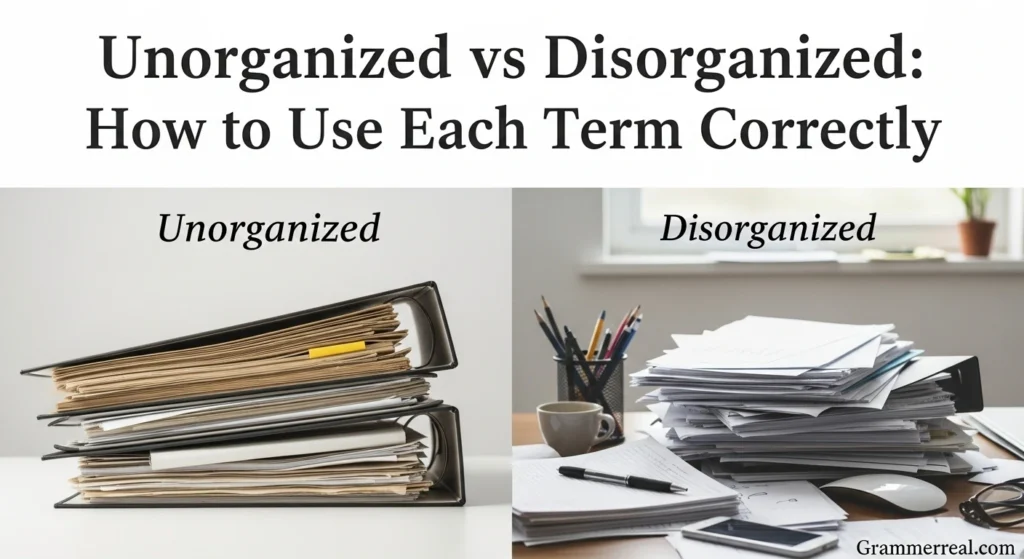
The words unorganized vs disorganized often confuse English learners and even fluent writers. Many people think these two words mean exactly the same thing, so they use them without thinking.
In some situations, they do overlap in meaning, but they are not always equal. Understanding unorganized vs disorganized helps you choose the right word for writing, speaking, and exams. It also helps you sound clearer and more precise. Both words describe a lack of order, but they often point to different causes and situations. This article explains the difference in very simple language. It uses clear grammar, easy examples, and short explanations. By the end, you will know when to use unorganized and when disorganized fits better.
Basic Meaning of Unorganized vs Disorganized
To understand unorganized vs disorganized, we first need to look at their basic meanings.
Meaning of Unorganized
Unorganized means something has no clear structure or system from the start.
- There was no plan.
- There was no order.
- Things were never arranged properly.
It often describes people, groups, or systems that never became organized.
Meaning of Disorganized
Disorganized means something was organized before but is now messy or confused.
- There was a plan before.
- The order is now broken.
- Things are mixed up or out of control.
It often suggests a change from order to disorder.
Core Difference Between Unorganized vs Disorganized
The main difference is about time and structure.
- Unorganized → no organization from the beginning
- Disorganized → organization existed but failed
This small difference changes the meaning of a sentence.
Grammar Category and Word Form
Both words belong to the same grammar category.
Part of Speech
- Unorganized → adjective
- Disorganized → adjective
They describe nouns such as people, plans, rooms, systems, or ideas.
Using Unorganized in Simple Sentences
Let us look at unorganized in context.
Examples
- The team was unorganized and had no clear leader.
- His notes were unorganized from the start.
- The event felt unorganized because no plan existed.
In these examples, order never existed.
Using Disorganized in Simple Sentences
Now look at disorganized.
Examples
- The office became disorganized after the move.
- She felt disorganized after missing several deadlines.
- The files were disorganized due to poor handling.
Here, order existed before but was lost.
Contextual Comparison Through Situations
Understanding context makes the difference clearer.
Situation 1: A New Project
- The project is unorganized because no plan was made.
- The project is disorganized because the plan failed later.
Situation 2: A Person
- He is unorganized and never plans his day.
- He is disorganized because his schedule fell apart.
Context decides the correct word.
Emotional Tone and Implied Meaning
The two words carry slightly different emotional tones.
Tone of Unorganized
- Neutral
- Describes lack of planning
- Often less blame
Tone of Disorganized
- Slightly negative
- Suggests failure or stress
- Often implies pressure
This difference matters in professional writing.
Common Mistakes With Unorganized vs Disorganized
Many learners make predictable mistakes.
Using Them as Exact Synonyms
While similar, they are not always interchangeable.
Incorrect:
- The system became unorganized after the update.
Correct:
- The system became disorganized after the update.
Ignoring Time Reference
If something never had order, unorganized fits better.
Overusing One Word
Some writers always use disorganized, even when unorganized is clearer.
American vs British English Usage
There is no major difference here.
Usage in Both Varieties
- American English uses both words.
- British English uses both words.
- Meanings remain the same.
Spelling does not change.
Formal and Informal Usage
Both words work in many settings.
Formal Writing
- The department appears disorganized after the policy change.
- The system remains unorganized due to poor planning.
Informal Speech
- I feel disorganized today.
- My desk is unorganized.
Tone depends on context, not the word itself.
Unorganized vs Disorganized in the Workplace
This difference matters in professional settings.
Unorganized Workplace
- No rules
- No system
- No planning
Example:
- The startup was unorganized in its early stage.
Disorganized Workplace
- Rules exist
- Systems exist
- Execution fails
Example:
- The office became disorganized during the merger.
Unorganized vs Disorganized for People
Both words can describe people.
Unorganized Person
- Never plans
- Avoids structure
- Works randomly
Example:
- She is unorganized and dislikes schedules.
Disorganized Person
- Tries to plan
- Feels overwhelmed
- Loses control
Example:
- He feels disorganized after a busy week.
Academic and Exam Usage
Exams often test subtle differences.
Exam Tip
- Choose unorganized for lack of structure.
- Choose disorganized for loss of structure.
Clear thinking helps avoid mistakes.
Idiomatic and Natural Usage
These words are not idioms, but they appear in fixed phrases.
Natural Phrases
- Disorganized thinking
- Unorganized effort
- Disorganized files
- Unorganized notes
Native speakers choose based on meaning.
Sentence Structure and Flow
Both words fit similar sentence patterns.
Example Structures
- Subject + verb + adjective
- Noun + adjective
Examples:
- The plan is unorganized.
- The plan became disorganized.
Verb tense helps show meaning.
Passive Voice Examples
Passive voice is also correct.
- The files were disorganized during the move.
- The team was unorganized from the start.
The meaning remains clear.
Choosing the Right Word Step by Step
Follow this simple method.
Step 1
Ask: Was there a system before?
- Yes → disorganized
- No → unorganized
Step 2
Check the time reference in the sentence.
Step 3
Read the sentence aloud for clarity.
Practical Tips for Easy Learning
Think About “Before”
Always think about what happened before the problem.
Replace the Word
Replace the word with a short explanation.
- No plan → unorganized
- Plan failed → disorganized
Practice With Real Examples
Use daily life examples like desks, schedules, or notes.
Practice Sentences
Correct Usage
- The class was unorganized because no rules were set.
- The class became disorganized after the teacher left.
Incorrect Usage
- The desk became unorganized after cleaning.
- The system was disorganized from the beginning.
Grammar Rules Applied in This Topic
This topic uses basic grammar rules.
Rules Used
- Adjective placement
- Verb tense consistency
- Clear subject–verb agreement
- Logical modifiers
These rules support clear meaning.
Writing Techniques Used in This Article
This article uses simple writing techniques.
Techniques
- Short paragraphs
- Clear headings
- Repetition for clarity
- Easy examples
These techniques help beginners learn faster.
How This Exercise Improves Writing Skills
Studying unorganized vs disorganized improves writing in many ways.
Benefits
- Better word choice
- Clear meaning
- Stronger sentences
- Better exam performance
Small distinctions create big improvement.
Real-Life Situations Where the Difference Matters
This difference appears often.
Common Situations
- School assignments
- Office reports
- Personal descriptions
- Daily conversations
Using the correct word improves communication.
Final Review of Unorganized vs Disorganized
Let us summarize clearly.
- Unorganized → no structure from the start
- Disorganized → structure existed but failed
- Both are adjectives
- Context decides meaning
Understanding this makes your English clearer.
Reflection on Grammar, Style, and Clarity
This topic shows how meaning depends on time and structure. It teaches careful verb and adjective use. It highlights how small word choices change tone. Writing with simple language improves clarity. Rewriting and reviewing sentences removes confusion. Practicing such topics builds strong grammar habits. It also improves accuracy and confidence in writing.
Conclusion
In conclusion, unorganized vs disorganized is a simple but important distinction. Both words describe disorder, but they describe different situations. Unorganized means there was no order from the beginning. Disorganized means order existed but was lost. Choosing the correct word depends on context and time. With simple thinking and practice, this difference becomes easy. Clear word choice improves writing, speaking, and understanding.
FAQs
- Are unorganized and disorganized the same?
No, they are similar but not always the same. - Which word means no planning at all?
Unorganized. - Which word suggests a loss of order?
Disorganized. - Can both words describe people?
Yes, both can describe people. - Is there a spelling difference in British English?
No, spelling stays the same. - Which word sounds more negative?
Disorganized often sounds more negative. - Can I use these words in formal writing?
Yes, both are acceptable. - Which word fits a new project with no plan?
Unorganized. - Which word fits a system that failed?
Disorganized. - How can I remember the difference easily?
Think about whether order existed before.



