Many English learners feel confused about stink vs stank vs stunk because these three words come from the same verb but are used in different situations. They all relate to bad smells, yet they do not mean exactly the same thing in every sentence.
The confusion mostly happens because English verbs change form based on time. Learners often mix present, past, and past participle forms without realizing it. Understanding stink vs stank vs stunk helps you speak and write more clearly. These words appear in daily conversations, stories, exams, and informal writing. The good news is that the rule is not difficult. Once you understand verb tenses, everything becomes clear. This article explains the difference using very simple language. It includes clear examples, common mistakes, and easy tips. By the end, you will know exactly when to use stink, stank, and stunk with confidence.
Understanding the Basic Difference Between Stink vs Stank vs Stunk
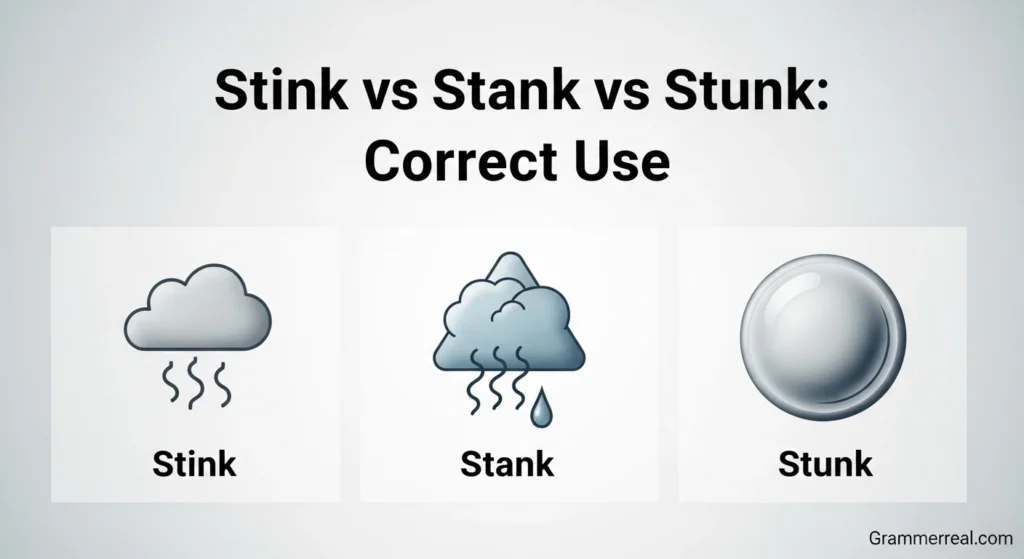
The main difference between stink vs stank vs stunk depends on verb tense. All three forms come from the verb to stink, which means to have a bad smell or to be very unpleasant.
Stink is the present tense. Stank is the past tense. Stunk is the past participle.
This simple idea solves most confusion.
What Does “Stink” Mean?
The word stink is the present tense form of the verb. It is used when talking about something that smells bad now or usually smells bad.
Uses of “stink”
- Talking about current smells
- Talking about habits or general truths
- Talking about ongoing situations
Examples of “stink”
This room stinks. Your shoes stink after the game. Garbage stinks if it stays too long.
In these sentences, the smell exists now or happens regularly.
Subject-verb agreement with “stink”
I stink You stink They stink He stinks She stinks
Always add -s with singular third-person subjects.
What Does “Stank” Mean?
The word stank is the simple past tense form of stink. It is used when the bad smell happened in the past and is finished.
Uses of “stank”
- Talking about past events
- Describing completed situations
- Telling stories
Examples of “stank”
The kitchen stank yesterday. His clothes stank after the trip. The water stank because it was dirty.
The smell happened in the past, not now.
Time expressions often used with “stank”
Yesterday Last night Earlier Last week
Example: The room stank last night.
What Does “Stunk” Mean?
The word stunk is the past participle form of stink. It is not used alone. It works with helping verbs like has, have, or had.
Uses of “stunk”
- Present perfect tense
- Past perfect tense
- Passive constructions
Examples of “stunk”
The food has stunk all day. The place had stunk for weeks. The trash has stunk since morning.
Here, stunk works with a helping verb.
Helping verbs used with “stunk”
Has Have Had
Without a helping verb, stunk is incorrect.
Simple Timeline for Stink vs Stank vs Stunk
Understanding time makes everything easier.
Present: stink Past: stank Past participle: stunk
Examples:
It stinks today. It stank yesterday. All week it has stunk.
Stink vs Stank vs Stunk in Sentences
Seeing the words together helps understanding.
Now, the milk stinks. Last night, the milk stank. Since yesterday, the milk has stunk .
Each form matches a different time.
Common Mistakes With Stink vs Stank vs Stunk
Many learners make similar mistakes when using these words.
Using “stank” with a helping verb
Incorrect: It has stank all day.
Correct: It has stunk all day.
Using “stunk” as simple past
Incorrect: The room stunk yesterday.
Correct: The room stank yesterday.
Using “stink” for past events
Incorrect: The trash stinks last night.
Correct: The trash stank last night.
Stink vs Stank vs Stunk in Questions
Questions follow the same tense rules.
Examples:
Does it stink in here? Did it stank yesterday? (Incorrect) Did it stink yesterday? (Correct) Has it stunk all week?
Use the base form after did.
Negative Sentences With Stink vs Stank vs Stunk
Negatives also follow tense rules.
Present: It does not stink.
Past: It did not stink.
Perfect: It has not stunk.
Do not change the main verb after did not.
Active and Passive Voice Examples
Active voice is more common.
The garbage stinks. The garbage stank yesterday.
Passive voice is rare but possible.
The room was stunk up by trash.
Active voice sounds clearer and more natural.
Stink vs Stank vs Stunk in Everyday Conversation
These words appear often in casual speech.
Examples:
This place stinks. Your socks stank yesterday. The fridge has stunk all week.
They are common in spoken English.
American vs British English Usage
There is no major difference between American and British English for stink vs stank vs stunk.
Both varieties use:
Stink as present Stank as past Stunk as past participle
The rules stay the same.
Idiomatic and Natural Expressions
The verb stink is also used in idioms.
Common expressions with “stink”
This deal stinks. The idea stinks.
Meaning: something is very bad.
Informal expressions
That test stank. The movie stunk.
These expressions describe poor quality, not smell.
Stink vs Stank vs Stunk in Formal and Informal Writing
Formal writing may avoid strong words, but usage stays correct.
Formal: The area stank due to waste.
Informal: This place stinks.
Both forms follow grammar rules.
Grammar Rules Applied
Understanding grammar improves accuracy.
Verb tense
Present: stink Past: stank Past participle: stunk
Helping verbs
Use has, have, or had with stunk.
Subject-verb agreement
He stinks They stink
Correct agreement keeps sentences clear.
Writing Techniques Used
Clear grammar improves writing quality.
Short sentences explain rules. Examples show real usage. Simple words reduce confusion. Logical order improves flow.
These techniques make learning easier.
Practical Tips to Remember Stink vs Stank vs Stunk
Here are easy tips.
Think about time first. For now, use stink. For the past, use stank. Use stunk with has or had. Read sentences aloud. Practice with daily examples.
Practice makes the rule automatic.
Rewritten and Polished Explanation (Clear and Simple)
To explain again in the simplest way, stink vs stank vs stunk are different verb forms of the same word. Stink is used for the present. Stank is used for the past. Stunk is used with helping verbs to show completed actions. The difference depends on time, not meaning. Using the correct form makes sentences sound natural. With regular practice, these forms become easy to use.
Why This Practice Improves Writing
Learning verb forms improves writing skills.
It strengthens grammar accuracy, reduces tense errors. It improves sentence clarity, builds confidence and it supports correct verb usage.
Small grammar rules make writing stronger.
Conclusion
In conclusion, understanding stink vs stank vs stunk is simple once verb tense is clear. For the present, use stink. For the past, use stank. Use stunk with helping verbs like has or had. All three forms describe bad smells or unpleasant situations, but they belong to different times. Paying attention to tense improves clarity and correctness. With practice, correct usage becomes natural in both writing and speaking.
FAQs
- Should I say “it stink” or “it stinks”?
Use “it stinks.” - Is “stank” a real word?
Yes, it is the past tense of stink. - Can I say “it has stank”?
No, use “it has stunk.” - Is “stunk” used alone?
No, it needs a helping verb. - Is “the room stunk yesterday” correct?
No, say “the room stank yesterday.” - Do American and British English use these words differently?
No, the rules are the same. - Can “stink” describe bad ideas?
Yes, informally it can. - Is “stinked” ever correct?
No, stinked is incorrect. - Which form is used with “did”?
Use the base form: stink. - What is the easiest way to remember the rule?
Remember: present stink, past stank, perfect stunk.