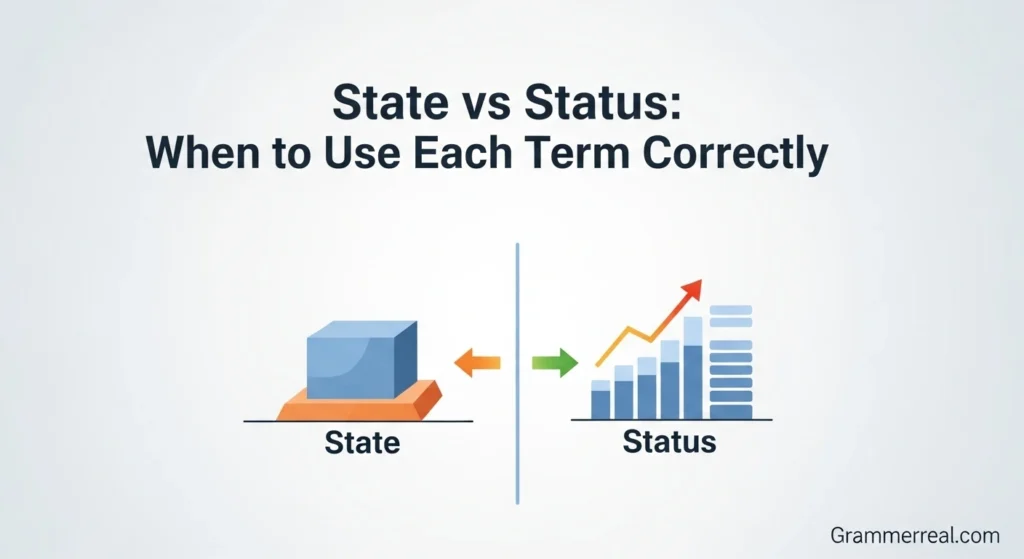
Many people get confused between the words “state” and “status.” This confusion happens because both words talk about a condition or situation, and they are sometimes used in similar contexts. However, they do not mean the same thing, and using the wrong word can make writing unclear or incorrect.
In this article, we will explain the difference between state and status in simple language. You will learn what each word means, how to use them correctly, and what mistakes to avoid. We will also look at examples, idiomatic expressions, American and British English usage, and practical tips. By the end, you will clearly understand when to use state and when to use status, which will improve your writing and communication.
What Does “State” Mean?
The word state refers to a condition or situation at a specific time. It often describes how something is right now. A state can change easily and does not always last long.
Examples of “state”:
- She was in a happy state after hearing the news.
- The computer is in sleep state.
- Water changes its state when it freezes.
- The country is in a state of emergency.
In all these examples, state describes a temporary condition or situation.
What Does “Status” Mean?
The word status refers to a position, rank, or condition that is officially recognized. It usually lasts longer than a state and is often defined by rules, systems, or society.
Examples of “status”:
- His employment status is full-time.
- Her marital status is single.
- The order status is pending.
- She has permanent resident status.
Here, status describes a fixed or recognized position.
Key Difference Between State vs Status
The main difference between state vs status is simple:
- State describes how something is at a moment.
- Status describes what position something has.
Think of it this way:
- State = condition
- Status = position or label
This small difference helps you choose the correct word.
State vs Status in Daily Use
In everyday language, both words are common, but they are used in different situations.
Correct usage:
- He is in a tired state.
- His job status is temporary.
Incorrect usage:
- He is in a tired status.
- What is your marriage state?
Using the correct word makes the sentence sound natural and clear.
Common Mistakes With State vs Status
Many learners make similar mistakes when using these words.
Mistake 1: Using “status” for feelings
- Incorrect: She is in a sad status.
- Correct: She is in a sad state.
Feelings and emotions are states, not statuses.
Mistake 2: Using “state” for official labels
- Incorrect: What is your relationship state?
- Correct: What is your relationship status?
Relationship categories are recognized labels, so status is correct.
Mistake 3: Mixing both words in formal writing
In forms, reports, or applications, confusing state vs status can make writing look careless. Always check the meaning before choosing the word.
State vs Status in Technology
Technology uses these words very clearly.
“State” in technology:
- active state
- idle state
- logged-in state
A state shows how a system behaves at a moment.
“Status” in technology:
- system status
- network status
- delivery status
A status shows reported information or progress.
State vs Status in Law and Official Use
In legal or official language, correct usage is very important.
Examples of “state”:
- state of residence
- state of emergency
These describe conditions or situations.
Examples of “status”:
- immigration status
- citizenship status
- marital status
These describe legal or social positions.
Idiomatic Expressions With State and Status
Some common expressions use these words naturally.
Idioms with “state”:
- state of mind
- state of affairs
- in a state
These focus on condition or situation.
Idioms with “status”:
- status quo
- status symbol
These focus on rank, position, or social standing.
American vs British English
There is no major difference between American and British English when using state vs status. Both varieties use the words in the same way and with the same meanings.
Only pronunciation may slightly change, but spelling and usage remain the same.
Practical Tips to Remember State vs Status
Here are some easy tips:
- Use state for feelings, conditions, or temporary situations.
- Use status for rank, labels, or official positions.
- Ask yourself: Is this a condition or a position?
- Remember common phrases like state of mind and marital status.
- Practice with examples to build confidence.
Grammar Rules Applied
- Nouns: Both state and status are nouns.
- Articles: Use “a” or “the” correctly (a state, the status).
- Prepositions:
- in a state
- have a status
- Subject-verb agreement is kept consistent in all examples.
Clear grammar helps meaning stay accurate.
Why This Practice Improves Writing
Learning the difference between state vs status improves writing in many ways:
- It reduces confusion
- It improves clarity
- It avoids common errors
- It builds confidence
- It makes writing sound professional
Simple word choices lead to stronger communication.
Conclusion
In conclusion, state vs status is a common source of confusion, but the difference is easy to understand. A state describes a condition at a moment, while a status describes a recognized position or label. States often change, but statuses usually last longer. Using the correct word improves clarity and accuracy in both speaking and writing. With practice and attention, choosing between state and status becomes natural and effortless.
FAQs
1. Can state and status mean the same thing?
No, they are related but not the same.
2. Is emotional condition a state or status?
It is a state.
3. Is job position a state or status?
It is a status.
4. Can technology systems have both?
Yes, they have internal states and reported statuses.
5. Is “relationship status” correct?
Yes, it is correct.
6. Is “state of mind” correct?
Yes, it is a common expression.
7. Are these words different in British English?
No, usage is the same.
8. Why do people confuse them?
Because both describe conditions.
9. Can a state change faster than a status?
Yes, states change more easily.
10. What is the easiest way to remember the difference?
State = condition, Status = position.



