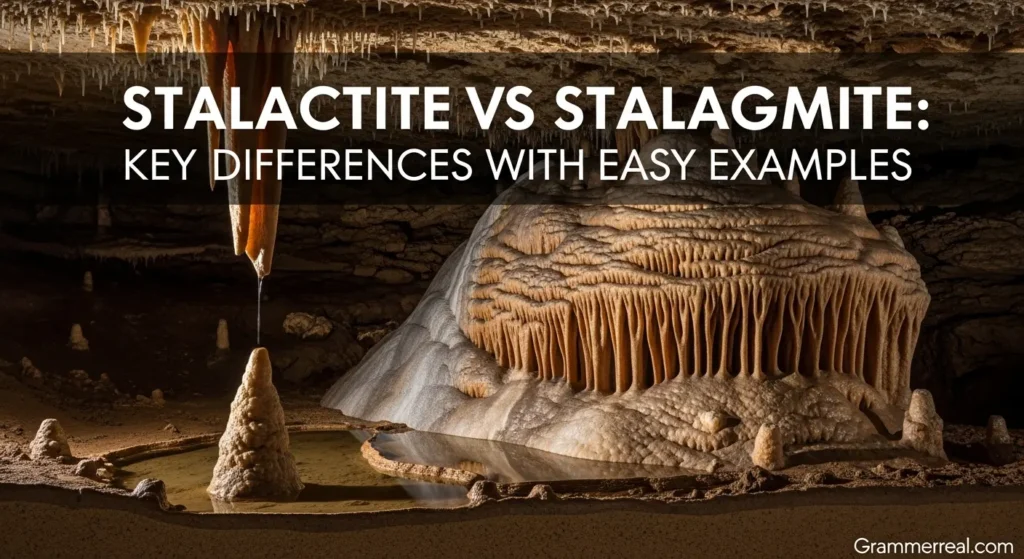
The topic Stalactite vs stalagmite often confuses students, readers, and even adults who learned these words long ago. These two words look similar, sound similar, and appear together in books, exams, and science lessons. Because of this, many people mix them up or forget which one is which. Both terms describe natural rock formations found in caves, but they grow in different directions and form in different places.
Understanding Stalactite vs stalagmite is important for clear writing, correct spelling, and basic science knowledge. This topic also helps improve memory skills and attention to detail. The confusion usually happens because both words come from similar roots and are learned at the same time. With clear explanations and simple examples, the difference becomes easy to remember. In this article, we will explain Stalactite vs stalagmite using very simple language and clear structure. Each section focuses on one idea to make learning easy and comfortable.
What Is a Stalactite?
A stalactite is a rock formation that hangs from the ceiling of a cave. It grows downward, pointing toward the floor. Stalactites form very slowly over many years.
They are created when water drips from the cave ceiling. This water contains minerals, usually calcium carbonate. When the water drips and evaporates, it leaves behind small mineral deposits. Over time, these deposits build up and form a stalactite.
Simple Definition of Stalactite
- A stalactite hangs from the top of a cave
- It grows downward
- It forms from dripping water
Examples of Stalactite in Sentences
- The stalactite hung from the cave ceiling.
- Water dripped slowly from the stalactite.
- The guide pointed to a large stalactite above us.
In each sentence, the stalactite is above and hanging down.
What Is a Stalagmite?
A stalagmite is a rock formation that rises from the floor of a cave. It grows upward, pointing toward the ceiling. Like stalactites, stalagmites form very slowly.
Stalagmites form when mineral-rich water drips onto the cave floor. When the water hits the ground and evaporates, it leaves minerals behind. Over time, these minerals build up and form a mound that grows upward.
Simple Definition of Stalagmite
- A stalagmite grows from the ground
- It grows upward
- It forms from dripping water hitting the floor
Examples of Stalagmite in Sentences
- A tall stalagmite rose from the cave floor.
- The stalagmite looked like a stone tower.
- Water drops helped the stalagmite grow.
In each sentence, the stalagmite starts from the bottom.
Why Stalactite vs Stalagmite Is Confusing
The confusion between Stalactite vs stalagmite is very common. Several reasons explain why people mix them up.
Main Reasons for Confusion
- The words look similar
- The words sound similar
- Both appear in caves
- Both form from dripping water
- Both are learned together
Because of these similarities, the brain often mixes them up. However, their direction of growth is the key difference.
Stalactite vs Stalagmite: The Key Difference
The easiest way to understand Stalactite vs stalagmite is to focus on where they grow.
Simple Comparison in Words
- Stalactite: grows from the ceiling down
- Stalagmite: grows from the floor up
This single idea helps most learners remember the difference.
Easy Memory Tricks for Stalactite vs Stalagmite
The memory tricks make learning easier and faster.
Memory Trick for Stalactite
- Stalactite has a T
- Think T for Top
- Stalactites come from the top
Memory Trick for Stalagmite
- Stalagmite has an M
- Think M for Mountain
- Stalagmites rise like mountains
These simple tricks work well for exams and daily use.
How Stalactites Form
Stalactites form through a slow natural process.
Formation Process
- Water enters the cave through cracks
- The water carries minerals
- Water drips from the ceiling
- Minerals stay behind
- The stalactite grows longer
This process can take hundreds or even thousands of years.
Important Points
- Growth is very slow
- Only a small amount grows each year
- Touching can damage growth
How Stalagmites Form
Stalagmites also form slowly and naturally.
Formation Process
- Water drips from the ceiling
- Water hits the cave floor
- Minerals remain after evaporation
- Layers build up
- The stalagmite grows taller
Stalagmites often form directly under stalactites.
Can Stalactites and Stalagmites Meet?
Yes, they can meet over time. When a stalactite grows down and a stalagmite grows up, they may connect.
When this happens, the formation is called a column or pillar. This process takes a very long time.
Example Sentence
- The stalactite and stalagmite formed a single column.
Stalactite vs Stalagmite in Science Classes
In science lessons, Stalactite vs stalagmite is often taught in earth science or geology.
Students are expected to:
- Know the definitions
- Understand formation
- Use the correct spelling
- Identify them in pictures
Clear understanding helps with tests and projects.
Common Mistakes with Stalactite vs Stalagmite
Many learners make similar mistakes.
Mistake 1: Mixing the Direction
Incorrect:
- A stalagmite hangs from the ceiling.
Correct:
- A stalactite hangs from the ceiling.
Mistake 2: Using the Wrong Word in Writing
Incorrect:
- The stalactite grew from the cave floor.
Correct:
- The stalagmite grew from the cave floor.
Mistake 3: Guessing Instead of Remembering
Guessing often leads to errors. Memory tricks help avoid this.
Sentence Examples for Practice
Correct Examples
- The stalactite pointed down from the ceiling.
- The stalagmite rose from the ground.
- Water dripped between the stalactite and stalagmite.
- The cave had many stalactites above us.
Incorrect Examples
- The stalagmite hung from the ceiling.
- The stalactite grew from the floor.
Practice improves accuracy.
Stalactite vs Stalagmite in American and British English
There is no difference between American and British English for these words.
- Spelling is the same
- Meaning is the same
- Usage is the same
Examples
American English:
- The cave has many stalactites and stalagmites.
British English:
- The cave has many stalactites and stalagmites.
Both forms follow the same rules.
Are There Idiomatic Expressions with These Words?
Unlike many English words, stalactite and stalagmite are not commonly used in idiomatic expressions. They are mainly scientific terms.
However, they are sometimes used in descriptive writing.
Descriptive Example
- Ice hung like stalactites from the roof.
This usage compares ice to cave formations.
Using Stalactite and Stalagmite in Writing
When using these words in writing, clarity matters.
Writing Tips
- Focus on direction
- Use clear descriptions
- Avoid long, confusing sentences
- Use examples if needed
Clear writing helps readers understand easily.
Practical Tips to Remember Stalactite vs Stalagmite
Here are easy tips you can use anytime.
Think of Direction
- Ceiling = stalactite
- Floor = stalagmite
Use Letters
- T in stalactite = top
- M in stalagmite = mountain
Picture It
Visual images help memory stay strong.
Why Learning This Difference Matters
Understanding Stalactite vs stalagmite helps in many ways.
- Improves science knowledge
- Helps with exams
- Improves spelling
- Builds confidence
- Reduces confusion
Small details matter in clear communication.
Reflection on Grammar Rules and Writing Techniques
This topic shows the importance of precision in language. Clear subject-verb agreement keeps sentences accurate. Consistent verb tense helps ideas flow smoothly. Articles and prepositions are used carefully to avoid confusion. Short sentences improve readability, while longer sentences explain processes clearly. Repetition is controlled to reinforce learning without boredom. Headings organize ideas and guide the reader. Simple vocabulary makes the content easy to understand. Practicing topics like Stalactite vs stalagmite improves clarity, memory, and writing accuracy.
Conclusion
In conclusion, Stalactite vs stalagmite is a common but simple topic to master. A stalactite hangs from the cave ceiling and grows downward. A stalagmite rises from the cave floor and grows upward. Both form slowly from dripping water and mineral deposits. The key difference is their position and direction of growth. Simple memory tricks make the difference easy to remember. With practice, these words become clear and natural to use.
FAQs
- What is the main difference between stalactite vs stalagmite?
A stalactite hangs from the ceiling. A stalagmite grows from the floor. - Which one grows downward?
A stalactite grows downward. - Which one grows upward?
A stalagmite grows upward. - Do they form in the same place?
Yes, both form in caves. - Can they join together?
Yes, they can form a column over time. - Are these words used differently in British English?
No, they are the same in both forms of English. - Are stalactites and stalagmites alive?
No, they are rock formations. - How long do they take to form?
They take hundreds or thousands of years. - What causes them to grow?
Mineral-rich dripping water causes growth. - How can I remember the difference easily?
Remember: stalactite from the top, stalagmite from the bottom.



