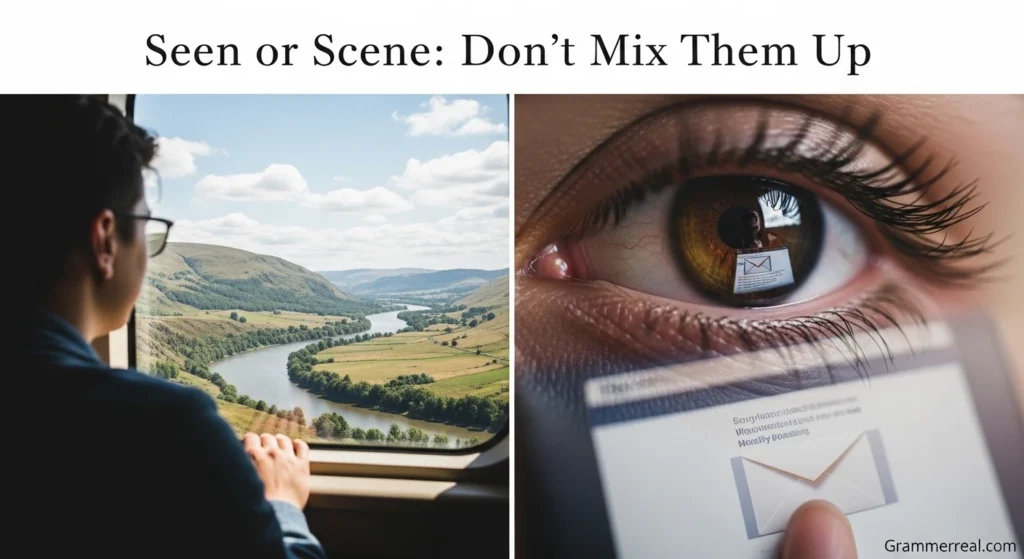
Many English learners feel confused about seen vs scene because both words look similar and sound almost the same. When two words have similar pronunciation but different meanings, students often mix them in writing. However, these two words are very different in meaning and grammar. One word is a verb form, and the other word is a noun. Therefore, it is important to understand the difference clearly. In this article, you will learn the meaning, grammar, and correct usage of seen and scene in very simple language. You will also read many easy examples. By the end, you will not confuse seen vs scene again.
The Basic Difference Between Seen and Scene
The difference is simple.
Seen is a verb form. Scene is a noun.
Seen comes from the verb “see.” Scene refers to a place, view, or part of a movie or story.
Although they sound similar, their spelling and meaning are different.
Meaning of Seen
The word seen is the past participle of the verb “see.”
Here are the forms of the verb see:
Present: see Past: saw Past participle: seen
We use seen with helping verbs like have, has, or had.
Examples:
I have seen that movie. She has seen the doctor. They had seen the accident before.
In these sentences, seen shows an action that happened in the past.
Important Rule About Seen
You cannot use seen alone as the main verb in a simple past sentence.
Wrong: I seen the movie yesterday. Correct: I saw the movie yesterday.
Wrong: She seen the dog. Correct: She saw the dog.
Remember this rule carefully. Seen needs a helping verb like have, has, or had.
Correct examples:
I have seen the movie. She has seen the dog. We had seen the problem before.
This rule is very important in exams.
Meaning of Scene
The word scene is a noun. It has different meanings.
First meaning: a part of a movie, play, or show. Second meaning: a view or place. Third meaning: a situation with strong emotion or drama.
Let us understand each meaning with simple examples.
Scene as Part of a Movie or Play
In movies and plays, a scene is a short part of the story.
Examples:
That scene in the movie was very funny. I liked the last scene of the film. The action scene was exciting.
Here, scene refers to a part of a story.
Scene as a View or Place
Scene can also describe what you see in a place.
Examples:
The mountain scene is beautiful. The beach scene looks peaceful. The accident scene was crowded.
In these examples, scene describes a location or view.
Scene as a Dramatic Situation
Sometimes scene describes an emotional or dramatic situation.
Examples:
She made a scene at the party. Please do not create a scene. He caused a scene in the store.
Here, scene means public drama or strong emotional behavior.
Easy Comparison Examples
Let us compare both words in simple sentences.
Correct use of seen: I have seen this movie before. She has seen that place.
Correct use of scene: That scene was very sad. The beach scene is beautiful.
Now look at common mistakes.
Incorrect: I have scene that movie. Correct: I have seen that movie.
Incorrect: That seen was funny. Correct: That scene was funny.
Spelling changes the meaning completely.
How to Choose the Correct Word
Ask yourself a simple question.
Are you talking about seeing something? If yes, use seen.
Are you talking about a place, view, or part of a movie? If yes, use scene.
This small question helps you choose correctly.
Short Practice Story
Let us read a short story to understand better.
Last night, I watched a movie. I have seen it before, but I wanted to watch it again. My favorite scene is the final one. In that scene, the hero saves his friend. I have seen many movies, but that scene is still special for me.
In this story, seen is a verb form, and scene is a noun.
Common Student Mistakes
First mistake: Using scene instead of seen Wrong: I have scene that show. Right: I have seen that show.
Second mistake: Using seen instead of scene Wrong: The last seen was emotional. Right: The last scene was emotional.
Third mistake: Using seen without helping verb Wrong: I seen him yesterday. Right: I saw him yesterday.
Understanding these mistakes helps you avoid them.
Easy Memory Trick
Here is a simple trick.
Seen has two e’s next to each other. Think of the word see inside it. Seen comes from see.
Scene has “ce” in the middle. You can think of “cinema” because both words start with “c.” Scene is often related to movies.
This small memory trick makes it easier to remember.
Why This Difference Is Important
Correct spelling shows good grammar skills. Small mistakes can change meaning and reduce marks in exams. Therefore, learning the difference between seen vs scene improves your writing and speaking. Practice helps you remember the rule clearly.
Quick Summary
Seen = past participle of see Scene = noun (part of movie, view, or situation)
Seen needs a helping verb like have, has, or had. Scene names a thing or situation.
If you follow this rule, you will not make mistakes.
Conclusion
In conclusion, the difference between seen vs scene is clear when you understand their grammar and meaning. Seen is the past participle of the verb see and must be used with helping verbs. Scene is a noun that describes a part of a movie, a view, or a dramatic situation. Even though both words sound similar, their spelling and usage are different. By focusing on the meaning of your sentence and using simple grammar rules, you can easily choose the correct word. With practice, you will never confuse seen and scene again.
FAQs
1. What is the main difference between seen and scene?
Seen is a verb form, while scene is a noun.
2. Can I say “I seen him yesterday”?
No, you should say “I saw him yesterday.”
3. When do we use seen?
We use seen with helping verbs like have, has, or had.
4. What does scene mean in movies?
Scene means a short part of a movie or play.
5. Is scene ever a verb?
No, scene is always a noun.
6. Can I write “I have scene that movie”?
No, the correct sentence is “I have seen that movie.”
7. What is the past tense of see?
The past tense of see is saw.
8. What is the past participle of see?
The past participle of see is seen.
9. What does “make a scene” mean?
It means to create drama or strong emotion in public.
10. How can I remember the difference easily?
Remember that seen comes from see, and scene is often related to cinema.



