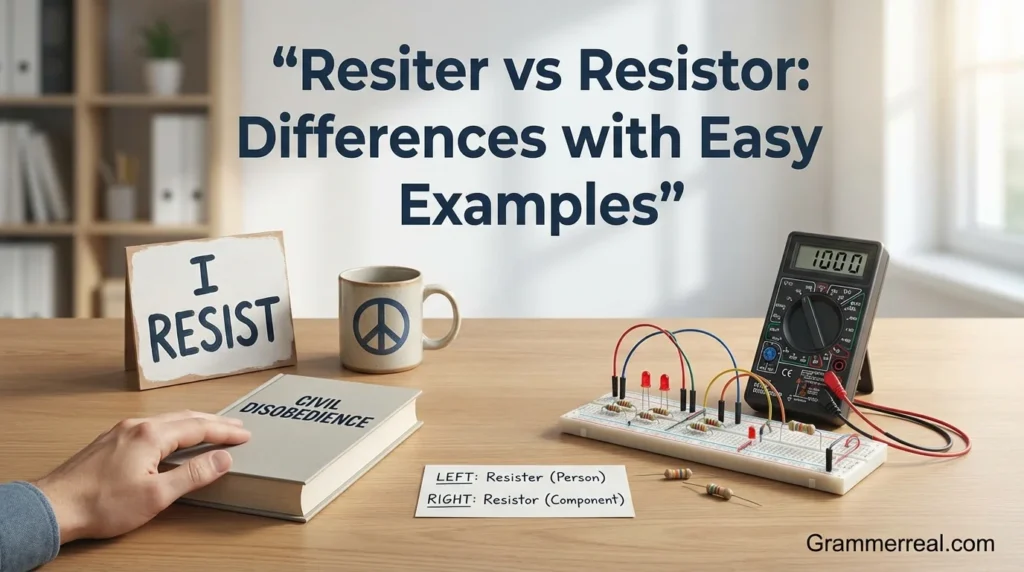
Many people confuse resister and resistor because they look almost the same and sound nearly the same. Yet these two words have different meanings and appear in different situations. When a reader sees them on the page, the difference becomes clear, but when a listener hears them in speech, a mistake can easily appear.
The phrase resister vs resistor often shows up in technical writing, classroom work, or editing tasks. While one word relates to a person who refuses something, the other refers to an electrical part that controls the flow of current. Knowing the difference helps a student, writer, or professional avoid errors in essays, reports, and conversations. These words also reveal how small spelling changes can change meaning. The idea of resister vs resistor also gives a useful lesson about prefixes, suffixes, and word formation in English. In the following sections, we will explore meaning, history, modern use, examples, grammar notes, and mistakes to avoid in a simple and clear way.
Meaning of “resister”
A resister is a person who resists something. The verb resist means to oppose, fight against, or push back. A resister may resist pressure, orders, rules, or ideas. This word often appears in political, social, or historical writing, especially in discussions about movements, protests, or civil action. But it can also appear in small personal situations, such as a child resisting homework.
Examples:
- “She was a resister during the conflict.”
- “He became a resister to unfair working conditions.”
- “The group described themselves as resisters of censorship.”
The tone of the word is neutral, but context may make it sound strong or heroic.
Meaning of “resistor”
A resistor is a small electrical component used to reduce or control electric current in a circuit. A resistor has a resistance value, often measured in ohms, and appears in electronics, science classes, and engineering work. It is a common part in computers, radios, toys, instruments, and many other devices.
Examples:
- “The engineer installed a resistor to protect the circuit.”
- “The board includes ten resistors with different values.”
- “Without the right resistor, the device may overheat.”
The tone is technical and specific, and it does not describe a person.
Origins and history
Resister comes from the verb resist, which traces back to Latin roots meaning “to stand against.” This form has existed for centuries and has appeared in writing about politics, military resistance, and social change.
Resistor is a more modern word tied to the age of electricity. It formed from the same verb resist, but with a technical sense that refers to electrical resistance. It is widely used in scientific and engineering fields, especially since the spread of electronics in the twentieth century.
Literal vs figurative uses
Resister can be used both literally and figuratively.
Literal:
- “The resister refused to follow orders.”
Figurative:
- “She was a resister of bad habits.”
Resistor is typically literal and rarely figurative, because it refers to a physical part. Figurative uses are uncommon and usually playful or creative.
Context and sentence examples
To show the difference more clearly, here are short pairs with similar sentence structure:
- “The resister stood up to the new policy.”
- “The resistor controlled the current in the circuit.”
- “The group of resisters refused to compromise.”
- “The technician replaced several resistors on the board.”
- “The teacher asked about resisters in history.”
- “The teacher asked about resistors in electronics.”
Context alone guides meaning.
Tone and connotation
Resister can carry emotional tone. It may suggest bravery, stubbornness, or determination depending on context. Writers often use it when describing political dissent or moral conscience.
Resistor is tone-neutral because it is a technical object. It simply names a part needed for function and design.
Common mistakes
Because the words differ by only one letter, spelling mistakes are common in student papers and online content. Some writers mistakenly believe resister is a misspelling of resistor, or vice versa.
Common errors include:
- Using resistor when writing about a protest
- Using resister when writing about electronics
- Assuming one form is always correct in all contexts
- Confusing spoken references when clarity is needed
A good rule: if a human is involved, it is likely resister. If electricity is involved, it is resistor.
Grammar and usage notes
Both words are nouns. Both form plurals with -s:
- resisters
- resistors
Neither takes irregular plural forms. Both can take articles or determiners:
- a resister, the resister, several resisters
- a resistor, the resistor, several resistors
Adjectives may clarify meaning:
- political resister
- environmental resister
- fixed resistor
- variable resistor
Neither noun commonly functions as a verb.
American vs. British English
In this case, American and British English use the same spelling for both words. There is no dialect split like that seen in words such as “color vs colour.” However, the contexts may differ slightly. British historical writing may use resister more often in discussions of wartime resistance movements, while American writing may use it in labor or civil rights topics. In technical fields, resistor appears globally in the same way.
Similar expressions and related words
Words related to resister:
- opponent
- protester
- dissenter
- rebel
- objector
Words related to resistor:
- capacitor
- transistor
- diode
- inductor
- conductor
These related lists reinforce the different semantic fields of social action vs technical parts.
When to avoid each term
Avoid resister when discussing physics, circuits, or electronics. It will confuse readers.
Avoid resistor when referring to humans, social groups, or political subjects. It may sound humorous or insulting if used wrongly.
Practical tips for remembering the difference
Simple memory aids help with clarity.
- Resistor has “tor,” like “motor.” Motors belong in machines, and so do resistors.
- Resister has “ter,” like “fighter.” Fighters are people, and so are resisters.
- When in doubt, ask: Is this about electricity or people?
These small tricks help prevent spelling mistakes in essays and assignments.
Examples in short dialogues
A: “What are those small parts on the board?” B: “Those are resistors that limit current.”
A: “Why did the workers protest?” B: “They were resisters of unfair rules.”
Cultural and modern relevance
The word resister may appear in the news during protests, strikes, or political disputes. It often signals agency or moral choice. It can show both unity and conflict.
The word resistor remains central in modern technology. As devices become smaller, resistors also shrink, yet remain essential for stable function. They support computers, communication tools, and everyday machines.
The modern world uses both words, but for very different reasons.
Conclusion
The comparison of resister vs resistor shows how close spelling can hide wide meaning differences. A resister is a person who resists, while a resistor is a part that resists electrical current. One belongs to human action and politics, while the other belongs to engineering and design. Knowing which form to choose helps a writer avoid confusion and keeps reading smooth and clear.
FAQs
1. Are “resister” and “resistor” the same word?
No. They are different words with different meanings and uses.
2. Which word refers to a person?
The word resister refers to a person who resists something.
3. Which word refers to an electrical component?
The word resistor refers to a part in an electrical circuit that controls current.
4. Do both words come from the same root?
Yes. Both words come from the verb “resist,” but they developed into different nouns.
5. Is one spelling more common than the other?
Yes. Resistor is very common in technical writing, while resister appears mainly in political, social, or historical contexts.
6. Do British and American spellings differ?
No. Both British and American English use the same spelling for both words.
7. Can the word “resister” be used figuratively?
Yes. It can describe someone resisting ideas, habits, pressure, or trends in a figurative way.
8. Can the word “resistor” be used figuratively?
It can be used figuratively, but such uses are rare and usually humorous or creative.
9. What is the plural form of “resistor”?
The plural form is resistors.
10. What is the plural form of “resister”?
The plural form is resisters.



