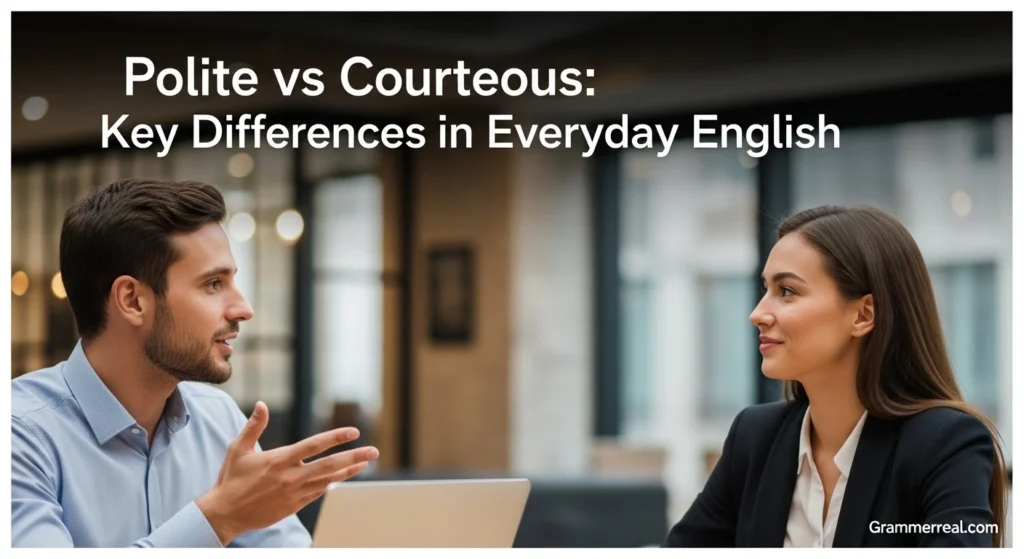
The words polite vs courteous often appear together, and many learners think they mean exactly the same thing. In daily speech, people sometimes use them as if there is no difference at all.
However, when you look more closely, you can see small but important differences between polite and courteous. Understanding polite vs courteous helps you speak and write more clearly. It also helps you choose the right word for the right situation. Both words relate to good behavior, respect, and manners, but they focus on slightly different ideas. This article explains the difference using very simple language. It gives clear examples, easy grammar, and practical tips so you can remember the difference easily.
Basic Meaning of Polite vs Courteous
To understand polite vs courteous, we should start with their basic meanings.
Meaning of Polite
Polite means showing good manners in speech and behavior.
- Saying “please” and “thank you”
- Speaking respectfully
- Following social rules
Politeness often focuses on words and actions.
Meaning of Courteous
Courteous means showing respect, care, and consideration for others.
- Thinking about other people’s feelings
- Acting kindly and thoughtfully
- Being respectful even without rules
Courtesy often focuses on attitude and intention.
Core Difference Between Polite vs Courteous
The main difference is simple.
- Polite → good manners and correct behavior
- Courteous → thoughtful and respectful behavior
A person can be polite without being warm. A courteous person often goes a step further.
Grammar Category and Word Form
Both words share the same grammar role.
Part of Speech
- Polite → adjective
- Courteous → adjective
They describe people, actions, speech, or behavior.
Using Polite in Simple Sentences
Let us look at polite in easy sentences.
Examples
- She is polite to her teachers.
- He gave a polite reply to the email.
- The child spoke in a polite way.
In these examples, the focus is on correct behavior and manners.
Using Courteous in Simple Sentences
Now look at courteous.
Examples
- The staff was courteous to the guests.
- He made a courteous gesture by holding the door.
- She gave a courteous response during the meeting.
Here, the focus is on kindness and respect.
Polite vs Courteous in Real Situations
Context makes the difference clearer.
Situation 1: Speaking to a Stranger
- A polite person says hello and uses respectful words.
- A courteous person also listens carefully and shows patience.
Situation 2: Customer Service
- A polite worker follows rules and speaks nicely.
- A courteous worker goes out of the way to help.
Both are good, but courteous behavior feels warmer.
Emotional Tone of Polite vs Courteous
The emotional tone of these words is different.
Tone of Polite
- Neutral
- Correct
- Rule-based
Politeness does not always show emotion.
Tone of Courteous
- Warm
- Kind
- Thoughtful
Courtesy often feels more personal.
Polite vs Courteous in Professional Settings
In offices and workplaces, both words matter.
Polite Behavior at Work
- Using respectful language
- Following company rules
- Avoiding rude words
Example:
- He wrote a polite email to his manager.
Courteous Behavior at Work
- Helping colleagues
- Respecting time and space
- Showing understanding
Example:
- She was courteous by covering a shift for a coworker.
Polite vs Courteous in Social Life
In social settings, the difference becomes clearer.
Polite Social Behavior
- Greeting people
- Saying thank you
- Using polite expressions
Courteous Social Behavior
- Offering help
- Respecting personal space
- Being patient
Courtesy often builds stronger relationships.
Polite vs Courteous in Writing
Both words appear in formal and informal writing.
Polite in Writing
- Polite requests
- Polite replies
- Polite tone
Example:
- Please let me know if you need more information.
Courteous in Writing
- Courteous tone
- Courteous language
- Courteous closing
Example:
- Thank you for your time and consideration.
Common Mistakes With Polite vs Courteous
Many learners confuse these words.
Treating Them as Exact Synonyms
They overlap, but they are not identical.
Incorrect:
- He was polite and kind in a deep way.
Better:
- He was courteous and kind.
Overusing Polite
Some people use polite for every situation, even when courteous fits better.
Ignoring Context
Context decides which word sounds more natural.
American vs British English Usage
There is no strong difference here.
Usage in Both Varieties
- American English uses both words.
- British English uses both words.
- Meanings remain the same.
Both are common and accepted.
Polite vs Courteous in Daily Speech
In everyday talk, people often prefer polite.
Daily Examples
- He is polite to everyone.
- Please be polite.
Courteous sounds slightly more formal and thoughtful.
Idiomatic and Natural Expressions
These words are not strong idioms, but they appear in common phrases.
Polite Expressions
- Polite request
- Polite answer
- Polite society
Courteous Expressions
- Courteous service
- Courteous manner
- Courteous behavior
Native speakers choose based on tone.
Sentence Structure and Grammar Use
Both words follow similar sentence patterns.
Examples
- Subject + verb + adjective
- Adjective + noun
Examples:
- She is polite.
- He gave a courteous reply.
Verb tense stays consistent.
Passive Voice Examples
Passive voice also works well.
- The guests were treated politely.
- The visitors were greeted in a courteous manner.
Meaning remains clear.
Polite vs Courteous for Describing People
These words describe personality and behavior.
Polite Person
- Follows rules
- Uses respectful words
- Avoids rude behavior
Courteous Person
- Thinks about others
- Acts kindly
- Shows respect naturally
A courteous person is often polite, but not always the opposite.
Polite vs Courteous in Customer Relations
This area shows the difference clearly.
Polite Service
- Saying welcome
- Speaking nicely
- Following policy
Courteous Service
- Helping patiently
- Solving problems
- Showing care
Customers often remember courtesy more.
Polite vs Courteous in Conflict Situations
Both words matter during disagreement.
Polite During Conflict
- Avoids rude words
- Maintains calm speech
Courteous During Conflict
- Listens carefully
- Respects opinions
- Responds thoughtfully
Courtesy helps reduce tension.
Choosing Between Polite vs Courteous
Use this simple method.
Step 1
Ask: Is the focus on manners or care?
- Manners → polite
- Care → courteous
Step 2
Think about the tone.
- Neutral → polite
- Warm → courteous
Step 3
Read the sentence again.
Choose the word that sounds natural.
Practical Tips for Easy Learning
Think About Feeling
If the action shows feeling, choose courteous.
Think About Rules
If the action follows rules, choose polite.
Practice With Daily Life
Observe people in real situations.
Practice Sentences
Correct Usage
- She gave a polite greeting to the guests.
- He showed courteous behavior during the delay.
Incorrect Usage
- He was courteous by saying please only.
- She was polite by helping without being asked.
Grammar Rules Applied in This Topic
This topic follows simple grammar rules.
Rules Used
- Correct adjective placement
- Clear verb tense
- Proper subject–verb agreement
- Logical modifiers
These rules support clarity.
Writing Techniques Used in This Article
This article uses basic techniques.
Techniques
- Short sentences
- Clear headings
- Repetition for memory
- Simple vocabulary
These help learners understand easily.
How This Exercise Improves Writing Skills
Learning polite vs courteous improves writing.
Benefits
- Better word choice
- Clear tone
- Stronger sentences
- Better communication
Small differences matter in good writing.
Cultural Aspect of Polite vs Courteous
Different cultures value these traits.
Cultural View
- Politeness follows social rules.
- Courtesy reflects personal values.
Both are important in global communication.
Review of Polite vs Courteous
Let us review simply.
- Polite → good manners
- Courteous → thoughtful respect
- Both describe good behavior
- Context decides usage
Understanding this improves clarity.
Reflection on Grammar, Style, and Clarity
This topic shows how words with similar meanings can differ. It teaches careful word choice. It improves awareness of tone and context. Simple grammar rules help express meaning clearly. Writing and rewriting improve clarity and confidence. Practicing such topics strengthens language skills.
Conclusion
In conclusion, polite vs courteous is an important comparison in English. Both words describe respectful behavior, but they focus on different ideas. Polite relates to manners and correct behavior. Courteous relates to kindness and consideration. A polite person follows rules, while a courteous person thinks about others. Knowing the difference helps you speak and write more clearly. With simple practice, choosing the right word becomes easy.
FAQs
- Are polite and courteous the same?
No, they are similar but not exactly the same. - Which word focuses on manners?
Polite. - Which word focuses on kindness?
Courteous. - Can a person be both polite and courteous?
Yes, often people are both. - Which word sounds warmer?
Courteous. - Is courteous more formal than polite?
It often sounds slightly more formal. - Can both words describe service?
Yes, both are common in service settings. - Is there a difference in British English?
No, meanings stay the same. - Which word fits a rule-based situation?
Polite. - Which word fits a thoughtful action?
Courteous.