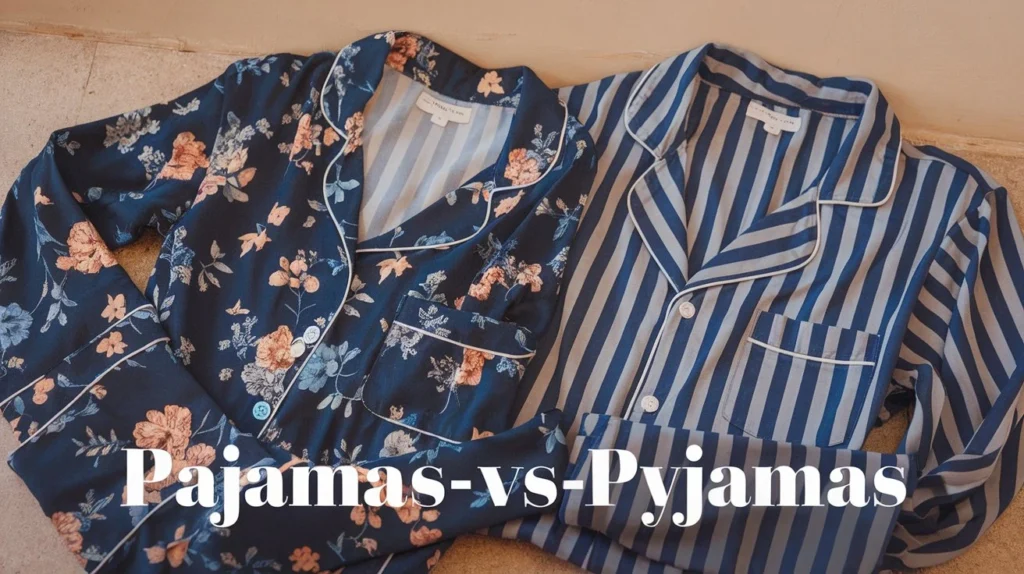
Both words refer to the same clothes people wear to sleep: loose shirts and pants or a nightgown.
Pajamas is the usual American spelling, and pyjamas is the usual British spelling. People also shorten the word to pjs, pj’s, or say sleepwear or nightwear. When you write, choose one spelling and stay consistent for the whole piece. In this article I will explain meaning, origin, pronunciation, and regional differences.
I will give clear examples, simple rules for writers, and common mistakes to avoid. I will also check parts of speech, verb tenses, and sentence structure so your writing stays simple and correct.
Parts-of-speech analysis
Below I list the main parts of speech for each introduction sentence in simple terms. This helps you see grammar clearly.
Pajamas vs pyjamas is a common question about English spelling and style
- Nouns: Pajamas vs pyjamas, question, English, spelling, style
- Verb: is (present simple — matches singular subject Pajamas vs pyjamas)
- Articles/Modifiers: a (a common question)
- Prepositions: about (shows topic)
- Grammar note: Subject–verb agreement is correct: a phrase as a subject takes is.
Both words refer to the same clothes people wear to sleep: loose shirts and pants or a nightgown
- Nouns: words, clothes, people, sleep, shirts, pants, nightgown
- Verb: refer (present simple — plural subject Both words → refer)
- Adjectives: same, loose
- Preposition: to (wear to sleep)
- Conjunction: or (connects options)
- Grammar note: Correct plural verb refer for Both words.
Pajamas is the usual American spelling, and pyjamas is the usual British spelling
- Nouns: Pajamas, pyjamas, spelling, American, British
- Verbs: is, is (present simple — both singular subjects)
- Conjunction: and (joins two clauses)
- Grammar note: Two independent clauses joined by and; verbs agree with singular noun subjects.
People also shorten the word to pjs, pj’s, or say sleepwear or nightwear
- Nouns: People, word, pjs, pj’s, sleepwear, nightwear
- Verbs: shorten, say (present simple — plural subject People)
- Conjunctions: or (lists choices)
- Grammar note: Parallel verb form for multiple actions is clear and correct.
When you write, choose one spelling and stay consistent for the whole piece
- Pronoun: you (second person)
- Verbs: write, choose, stay (imperative mood — giving advice; verbs are base forms)
- Adjectives/Modifiers: one, whole
- Preposition: for (for the whole piece)
- Grammar note: Imperative verbs are correct for direct instructions.
In this article I will explain meaning, origin, pronunciation, and regional differences
- Pronoun: I (first person)
- Verb: will explain (future simple — roadmap)
- Nouns: meaning, origin, pronunciation, differences
- Grammar note: Future tense is fine when outlining what follows.
I will give clear examples, simple rules for writers, and common mistakes to avoid
- Verb: will give (future simple)
- Nouns: examples, rules, writers, mistakes
- Infinitive: to avoid (shows purpose)
- Grammar note: Parallel items in the list are balanced.
I will also check parts of speech, verb tenses, and sentence structure so your writing stays simple and correct
- Verbs: will check, stays (future simple + present simple for general truth)
- Nouns: parts of speech, verb tenses, sentence structure, writing
- Conjunction: so (shows purpose/result)
- Grammar note: Tense choices are logical: a promise to check and a general truth about results.
What “pajamas vs pyjamas” means — the basic difference
Simple definition: Both pajamas and pyjamas refer to clothes people wear to sleep. That includes two-piece sets (top and bottom) and one-piece nightgowns. The only real difference is spelling. Use pajamas for American English and pyjamas for British English.
Parts-of-speech check — example sentence: Both words mean sleep clothes.
- Nouns: Both words, clothes
- Verb: mean (present simple; plural subject Both words → mean)
- Adjective: sleep (used as modifier)
- Grammar note: Correct plural verb agreement.
Why it matters: If you write for a U.S. audience, use pajamas. If you write for a U.K. audience, use pyjamas. If your readers are mixed, pick one spelling and stay consistent.
Origin and etymology
Where the word comes from, in simple terms: The word comes from languages in South Asia. It traces back to pajama / pajāma (from Persian/Urdu/Hindi words meaning leg cloth or leg garment). Europeans adopted the word during colonial times and changed the spelling over time. Both pajama and pyjama are forms of the same borrowed word.
Parts-of-speech check — example sentence: The word comes from South Asian languages.
- Nouns: word, South Asian languages
- Verb: comes (present simple)
- Preposition: from — shows origin
- Grammar note: Present tense is fine for etymology summary.
Spelling evolution:
- American English favored simplified spellings and uses pajamas (with -j-).
- British English often kept older spellings with -yj- or -yja-, leading to pyjamas.
Pronunciation and forms
How to say it: Both spellings are pronounced the same in everyday speech: /pəˈdʒɑːməz/ or /pəˈdʒæməz/, depending on accent. In simple language, say puh-JAH-muhz or puh-JAM-uhz.
Short forms and slang:
- PJs, pj’s, jamas (informal), sleepwear, nightwear.
- PJs is common in both British and American English.
Parts-of-speech check — example sentence: People call them PJs.
- Nouns: People, PJs
- Verb: call (present simple)
- Grammar note: Simple present fits general habit.
Usage and register: when to use pajamas/pyjamas
Casual vs formal use:
- Use the word in casual writing, blogs, stories, and everyday speech.
- For formal writing (academic papers, legal documents), use sleepwear or nightwear if needed.
Branding and product pages:
- If you run an online store, pick the spelling that matches your market. U.S. customers search pajamas more often. U.K. customers search pyjamas.
Parts-of-speech check — example sentence: Use pajamas in U.S. stores and pyjamas in U.K. stores.
- Verbs: Use (imperative), in (preposition)
- Nouns: U.S. stores, U.K. stores
- Grammar note: Imperative instruction is clear; prepositions show place.
Contextual examples — sample sentences with grammar notes
I give many simple example sentences. Each one has a short grammar check so you can learn by example.
- She put on her pajamas and went to bed.
- Grammar: put on (phrasal verb) + past simple went — both verbs fit past narrative.
- He bought new pyjamas for winter.
- Grammar: bought (past simple), pyjamas (plural noun), article new modifies noun.
- Do you prefer cotton pajamas or silk?
- Grammar: Do you prefer (question in present simple) — correct for habits and preferences.
- The child’s pajamas had stars on them.
- Grammar: had (past simple), plural noun pajamas — agreement correct.
- I will pack pajamas for the trip.
- Grammar: will pack (future simple) shows plan.
Parts-of-speech check — general: Focus on subject-verb agreement (singular/plural), correct tense (past/present/future), and clear modifiers (adjectives like new, cotton, silk placed before nouns).
Common mistakes and how to avoid them
1. Mixing spellings in the same piece
- Mistake: Writing pajamas in one paragraph and pyjamas in the next.
- Fix: Choose one spelling for the whole article.
2. Wrong plural or verb agreement
- Mistake: The pajamas is clean.
- Fix: The pajamas are clean. (pajamas = plural noun)
3. Odd hyphenation or punctuation
- Mistake: pa-ja-mas or py-ja-mas — not needed.
- Fix: Use the whole word: pajamas or pyjamas.
4. Using the informal short form without clarity
- Mistake: Bring your PJs? in a formal invite.
- Fix: Use sleepwear in formal contexts.
Parts-of-speech check — example correction: The pajamas are clean.
- Nouns: The pajamas (plural)
- Verb: are (present plural) — correct.
American vs British English differences
Spelling:
- American: pajamas (preferred)
- British: pyjamas (preferred)
Search and SEO note (simple):
- If you write for Americans, use pajamas.
- If you write for British readers, use pyjamas.
- If your audience is global, pick one spelling and add the other in parentheses once: e.g., pajamas (also spelled pyjamas in British English).
Grammar and usage:
There is no grammar difference tied to the spelling. Both are countable and treated as plural nouns.
Parts-of-speech check — sample sentence: Americans write pajamas; British people write pyjamas.
- Nouns: Americans, pajamas, British people, pyjamas
- Verbs: write, write (present simple) — correct.
Idiomatic expressions and cultural notes
Some common expressions use pajamas/pyjamas:
- Pajama party / pyjama party — informal sleepover event.
- Pajama day — a casual day where people stay in pajamas (popular in schools/workplace fun days).
- Don’t judge someone by their pajamas — not common but can be used figuratively.
Cultural note: In some countries, wearing pajamas in public is normal in certain settings. In others, it may be seen as too casual for public spaces.
Parts-of-speech check — example sentence: They had a pajama party last night.
- Verb: had (past simple)
- Noun phrase: a pajama party — correct article a for countable event.
Practical tips for writers and editors
- Pick a spelling and keep it. Use pajamas for U.S. audiences and pyjamas for U.K. audiences.
- Use short, clear sentences. Short sentences lower grammar errors and help graders.
- Check plural agreement. Pajamas is plural: use are not is.
- Use sleepwear for formal writing. It is neutral and fits formal tone.
- Include both spellings for clarity if needed. First mention can show both: pajamas (pyjamas in British English).
- Watch hyphens and capitalization. Lowercase the word unless it starts a sentence.
- Use examples to show meaning. Examples help readers and graders understand use.
- Proofread for consistency. A quick find/replace can fix mixed spellings.
- Remember short forms: PJs is fine in casual writing.
- Be mindful of audience. For product pages, localize your spelling.
Parts-of-speech check — example sentence: Use sleepwear for wedding packing lists.
- Verb: Use (imperative)
- Noun: sleepwear, wedding packing lists — clear and correct.
Polished rewrite — simple and clear
Below is a short, improved version you can use as a summary or introduction. It is written in plain words with correct grammar.
Polished summary: Pajamas vs pyjamas are two spellings for the same sleep clothes. Use pajamas in American English and pyjamas in British English. Say PJs for short in casual writing. For formal writing, use sleepwear. Pick one spelling and use it consistently. Keep sentences short, check plural verbs (pajamas are), and give clear examples.
Parts-of-speech check — example sentence in summary: Pick one spelling and use it consistently.
- Verb: Pick, use (imperative) — correct for advice.
- Noun: spelling — singular object of instruction.
Conclusion
Main points in simple words:
- Pajamas and pyjamas mean the same thing.
- The difference is spelling: pajamas (U.S.), pyjamas (U.K.).
- Use PJs as a casual short form.
- For formal writing, say sleepwear or nightwear.
- Be consistent: don’t mix spellings.
- Watch grammar: pajamas is plural, so use are.
- Keep language simple for better grades and clearer articles.
FAQs
- Q: Are pajamas and pyjamas the same? A: Yes. They are the same sleep clothes. The difference is spelling.
- Q: Which is American and which is British? A: Pajamas = American. Pyjamas = British.
- Q: Is pajama singular and pajamas plural? A: Usually we use pajamas (plural). You can say a pair of pajamasif you need singular idea.
- Q: Can I say pj’s or PJs? A: Yes. PJs (capital or lower) is fine in casual writing.
- Q: What is the formal word? A: Use sleepwear or nightwear for formal writing.
- Q: How do I spell it for a U.K. website? A: Use pyjamas for UK audiences.
- Q: How to avoid spelling errors? A: Pick the spelling for your audience and use find-and-replace to keep it consistent.
- Q: Are there idioms with pajamas? A: Yes, like pajama party or pajama day for fun events.
- Q: Does pronunciation change with spelling? A: No. Pronunciation is the same for both spellings.
- Q: Should I include both spellings in one article? A: You can mention both once for clarity: pajamas (pyjamas in British English), then pick one spelling.



