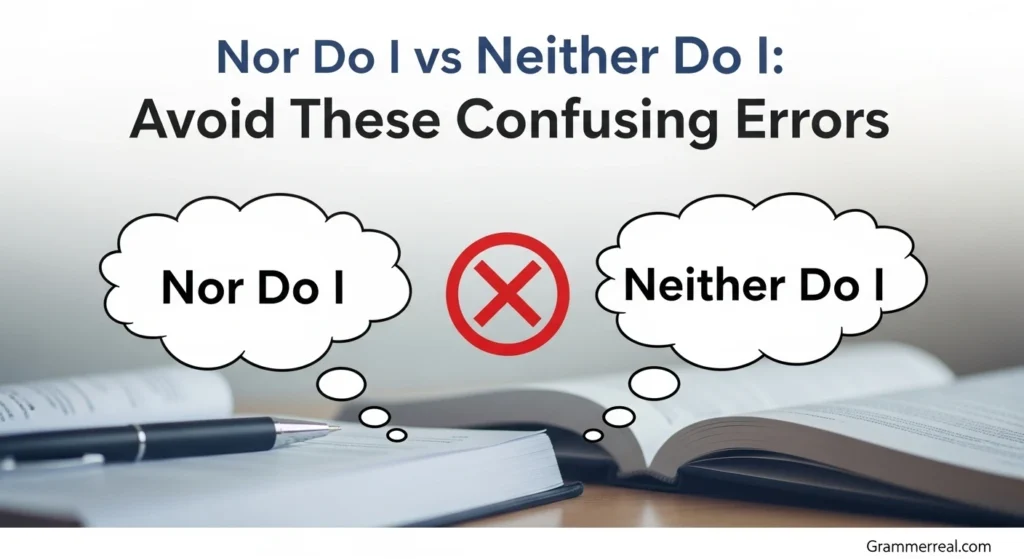
Many English learners wonder about the difference between nor do I and neither do I. Both expressions appear in everyday conversation and formal writing. They sound similar and share the same basic idea, but they follow different grammar patterns.
When spoken quickly, the two phrases may seem interchangeable, but context and structure affect how they are used. Understanding nor do I vs neither do I helps learners avoid confusion and sound natural in English. These expressions also connect with subject-verb agreement and negative statements. Learning how to use them clearly improves communication. The choice depends on formality, sentence style, and personal preference.
What Does “Nor Do I vs Neither Do I” Mean?
Both expressions show agreement with a negative statement. When someone says they do not like something or do not do something, another speaker may respond by using nor do I or neither do I to show the same idea.
Examples:
Speaker A: I do not drink coffee. Speaker B: Nor do I. Speaker B: Neither do I.
In both cases, the second speaker agrees with the negative idea.
When to Use “Nor Do I”
Nor do I is used after a negative statement or sentence. It fits well in formal speech and writing. Nor sounds slightly more formal than neither in modern English. Nor connects two negative ideas.
Examples:
- I do not eat meat, nor do I cook it.
- He cannot drive, nor do I.
- She does not swim, nor do I.
Nor do I can appear after a full sentence or as a short response.
Expanded example:
Speaker A: I do not enjoy loud music. Speaker B: Nor do I.
Nor keeps the negative idea going smoothly.
When to Use “Neither Do I”
Neither do I is more common in everyday conversation. It works well after negative statements. Neither can stand alone or connect two parts of speech. In spoken English, neither do I sounds natural and friendly.
Examples:
- I do not play soccer. Neither do I.
- He cannot speak French. Neither do I.
- She does not like cold weather. Neither do I.
Both nor do I and neither do I show agreement, but neither has a softer tone.
Grammar Structure
Both forms rely on inversion, which means the auxiliary verb comes before the subject. The structure matches other agreement phrases like so do I, so can we, and so does he. The inversion makes the sentence sound correct and balanced.
Structural pattern:
Negative statement + Nor/Neither + Auxiliary + Subject
Example:
I cannot sing. Nor can I. I cannot sing. Neither can I.
Using inversion is important because English grammar avoids double negatives. If a learner tries to say “I cannot sing, and I cannot too,” the structure sounds wrong.
Contextual Examples of Correct Usage
Formal Writing
- I do not support the plan, nor do I support the budget.
- The report did not show progress, nor did it offer solutions.
Informal Conversation
- I do not like spicy food. Neither do I.
- I do not stay up late. Neither do I.
Short Responses
- I do not agree. Nor do I.
- I do not agree. Neither do I.
These examples show how tone and formality can change the choice.
American vs British English
Both American and British English use nor do I and neither do I. However, neither do I is more common in everyday conversation in both regions. Nor do I may appear more often in writing, journalism, or speeches.
Examples:
American English:
- I do not want dessert. Neither do I.
British English:
- I do not support the idea. Nor do I.
Both varieties understand both expressions clearly.
Common Mistakes with “Nor Do I vs Neither Do I”
Skipping inversion
Learners sometimes skip inversion and say:
Incorrect: I do not dance. Neither I do. Correct: I do not dance. Neither do I.
Using double negatives
English avoids sentences like:
Incorrect: I do not dance and nor I do not. Correct: I do not dance, nor do I.
Using neither after positive statements
Neither and nor follow negative ideas. Using them after positive statements confuses meaning.
Incorrect: I like chocolate. Neither do I. Correct: I do not like chocolate. Neither do I.
Confusing nor with or
Nor and or do not mean the same thing. Or offers choices. Nor continues negatives.
Example:
Choice: You can choose tea or coffee. Negative: I do not drink tea, nor do I drink coffee.
Idiomatic and Natural Usage
Natural examples:
- I do not enjoy sightseeing alone. Neither do I.
- I do not visit crowded places. Nor do I.
- He cannot understand the instructions. Neither can I.
- She does not travel much. Nor does he.
These expressions appear often in polite conversation and shared opinions.
Practical Tips to Remember the Correct Form
Think about formality
Nor do I → formal Neither do I → informal or neutral
Think about inversion
Do/Can/Will + Subject
Think about agreement
Both forms agree with negative statements
Choose based on audience
For everyday talk, neither do I feels natural
Stay consistent
Do not mix nor and neither in the same short response
Sentence Examples for Practice
Formal Usage (Nor Do I)
- I cannot attend the event, nor do I wish to.
- She does not watch movies, nor does she read novels.
- They do not own a car, nor do they rent one.
Neutral Usage (Neither Do I)
- I do not like coffee. Neither do I.
- He cannot drive. Neither can I.
- She does not travel often. Neither does he.
Short Agreement Responses
- Nor do I.
- Neither do I.
Why Using the Correct Form Matters
Using the correct form helps speakers sound natural and polite. It also helps listeners understand agreement clearly. In conversation, responding to negative statements with correct grammar improves fluency. In writing, using nor do I and neither do I shows control of grammar and tone.
Conclusion
In conclusion, nor do I and neither do I both show agreement with negative ideas. The difference lies in tone and formality. Nor do I sounds formal and appears often in writing. Neither do I sounds natural in everyday speech. Both follow the same structure and share the same basic meaning. By paying attention to form and context, learners can sound accurate and clear in communication.
FAQs
Is nor do I correct?
Yes, especially in formal settings.
Is neither do I correct?
Yes, in both formal and informal settings.
Do both forms mean the same thing?
Yes, they show agreement with a negative statement.
Which form is more common in speech?
Neither do I.
Which form is more common in writing?
Nor do I.
Do they follow inversion?
Yes, the auxiliary comes before the subject.
Can I use them after positive sentences?
No, they follow negative ideas.
Are they used in America and Britain?
Yes, in both.
Do they sound polite?
Yes, both are polite.
How do I choose the right form?
Think about tone, formality, and context.



