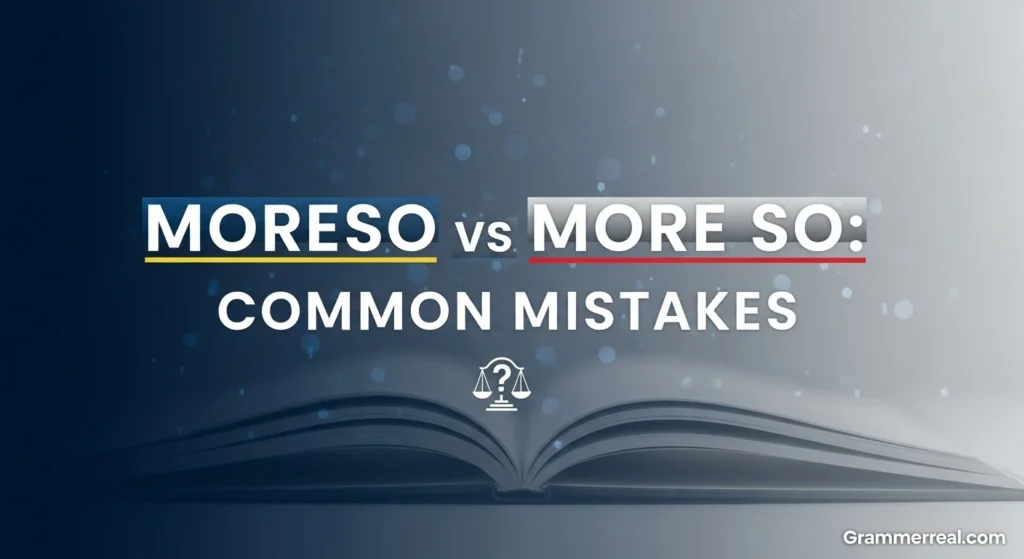
Many people feel confused about the words moreso and more so. They look almost the same, sound the same when spoken, and appear in similar sentences. Because of this, writers often wonder whether both forms are correct or if one is better than the other.
This confusion is very common in student writing, emails, and everyday English. Understanding the difference between moreso or more so helps you write more clearly and correctly. It also helps your sentences sound more natural to native readers. In simple terms, one form is widely accepted as standard, while the other is debated and often discouraged in formal writing. This article explains the difference in very clear and simple language. You will see meanings, examples, common mistakes, and practical tips. By the end, you will know exactly which form to use and why.
What Does “More So” Mean?
The phrase more so is an adverbial expression. It means to a greater degree or to a higher extent. It is used to add emphasis or to compare one thing with another.
Simple meaning of “more so”
- to a greater extent
- especially
- even more
Examples of “more so” in sentences
- She likes coffee, but she likes tea more so.
- He was tired, and more so after working late.
- The job is stressful, more so during busy seasons.
In all these sentences, more so adds emphasis and comparison. It shows that something is true to a greater degree.
What Does “Moreso” Mean?
The word moreso is often seen in writing, but it is more controversial. Some dictionaries list it as an adverb, while others treat it as informal or nonstandard. Many teachers and editors still prefer more so as two words.
Important point about “moreso”
- It is often considered informal
- It appears more in casual writing
- It is less accepted in academic or formal writing
Example of “moreso”
- She was angry, moreso after the argument.
While this sentence may look acceptable, many grammar guides suggest writing more so instead.
Moreso or More So: Which One Is Correct?
When comparing moreso or more so, the safest and most widely accepted choice is more so.
- More so → standard and preferred
- Moreso → debated and often discouraged
In school, exams, and formal writing, more so is the correct option. Using moreso may be marked wrong by teachers or editors.
Why “More So” Is Preferred
The phrase more so follows normal English structure. The word more works as an adverb that modifies so. Keeping them separate makes the meaning clear.
English often keeps similar expressions as two words, such as:
- more often
- more clearly
- more easily
In the same way, more so fits naturally into English grammar.
Common Contexts for “More So”
The phrase more so appears in many common situations.
Comparison
- This book is interesting, more so than the last one.
Emphasis
- He was nervous, more so before the interview.
Clarification
- The rule applies to everyone, more so to beginners.
These uses are clear and natural.
Common Mistakes With Moreso or More So
Many writers make small but important mistakes when using these words.
Mistake 1: Using “moreso” in formal writing
- Incorrect (formal): This rule applies to adults, moreso to children.
- Correct: This rule applies to adults, more so to children.
Mistake 2: Thinking both forms are always equal
While moreso exists, it is not equally accepted everywhere. Assuming they are the same can lead to errors.
Mistake 3: Using it without comparison
- Incorrect: I like music more so.
- Correct: I like music, more so than movies.
The phrase usually needs comparison or emphasis.
Moreso or More So in Sentence Structure
Sentence structure plays an important role in clarity.
Correct structure
- Statement + comma + more so + comparison
Example:
- She felt sad, more so after the news.
Incorrect structure
- Placing it without context
Example:
- She felt more so.
This sentence feels incomplete.
American vs British English Usage
There is no major difference between American and British English when it comes to moreso or more so.
Shared rules
- More so is preferred in both varieties
- Moreso is less common in formal writing
Both American and British writers usually avoid moreso in serious or academic texts.
Idiomatic and Natural Uses of “More So”
Although more so is not a fixed idiom, it appears naturally in many expressions.
Common patterns
- more so than
- and more so
- even more so
Examples
- This affects adults, and more so children.
- The weather was bad, even more so at night.
These patterns sound natural and correct.
Practical Tips to Remember the Difference
Here are easy tips to avoid confusion between moreso or more so.
- Use more so in school and formal writing.
- Think of more modifying so.
- Avoid moreso unless writing casually.
- Always include comparison or emphasis.
- Read the sentence aloud to check clarity.
These steps help prevent mistakes.
Grammar Rules Applied
Several grammar rules support correct usage.
Adverbs
- More is an adverb
- So is an adverb
- Together, they work clearly as more so
Punctuation
- A comma often comes before more so
- This helps with sentence flow
Subject-verb agreement
The phrase more so does not affect verb form, but verbs must still match the subject correctly.
Style and Clarity in Writing
Using more so correctly improves writing quality.
- Sentences become clearer
- Meaning is more precise
- Writing sounds natural
- Errors are reduced
Simple choices often make the biggest difference.
Why This Practice Improves Writing Skills
Learning the difference between moreso or more so improves writing in many ways.
- It builds grammar awareness
- It improves sentence flow
- It prevents common mistakes
- It increases confidence
Careful word choice shows attention to detail.
Rewritten and Polished Explanation (Improved Clarity)
To restate clearly: more so is the correct and preferred form in standard English. It means to a greater degree and is used for emphasis or comparison. The form moreso appears in some writing, but it is often considered informal and should be avoided in academic or professional work. Choosing more so keeps writing clear, correct, and widely accepted. This simple decision improves accuracy and readability without effort.
Conclusion
In conclusion, the confusion between moreso or more so is common, but the solution is simple. More so is the standard and preferred form in English. It is used to show emphasis or a higher degree of something. Moreso, while sometimes seen, is less accepted and often discouraged in formal writing. By choosing more so, you avoid errors and improve clarity. Remember to use it with comparison or emphasis for best results. With practice, correct usage becomes natural and easy.
FAQs
1. Is “moreso” a real word?
It appears in some dictionaries, but it is often considered informal.
2. Which is correct: moreso or more so?
More so is the preferred and safer choice.
3. Can I use “moreso” in exams?
No, it is better to use more so.
4. What does “more so” mean?
It means to a greater degree.
5. Is “more so” formal?
Yes, it is acceptable in formal writing.
6. Do American and British English differ here?
No, both prefer more so.
7. Can “more so” start a sentence?
It usually works better in the middle of a sentence.
8. Does “more so” need a comparison?
Yes, it often compares two ideas.
9. Is punctuation important with “more so”?
Yes, a comma often improves clarity.
10. What is the easiest way to remember the correct form?
Remember that more modifies so, so keep them separate.