Your brain is working right now, even as you read these words. It is quietly translating symbols into meaning, pulling memories from hidden shelves, balancing attention like a tightrope walker, and humming with electric life. You cannot see it, but it shapes everything—your thoughts, your fears, your laughter, your dreams.
The brain is not just an organ. It is a universe of connections, a storyteller, a problem-solver, a keeper of secrets. That is why metaphors for your brain are so fascinating. The brain is complex and mysterious, and metaphors help us describe it in ways that feel vivid, human, and understandable.
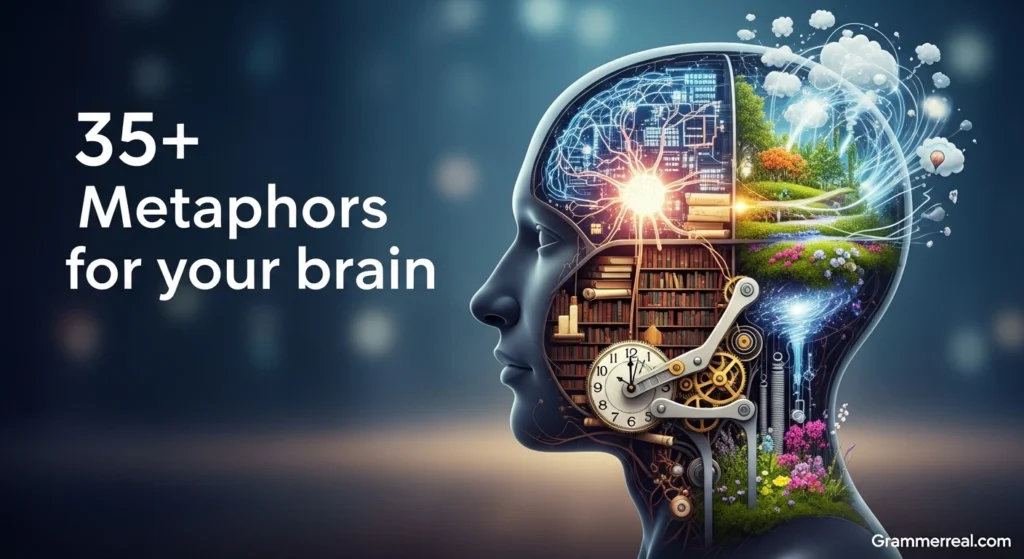
Metaphors turn the brain into a computer, a library, a garden, a storm, or a city at night. These images help us explore how the brain functions, how it feels, and what it represents in our lives.
What the Brain Represents Beyond Biology
The brain is often seen as the center of identity. It holds memory, personality, imagination, logic, and emotion. When we talk about the brain, we are often talking about the self.
It is also a symbol of complexity. Millions of neurons, countless pathways, constant activity—your brain is always becoming.
Metaphors help bridge science and feeling, making the brain easier to relate to.
Why Metaphors Help Us Understand the Brain
The brain is hard to explain directly. We cannot easily describe thought, memory, or consciousness in plain words. Metaphors give shape to the invisible.
Instead of saying “I’m overwhelmed,” someone might say “My brain feels like a browser with too many tabs open.” That metaphor instantly makes the experience clear.
Metaphors make the brain relatable.
Your Brain as a Library
A library metaphor emphasizes memory and knowledge.
Meaning: The brain stores information like shelves filled with books.
Example idea: “Her brain was a library, full of stories and facts waiting to be opened.”
Alternative expressions:
- A vault of memories
- A bookshelf of experience
This metaphor highlights learning and recall.
Your Brain as a Computer
This is one of the most common modern metaphors.
Meaning: The brain processes information, solves problems, and sometimes crashes.
Example idea: “My brain froze like a computer when I tried to answer.”
Alternative expressions:
- Mental processor
- Hard drive of thoughts
This metaphor works well for focus and overload.
Your Brain as a Garden
A garden metaphor shows growth and care.
Meaning: Thoughts can be planted, nurtured, or left to become weeds.
Example idea: “His brain was a garden where ideas bloomed with attention.”
Alternative expressions:
- Mind as soil
- Seeds of imagination
This metaphor feels gentle and hopeful.
Your Brain as a Busy City
A city metaphor shows constant activity.
Meaning: The brain is full of movement, signals, and interaction.
Example idea: “My brain is a city at rush hour, thoughts speeding everywhere.”
Alternative expressions:
- Highway of neurons
- Streets of ideas
This metaphor captures mental busyness.
Your Brain as a Storm
Storm metaphors express chaos and emotion.
Meaning: The brain can feel turbulent, especially with anxiety or anger.
Example idea: “Her brain was a storm of worries she couldn’t quiet.”
Alternative expressions:
- Thundercloud of thoughts
- Tempest inside
This metaphor shows mental overwhelm.
Your Brain as a Control Room
This metaphor highlights decision-making.
Meaning: The brain manages signals, choices, and reactions.
Example idea: “His brain was a control room, constantly adjusting the switches of life.”
Alternative expressions:
- Command center
- Pilot seat of the mind
This metaphor suggests responsibility and power.
Your Brain as a Puzzle
A puzzle metaphor emphasizes complexity.
Meaning: The brain is intricate, full of pieces that connect slowly.
Example idea: “My brain felt like a puzzle missing one crucial piece.”
Alternative expressions:
- Mystery box
- Labyrinth of thought
This metaphor works for confusion and problem-solving.
Your Brain as an Ocean
An ocean metaphor suggests depth.
Meaning: The brain holds endless layers, conscious and unconscious.
Example idea: “Her brain was an ocean, with thoughts drifting like waves.”
Alternative expressions:
- Sea of memories
- Deep waters of the mind
This metaphor feels poetic and emotional.
Your Brain as a Radio
A radio metaphor shows attention and distraction.
Meaning: The brain tunes into different channels of thought.
Example idea: “My brain kept switching stations, unable to focus.”
Alternative expressions:
- Static in the mind
- Mental broadcast
This metaphor fits restlessness.
When the Brain Feels Like a Friend or Enemy
Sometimes the brain comforts us, and sometimes it sabotages us.
Metaphors for a supportive brain:
- A wise guide
- A lighthouse
- A steady compass
Metaphors for a difficult brain:
- A noisy roommate
- A runaway train
- A tangled knot
These images show our complicated relationship with our own minds.
How Writers Use Brain Metaphors
Writers often use brain metaphors to show inner life.
A character might feel their mind as a storm during grief, or as a library when remembering childhood. These metaphors help readers feel thought as something alive.
Even in everyday storytelling, brain metaphors make emotions clearer.
A Simple Activity to Describe Your Brain Today
Complete this sentence:
“My brain today feels like ______.”
Possible answers:
- A city at rush hour
- A garden growing ideas
- A computer with too many tabs
- An ocean of memories
This helps you express your mental state creatively.
Using Brain Metaphors in Daily Life
Brain metaphors are useful in conversation, writing, and self-reflection.
Instead of saying “I’m distracted,” you might say: “My brain feels like a radio stuck on static.”
Instead of “I’m learning,” you might say: “My mind is a garden where new ideas are blooming.”
Metaphors make inner experiences easier to share.
Keeping Brain Metaphors Clear and Relatable
The best brain metaphors are simple and sensory. Choose images people understand: libraries, storms, computers, gardens.
Avoid mixing too many metaphors at once. One strong comparison is enough to make the mind vivid.
Conclusion
Metaphors for your brain help describe the invisible world inside you. Whether your brain feels like a library of memories, a city of busy thoughts, a garden of growing ideas, or a storm of emotion, metaphors bring clarity and beauty to something deeply complex. They remind us that the brain is not only biology—it is the living landscape of who we are.
FAQs
Why are metaphors for the brain helpful?
They make complex mental experiences easier to describe and understand.
What is the most common brain metaphor?
The brain as a computer is very common because it processes information.
Which metaphor fits creativity best?
The brain as a garden or ocean captures imagination and depth.
Can brain metaphors help with emotions?
Yes. They help express anxiety, overwhelm, calm, or focus more clearly.
How can I create my own brain metaphor?
Think about how your mind feels—busy, calm, tangled, deep—and compare it to something familiar.



