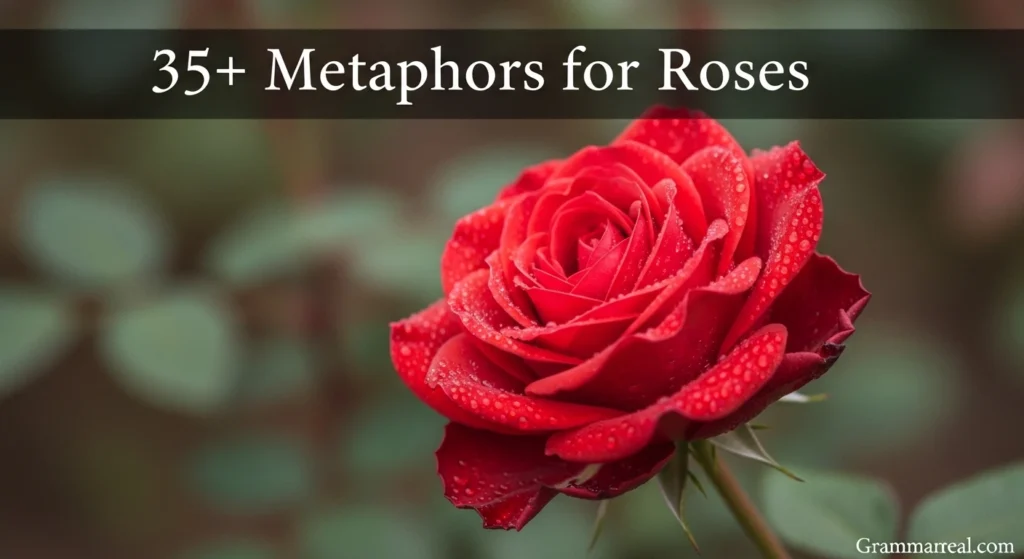
A rose does not simply bloom. It unfolds. It does not only decorate a garden and it commands attention without raising its voice. Beauty rests in its petals, yet strength hides in its thorns. Softness and sharpness live together in the same stem.
Because the word rose can symbolize love, passion, secrecy, sacrifice, growth, or even pain, writers use metaphors to deepen its emotional impact. A rose is never just a flower. It becomes a language of feeling. Through imagery, its petals transform into expressions of the heart. The comparisons below explore different emotional layers of roses while expanding meaning with clarity and depth.
A Rose as a Whisper of the Heart
A blooming rose opens quietly at dawn, revealing its petals layer by layer.
Meaning: A rose represents unspoken love or gentle emotion.
For example: “Her feelings unfolded like a rose at sunrise.”
Love does not always arrive loudly. Sometimes it grows in silence, petal by petal, without demand. A soft confession can carry more depth than dramatic declarations. As a result, writers often use roses to symbolize tender affection that grows naturally.
Emotions that develop slowly often last longer. Like petals unfolding, true feelings reveal themselves over time.
A Rose as Fire Wrapped in Silk
Its color burns red, yet its petals feel smooth and delicate.
Meaning: A rose reflects passion hidden within gentleness.
For instance: “His anger burned like a rose wrapped in silk.”
Passion can appear beautiful while holding intensity beneath the surface. Strength and sensitivity often coexist. Therefore, a rose becomes a symbol of controlled emotion — powerful yet refined.
Not all fire destroys. Some fire inspires warmth and desire.
A Rose as a Crown of Nature
In a garden full of flowers, the rose often stands at the center.
Meaning: A rose symbolizes honor and admiration.
Example: “She was the rose in a field of daisies.”
Certain people naturally command respect. Their presence feels elevated without arrogance. A rose, in this way, becomes a metaphor for distinction and grace.
Recognition does not always require noise. Sometimes quiet elegance rises above everything else.
A Rose as a Secret Sealed in Petals
In history, the phrase “under the rose” symbolized confidentiality.
Meaning: A rose represents hidden truth or secrecy.
For example: “Their promise remained beneath the rose.”
Secrets resemble tightly closed buds. They remain protected until the right moment arrives. The layers of petals reflect layers of silence.
Trust often depends on what remains unspoken.
A Rose as a Warrior Guarded by Thorns
Beauty grows alongside protection.
Meaning: A rose symbolizes vulnerability defended by strength.
For instance: “Her kindness stood like a rose guarded by thorns.”
Gentle hearts still require boundaries. The presence of thorns reminds us that softness does not mean weakness. Instead, it signals balance.
Protection preserves beauty. Without thorns, petals would not survive long.
A Rose as a Fading Sunset
As a rose wilts, its petals curl inward and darken.
Meaning: A rose reflects the temporary nature of beauty.
Example: “Their youth faded like a rose at dusk.”
Nothing remains untouched by time. The fading of a rose reminds writers of life’s fragile rhythm. Beauty shines brightly, but only for a season.
Because of this, roses often represent both celebration and melancholy.
A Rose as a Promise in Bloom
A bud carries the future within its tight form.
Meaning: A rose represents hope and unfolding potential.
For example: “The new beginning felt like a rose about to bloom.”
Growth does not happen instantly. It develops gradually. Patience nurtures possibility. Therefore, a rosebud becomes a symbol of anticipation and optimism.
Every closed bud carries a hidden masterpiece.
A Rose as Blood on White Silk
Red petals against pale surroundings create striking contrast.
Meaning: A rose can symbolize sacrifice or deep emotion.
For instance: “His loyalty stained the past like a rose on white silk.”
Strong emotion often leaves marks. Love, devotion, and sacrifice can carry both beauty and cost. Writers use this imagery to intensify dramatic scenes.
Contrast strengthens symbolism. The softness of petals makes the metaphor even sharper.
A Rose as a Compass of Romance
Across cultures, roses guide expressions of love.
Meaning: A rose directs emotional intention.
Example: “He let the rose speak what he could not say.”
Flowers communicate when words hesitate. A single rose can carry apology, admiration, or longing. Its symbolism crosses language barriers.
Emotion sometimes travels best through imagery rather than explanation.
A Rose as a Garden’s Heartbeat
The presence of roses often defines the mood of a garden.
Meaning: A rose symbolizes emotional center.
For instance: “Her laughter was the rose in their quiet home.”
Certain elements anchor entire environments. Remove the rose, and the garden feels incomplete. Similarly, some people become the emotional core of relationships.
Central beauty shapes surrounding harmony.
Why Writers Use Metaphors for Roses
The word “rose” carries emotional richness. It can represent love, danger, sacrifice, hope, admiration, fragility, or secrecy. Because it holds both softness and sharpness, it adapts to many tones.
Comparing love to a blooming rose emphasizes growth. Describing pain as thorns highlights protection. Referring to fading petals conveys impermanence. Each metaphor reveals a different emotional angle.
Through layered imagery, roses transform simple description into vivid storytelling.
The Dual Nature Hidden in Roses
Roses teach balance. Petals attract. Thorns defend. Fragrance invites. Stem supports.
Life often mirrors this structure. Beauty and difficulty grow together. Strength and softness exist side by side. Therefore, the rose becomes more than decoration. It becomes philosophy.
True elegance contains resilience. Genuine love includes boundaries. Growth demands patience.
How to Use Rose Metaphors Effectively
Choose one dominant quality of the rose — beauty, thorns, fragrance, bloom, or fading. Build your sentence around that single image.
Weak example: “She was a rose, a sunset, a flame, and a crown all at once.”
Stronger example: “She carried herself like a rose guarded by quiet thorns.”
Focused imagery creates stronger emotional impact. Allow the metaphor to breathe. Avoid overcrowding your sentence.
A Moment to Reflect
When you picture a rose, what stands out first?
Do you see blooming petals? Do you notice sharp thorns?
Your focus reveals how you interpret love, beauty, and protection.
Conclusion
Metaphors for roses capture the complexity of human emotion. A rose can symbolize whispered love, guarded vulnerability, fading beauty, unfolding hope, or silent sacrifice. Each comparison uncovers a different dimension of experience.
Although roses appear delicate, they embody strength beneath softness. Through thoughtful metaphor, writers reveal that beauty is rarely simple. It carries depth, contrast, and resilience within every petal.
FAQs
What do roses usually symbolize in literature?
Roses most commonly represent love and passion, but they also symbolize secrecy, sacrifice, beauty, and protection.
Why are thorns important in rose metaphors?
Thorns add contrast. They show that vulnerability often requires defense and that beauty can coexist with strength.
Can a rose represent sadness?
Yes. A wilting rose often symbolizes fading love, lost youth, or the passing of time.
How can I create a unique rose metaphor?
Focus on one aspect of the rose — such as its bloom, fragrance, or thorns — and connect that trait directly to your theme.
Are rose metaphors always romantic?
No. Roses can express power, secrecy, resilience, and even conflict depending on how the imagery is used.