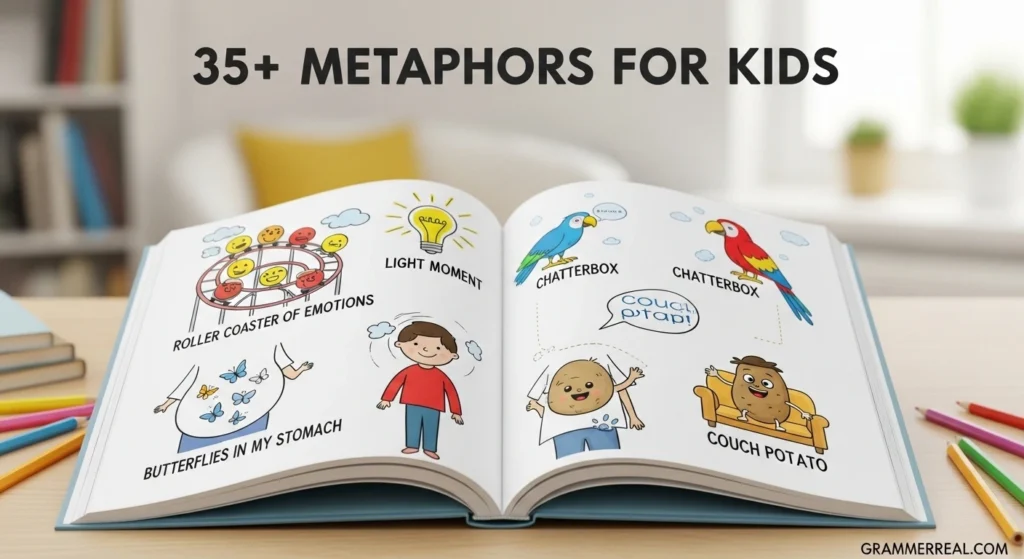
Kids bring life to a place. A quiet house becomes loud when children arrive. Energy fills the room. Laughter spreads through the air. Curiosity grows in every corner.
Adults often describe children using metaphors because simple comparisons help explain their bright and playful nature. A child can be like sunshine, like a spark, or like a small seed that will grow into something strong.
Language becomes easier to understand when images are used. A metaphor turns an idea into a picture inside the reader’s mind. Through these pictures, the spirit of childhood becomes clearer.
The sections below explore different metaphors for kids. Each one shows a special quality of children such as joy, growth, imagination, and hope.
Kids Are Like Little Suns
Warm sunlight can brighten a cold morning. A smiling child can create the same feeling in a home.
Meaning: Children bring warmth and happiness.
For example: “The kids in the classroom were little suns lighting the day.”
Energy flows naturally from young people. A playful voice or a loud laugh can lift the mood of everyone nearby. Families often feel brighter when children are around.
Light spreads quickly. Joy spreads in the same way when kids play, learn, and explore.
Kids Are Like Fresh Seeds in a Garden
A tiny seed may look simple, yet it holds great potential.
Meaning: Children represent future growth.
For example: “Each student in the school is a seed ready to grow.”
Care, patience, and guidance help seeds develop into strong plants. Kids grow in a similar way when adults support them with kindness and learning.
Every great tree once started as a small seed.
Kids Are Like Colorful Balloons
Balloons float, move, and attract attention.
Meaning: Kids are full of excitement and energy.
For example: “The playground looked like a sky full of balloons.”
Movement and laughter appear everywhere when children gather. Colorful balloons also bring celebration. Childhood carries that same feeling of fun.
Energy in kids rarely stays still.
Kids Are Like Curious Little Explorers
Explorers search for new places and discoveries.
Meaning: Children love learning and asking questions.
For example: “My nephew is an explorer in a world of questions.”
Curiosity pushes kids to touch, look, and wonder. Every new experience becomes an adventure. Small discoveries feel huge in the eyes of a child.
Learning begins with curiosity.
Kids Are Like Morning Dew
Dew appears fresh and pure in the early morning.
Meaning: Children symbolize innocence and freshness.
For example: “Her laughter felt like morning dew on a quiet field.”
Soft beauty exists in simple things. Childhood carries the same gentle purity.
A clear heart often shines through the actions of a young child.
Kids Are Like Small Fireworks
Fireworks burst with light and sound.
Meaning: Kids express excitement and strong emotions.
For example: “The birthday party was full of little fireworks.”
Joy appears suddenly in children. Loud laughter or fast movement often fills the room.
Bright sparks describe the lively spirit of childhood.
Kids Are Like Open Books
An open book invites reading.
Meaning: Children show their feelings honestly.
For example: “You can read his emotions like an open book.”
Honesty appears naturally in young minds. Feelings come out quickly without hiding.
Truthful expressions make childhood unique.
Kids Are Like Busy Bees
Bees move from place to place collecting nectar.
Meaning: Kids stay active and busy.
For example: “The class looked like a group of buzzing bees.”
Movement keeps children learning and exploring. Curiosity pushes them toward new activities every day.
Energy rarely stops during childhood.
Kids Are Like Bright Crayons
Crayons fill a blank page with color.
Meaning: Children add creativity and imagination to life.
For example: “The children in the art class were bright crayons in a box.”
Imagination grows easily in young minds. Simple drawings or playful stories often carry deep creativity.
Colorful ideas bring joy to learning.
Kids Are Like Small Rivers
A river moves forward with energy.
Meaning: Kids grow and change constantly.
For example: “His childhood flowed like a lively river.”
Movement never stops in a river. Growth never stops in a child.
Every day brings new learning.
Kids Are Like Spring Flowers
Flowers bloom beautifully during spring.
Meaning: Children represent new life and beauty.
For example: “The playground looked like a field of flowers.”
Smiles appear like blossoms in warm weather. Bright faces and playful voices create the same beauty.
Life feels fresh during childhood.
Kids Are Like Tiny Stars
Stars shine in the night sky.
Meaning: Every child carries unique potential.
For example: “Each student is a star waiting to shine.”
Different stars glow in different ways. Each child has talents that appear with time.
Guidance helps that light grow brighter.
Kids Are Like Soft Clouds
Clouds float gently across the sky.
Meaning: Children often show gentle emotions.
For example: “Her kindness felt like a soft cloud.”
Gentle hearts appear naturally in many young people. Compassion grows when kindness is encouraged.
Softness can hold quiet strength.
Kids Are Like Small Sparks
A spark may look tiny, yet it can start a strong fire.
Meaning: Children hold powerful future potential.
For example: “His curiosity was a spark of great ideas.”
Ideas begin small. Learning helps them grow larger.
Big achievements often start with a simple spark.
Kids Are Like New Books
A new book holds many untold stories.
Meaning: Childhood is full of possibilities.
For example: “Each child is a new story waiting to unfold.”
Pages remain unwritten at the beginning. Life experiences slowly fill them.
Future paths begin during childhood.
Kids Are Like Happy Music
Music fills a space with rhythm and joy.
Meaning: Children bring life and happiness.
For example: “The school hallway sounded like happy music.”
Laughter and playful voices create a cheerful atmosphere.
Life feels more colorful with children around.
Why Metaphors Help Describe Kids
Simple comparisons make language easier to understand. A metaphor turns an idea into a clear image. Teachers, writers, and parents often use metaphors to explain emotions and behavior.
Kids themselves enjoy imaginative language. Pictures in the mind help them connect words with feelings and experiences.
Learning becomes more fun when imagination joins the process.
Conclusion
Metaphors for kids show how bright and powerful childhood can be. A child may be compared to a seed, a star, a balloon, or a spark. Each metaphor highlights growth, joy, creativity, and hope.
Young minds carry endless possibilities. Care and guidance help those possibilities grow into strong futures.
Every child holds a story that has only begun.
FAQs
Why are kids compared to seeds?
Seeds represent growth and future potential.
What does the metaphor “kids are little suns” mean?
It means children bring warmth and happiness to people around them.
Why are kids called explorers?
Children naturally love learning and discovering new things.
What does “kids are sparks” represent?
It shows that children have powerful potential that can grow with time.
Why are metaphors useful when describing children?
Metaphors create simple images that help people understand emotions and ideas easily.



