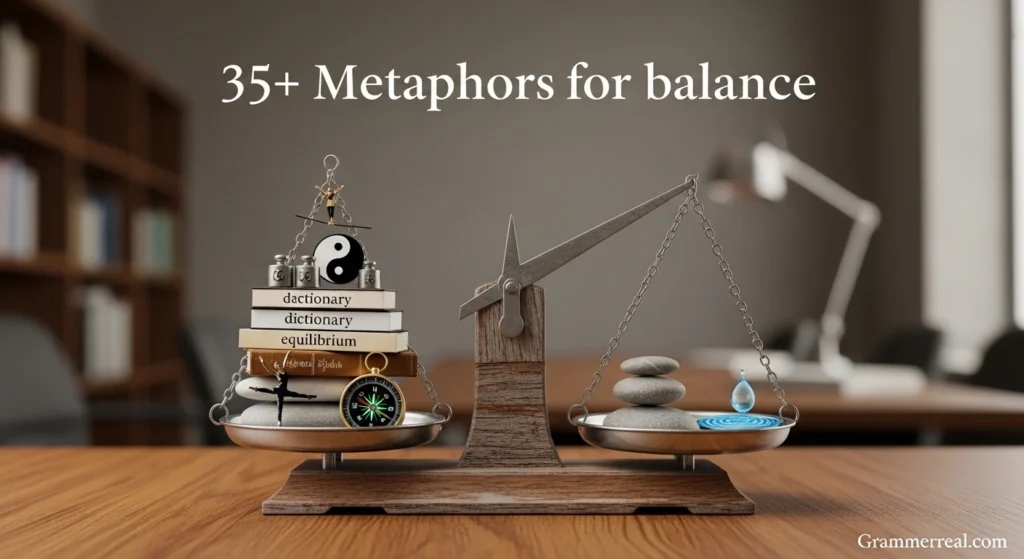
Balance is something we feel even when we cannot explain it. It is the quiet steadiness of walking without stumbling, the calm of a mind that is not pulled in ten directions, the sense that life is not tipping too far into chaos or exhaustion. Balance is not always perfect stillness—it is often a gentle adjustment, a constant return to center.
People search for balance in work and rest, in love and independence, in ambition and peace. Yet balance is difficult to describe with plain words, because it lives in the space between extremes. That is why metaphors for balance are so meaningful. They turn an invisible harmony into images we can see clearly.
Metaphors help balance become a tightrope, a set of scales, a dancer’s grace, a calm sea after waves. Through these comparisons, we understand balance not as a fixed state, but as a living practice.
What Balance Means Beyond Stability
Balance is not only physical. It can be emotional, mental, spiritual, or relational. A balanced life does not mean nothing goes wrong—it means you are not constantly falling apart when things shift.
Balance often represents harmony: giving and receiving, speaking and listening, working and resting. It is the art of holding opposites without breaking.
Why Metaphors Help Us Understand Balance
Balance is abstract. You cannot hold it in your hands, but you know when it is missing. Metaphors translate balance into something concrete.
Instead of saying “I need balance,” someone might say “I feel like I’m walking a tightrope.” That metaphor instantly shows fragility, effort, and the fear of falling.
Metaphors also remind us that balance is dynamic, not static. Like riding a bicycle, you stay upright by moving.
Balance as a Set of Scales
The scale is one of the oldest metaphors for balance.
Meaning: It represents fairness, equal weight, and careful adjustment.
Example idea: “She tried to keep her life like a scale, not letting one side grow too heavy.”
Alternative expressions:
- Weighing priorities
- Keeping things even
This metaphor works well for decision-making and justice.
Balance as Walking a Tightrope
A tightrope suggests delicacy and focus.
Meaning: Balance becomes something you must concentrate on, step by step.
Example idea: “Between work and family, he felt like he was walking a tightrope.”
Alternative expressions:
- On the edge
- Carefully staying upright
This metaphor often carries tension, showing balance as effort.
Balance as a Dancer’s Grace
Dance metaphors make balance feel beautiful rather than stressful.
Meaning: Balance is fluid, graceful, and responsive.
Example idea: “She moved through challenges like a dancer, adjusting without losing her rhythm.”
Alternative expressions:
- Flowing through life
- Moving with grace
This metaphor suggests elegance in handling change.
Balance as a Calm Sea
A calm sea represents steadiness and peace.
Meaning: Balance becomes emotional quiet, not constant storms.
Example idea: “After months of stress, she finally felt like her mind was a calm sea.”
Alternative expressions:
- Still waters
- Gentle waves
This metaphor is soothing and hopeful.
Balance as a Bicycle in Motion
A bicycle stays upright only when moving.
Meaning: Balance requires momentum and ongoing adjustment.
Example idea: “Life is like riding a bicycle—you stay balanced by continuing forward.”
This metaphor reminds us that balance is active, not passive.
Balance as a Bridge Between Extremes
A bridge connects two sides.
Meaning: Balance is the space between opposites: rest and effort, emotion and logic.
Example idea: “He learned to be a bridge between ambition and peace.”
Alternative expressions:
- Meeting in the middle
- Holding both sides
This metaphor suggests integration.
Balance as Holding a Bowl of Water
This image is delicate and sensory.
Meaning: Balance is careful attention, preventing spillover.
Example idea: “She carried her responsibilities like a bowl of water, steady and mindful.”
Alternative expressions:
- Not letting things overflow
- Moving carefully
This metaphor captures fragility and care.
Balance as Seasons in Nature
Nature never stays the same, yet it remains balanced.
Meaning: Balance is change in harmony, not permanence.
Example idea: “Her life found balance like the seasons—each phase arriving in its time.”
Alternative expressions:
- Cycles of life
- Natural rhythm
This metaphor feels gentle and wise.
When Balance Feels Peaceful
Sometimes balance feels like:
- A quiet morning
- A steady breath
- A centered heart
These metaphors show balance as comfort and calm.
When Balance Feels Difficult
Other times, balance feels like:
- Spinning plates
- Standing in strong wind
- Keeping a ship steady in waves
These images show struggle and effort, reminding us balance is earned.
How Writers Use Balance Metaphors
In writing, balance metaphors can reveal inner conflict. A character might feel like a tightrope walker when under pressure, or like a calm sea when healed.
Metaphors help show emotional states without directly naming them, creating deeper connection for readers.
A Simple Activity to Find Your Balance Metaphor
Complete this sentence:
“My life right now feels like ______.”
Possible answers:
- A scale tipping back and forth
- A bicycle trying to stay upright
- A dancer finding rhythm
- A bridge between two worlds
This helps you understand your current emotional balance.
Using Balance Metaphors in Daily Life
Balance metaphors can help you communicate needs clearly.
Instead of saying “I’m overwhelmed,” you might say: “I feel like I’m juggling too many plates.”
Instead of saying “I’m doing better,” you might say: “I finally feel steady again.”
These images make feelings easier to share.
Keeping Balance Metaphors Simple and Honest
The best metaphors for balance are clear and relatable. Choose images that match your experience. Balance is personal—what feels like calm water to one person may feel like a tightrope to another.
One strong metaphor can say more than many explanations.
Conclusion
Metaphors for balance help us describe one of life’s most important but fragile experiences. Whether balance feels like scales, a dancer’s rhythm, a calm sea, or a bicycle in motion, these images remind us that harmony is not perfection—it is adjustment, awareness, and returning to center again and again.
FAQs
What do metaphors for balance help explain?
They help describe harmony, stability, and the emotional effort of staying centered.
Is balance a fixed state or a changing process?
Balance is usually dynamic, requiring constant adjustment rather than permanence.
What metaphor works best for stressful balance?
Tightrope and spinning plates metaphors capture pressure and fragility.
What metaphor works best for peaceful balance?
Calm sea and dancer metaphors express ease and harmony.
How can I create my own balance metaphor?
Think about how balance feels to you—steady, fragile, flowing—and choose an image that matches.



