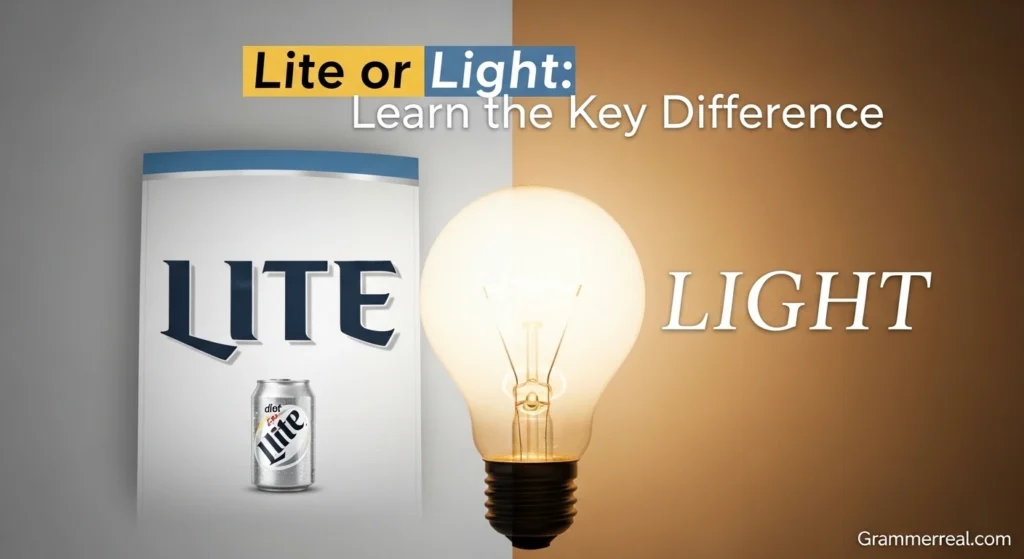
English learners often feel confused between lite vs light because both words look related and sound similar. However, their meanings, usage, and level of formality are different.
This confusion appears frequently in exams, advertisements, menus, and everyday writing. Many beginners think both words can replace each other in all situations, but that is not correct. Understanding lite vs light helps avoid spelling mistakes and meaning errors. Clear usage also improves writing quality and reader understanding. In this article, we explain lite vs light in very simple language. Easy examples, grammar rules, and practical tips guide you step by step. By the end, choosing the correct word will feel natural and easy.
Main Difference Between Lite and Light
The difference between lite vs light is mainly about formality and meaning.
- Light is the standard English word.
- Lite is an informal spelling, mostly used in marketing.
Because of this difference, light is correct in most writing situations, while lite appears only in limited contexts.
What Does “Light” Mean?
The word light has several meanings in English. It can function as a noun, adjective, or verb, depending on context.
Simple meanings of light
- Not heavy
- Bright or giving illumination
- Having less seriousness or intensity
Usage explanation
The word light is correct in formal writing, exams, academic texts, and daily communication. It is the original and accepted form in standard English.
Examples of “Light” in Sentences
Context: describing weight Correct: This bag is very light to carry. Incorrect: This bag is very lite to carry.
Context: describing brightness Correct: The room has enough light. Incorrect: The room has enough lite.
Context: describing food Correct: She prefers light meals at night. Incorrect: She prefers lite meals at night.
Each correct sentence uses light because it fits standard grammar rules.
What Does “Lite” Mean?
The word lite is an informal spelling of light. Writers mainly use it in advertising and product labels.
Simple meaning of lite
- Having less calories, fat, or sugar
- Reduced or simplified version
Usage explanation
Companies use lite to make products look modern or attractive. However, this spelling does not appear in formal or academic writing.
Examples of “Lite” in Sentences
Context: product label Correct: This drink is a lite version with less sugar. Incorrect: This drink is a light version with less sugar on the label.
Context: advertising style Correct: The app offers a lite version for beginners. Incorrect: The app offers a light version for beginners in marketing text.
Here, lite works because the context is informal and promotional.
Grammar Difference Between Lite and Light
Grammar rules clearly separate these two words.
- Light follows standard grammar rules.
- Lite is not used in formal grammar contexts.
Part of speech
Light: noun, adjective, or verb Lite: adjective only, mainly informal
Sentence structure
Correct: A light jacket works well in summer. Correct: A lite app uses less memory.
Understanding grammar helps avoid misuse.
Contextual Usage of Lite vs Light
Food and Drinks
Formal writing prefers light. Product labels often use lite.
Example context sentence: Correct: She ordered a light salad for dinner. Correct: The store sells lite snacks for dieting customers.
Technology
Software companies use lite for simplified versions.
Example context sentence: Correct: This software includes a lite mode for slow devices. Correct: The screen produces soft light at night.
Common Mistakes and How to Avoid Them
Using lite in formal writing
Context sentence: academic or exam writing Correct: Exercise helps maintain a light body weight. Incorrect: Exercise helps maintain a lite body weight.
Using light on product labels incorrectly
Context sentence: advertising text Correct: The company launched a lite edition of the app. Incorrect: The company launched a light edition of the app.
Thinking lite is always acceptable
Remember that lite fits marketing language, not formal grammar.
How to Remember the Difference Easily
Use this simple rule.
- If the sentence is formal, academic, or exam-related, choose light.
- If the sentence sounds like advertising or product promotion, lite may fit.
This method solves most confusion.
Lite vs Light in Daily English
In daily conversation, people mostly use light. The word lite appears mainly on packaging, signs, or advertisements.
Example sentence comparison: Correct: I want a light breakfast today. Correct: The bottle says it is a lite drink.
Meaning changes based on context, not pronunciation.
American vs British English Usage
Both American and British English follow the same pattern.
- Light is standard in both varieties.
- Lite appears in marketing in both varieties.
No major regional difference exists in meaning or usage.
Idiomatic and Natural Expressions
Common expressions with light:
- Light work
- Light sleep
- Light rain
Example usage sentence: Correct: The rain was light in the morning.
The word lite does not appear in idiomatic expressions.
Choosing the Right Word
Ask yourself one question before choosing.
Is the sentence formal or grammatical? Use light.
Is the sentence promotional or informal? Use lite.
This decision keeps writing clear and correct.
Practical Tips for Learners
- Use light in exams and formal writing.
- Use lite only when copying product or brand language.
- Avoid replacing light with lite automatically.
- Check context before choosing spelling.
- Practice reading advertisements to see how lite is used.
Regular practice improves accuracy.
Grammar Rules Applied
- Correct adjective usage
- Proper noun modification
- Standard spelling preference
- Clear sentence structure
- Mostly active voice
These rules ensure clarity and correctness.
Writing Techniques Used
This article uses:
- Simple vocabulary
- Varied sentence openings
- Clear headings
- Transition words for flow
- No unnecessary repetition
These techniques support easy reading.
Rewritten and Polished Explanation
In simple words, light is the correct and standard English word. It works in all formal, academic, and daily situations. Lite is an informal spelling, mainly used in advertising and product labels to suggest reduced content. Both words sound similar, but their usage depends on context. Understanding this difference prevents grammar and spelling mistakes.
How This Practice Improves Writing
Learning lite vs light helps writers:
- Avoid informal spelling in formal writing
- Understand context-based word choice
- Improve clarity and accuracy
- Build exam confidence
- Strengthen vocabulary awareness
Small distinctions create strong writing habits.
Conclusion
In conclusion, lite vs light differs in formality and usage. Light is the standard word used in grammar, exams, and formal writing. Lite is an informal spelling used mainly in marketing and product descriptions. Choosing the correct word depends on context, not sound. With careful attention and practice, using these words correctly becomes easy.
FAQs
- Are lite and light the same in meaning?
They are related, but lite is informal while light is standard. - Can I use lite in exams?
No, exams require the standard word light. - Is lite grammatically correct?
It is acceptable only in informal or marketing contexts. - Does lite exist in dictionaries?
Yes, but it is marked as informal. - Can lite replace light everywhere?
No, lite has limited usage. - Is light used for weight and brightness?
Yes, light has multiple meanings. - Is lite used in daily conversation?
Rarely, it appears mostly in advertising. - Are lite products always healthy?
No, lite only suggests reduced content. - Is there a British or American difference?
No major difference exists. - Which word is safer to use?
Light is always the safer choice.



