Many people feel confused about the words invaluable and valuable. At first glance, they seem to mean opposite things, yet they are often used in similar situations. This confusion happens because the prefix in- usually suggests a negative meaning, but that is not always true in English.
As a result, learners sometimes misunderstand these words or use them incorrectly. Understanding invaluable vs valuable helps you express importance, worth, and usefulness more clearly. These words appear often in school writing, professional documents, and everyday speech. Using the wrong one can change the meaning of a sentence. This article explains the difference in very simple language. It includes clear meanings, examples, common mistakes, and practical tips. By the end, you will know exactly when to use invaluable and when to use valuable, and your writing will sound more accurate and confident.
What Does “Valuable” Mean?
The word valuable describes something that has worth, importance, or usefulness. This value can be related to money, usefulness, skill, time, or importance. It is an adjective that describes a noun.
Simple meaning of “valuable”
- worth a lot of money
- very useful
- important
Examples of “valuable” in sentences
- This painting is very valuable.
- Her advice was valuable to the team.
- Time is a valuable resource.
- He gained valuable experience at his first job.
In these examples, valuable shows that something has clear worth or benefit.
What Does “Invaluable” Mean?
The word invaluable means extremely useful or so valuable that it cannot be measured. Even though it looks negative, it actually expresses a very strong positive meaning.
Simple meaning of “invaluable”
- extremely useful
- very important
- beyond price
Examples of “invaluable” in sentences
- Her support was invaluable during the project.
- The guide’s knowledge was invaluable to the team.
- His experience proved invaluable in difficult situations.
- These records are invaluable for research.
In all these cases, invaluable means more than just valuable.
Invaluable vs Valuable: The Core Difference
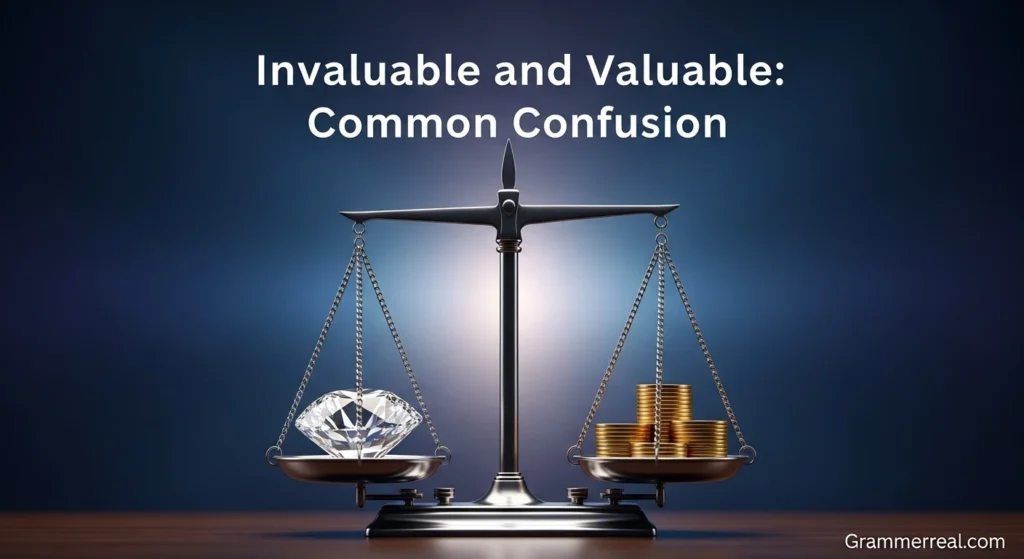
The main difference between invaluable vs valuable is the degree of importance.
- Valuable means something has worth.
- Invaluable means something is extremely important or beyond measure.
Simple comparison
- A laptop is valuable.
- Trust from a close friend is invaluable.
Both are positive words, but invaluable shows stronger importance.
Why “Invaluable” Does Not Mean “Not Valuable”
Many learners think invaluable means not valuable because of the prefix in-. However, English prefixes do not always work the same way.
Understanding the prefix “in-”
The prefix in- can mean:
- not (inactive)
- into (inject)
- very or intense (invaluable, inflammable)
In invaluable, the prefix adds strength, not negation. This is why invaluable means extremely valuable, not worthless.
Grammar Role of Invaluable and Valuable
Both invaluable and valuable are adjectives. They describe nouns and answer the question what kind?
Examples
- valuable skill
- invaluable help
- valuable item
- invaluable experience
Because both are adjectives, they fit in similar sentence positions.
Contextual Examples of Invaluable vs Valuable
Seeing both words in similar contexts helps clarify meaning.
- Her feedback was valuable, but her guidance was invaluable.
- The tool is valuable, yet the knowledge to use it is invaluable.
- Money is valuable, but health is invaluable.
These sentences show that invaluable expresses a higher level of importance.
Invaluable vs Valuable in Everyday Language
In daily speech, people often use valuable more frequently. Invaluable is used when someone wants to emphasize importance.
Common everyday uses
- valuable time
- valuable lesson
- invaluable support
- invaluable advice
Both words are natural, but they serve slightly different purposes.
Common Mistakes With Invaluable vs Valuable
Many mistakes happen because of misunderstanding meaning.
Thinking “invaluable” means useless
- Incorrect: This old book is invaluable, so it has no value.
- Correct: This old book is invaluable because it is rare.
Invaluable never means useless.
Avoiding “invaluable” due to confusion
Some writers avoid invaluable and use valuable instead, even when stronger meaning is needed.
- Weak: Her help was valuable.
- Better: Her help was invaluable.
Using both words together incorrectly
- Incorrect: This is an invaluable valuable item.
- Correct: This is an invaluable item.
One word is enough.
Sentence Structure With Valuable
Valuable works well in simple and direct sentences.
Examples
- This watch is valuable.
- He shared valuable information.
- She learned valuable skills.
It fits easily before nouns.
Sentence Structure With Invaluable
Invaluable often appears in sentences that stress importance.
Examples
- Her experience was invaluable.
- His advice became invaluable over time.
- These contacts are invaluable in business.
It often follows verbs like was, became, or proved.
Invaluable vs Valuable in Formal Writing
Both words are accepted in formal writing.
Formal examples
- The data provides valuable insights.
- Expert guidance is invaluable in this field.
Using the correct word improves tone and precision.
Invaluable vs Valuable in Informal Writing
In informal writing, both words are also common.
- Thanks for your valuable help.
- Your support was invaluable to me.
Tone stays friendly and clear.
American vs British English Usage
There is no major difference between American and British English when using invaluable vs valuable.
Shared usage
- Same spelling
- Same meaning
- Same grammar rules
Both varieties understand invaluable as extremely valuable.
Idiomatic and Natural Expressions
Some expressions commonly use valuable or invaluable.
Expressions with “valuable”
- valuable time
- valuable lesson
- valuable resource
Example:
- This mistake taught me a valuable lesson.
Expressions with “invaluable”
- invaluable support
- invaluable experience
- invaluable contribution
Example:
- Her contribution was invaluable to the project.
These expressions sound natural and correct.
Choosing Between Invaluable vs Valuable
Use this simple guide:
- Ask: Is it useful or important?
- Yes → valuable
- Ask: Is it extremely important or beyond measure?
- Yes → invaluable
This method works in most cases.
Practical Tips to Remember the Difference
Here are easy tips to avoid confusion:
- Remember: invaluable = extremely valuable
- Use valuable for general worth
- Use invaluable for strong emphasis
- Do not assume in- always means “not”
- Practice by writing short sentences
Simple practice builds confidence.
Grammar Rules Applied
Understanding grammar helps correct usage.
Adjective use
Both words describe nouns and do not change form.
- valuable advice
- invaluable advice
Articles
- a valuable item
- an invaluable resource
Use an before invaluable because it starts with a vowel sound.
Sentence Flow and Clarity
Clear writing depends on correct word choice.
- Short sentences improve understanding
- Longer sentences work when ideas connect
- Active voice keeps meaning direct
- Passive voice adds formality when needed
Choosing the right adjective supports smooth reading.
Rewritten and Polished Explanation (Clear and Simple)
To restate clearly, valuable means something has worth or usefulness. Invaluable means something is so useful or important that its value cannot be measured. Even though the words look opposite, their meanings are not. Invaluable is stronger than valuable, not weaker. Understanding this difference helps you express importance accurately. Using the correct word makes writing clearer and more natural.
Why This Exercise Improves Writing
Learning invaluable vs valuable improves writing skills in many ways.
- It improves vocabulary accuracy
- It prevents meaning errors
- It strengthens descriptive writing
- It builds confidence
- It improves clarity
Small word choices create strong communication.
Conclusion
In conclusion, the difference between invaluable vs valuable is based on strength, not opposition. Valuable means something has worth or usefulness. Invaluable means something is extremely important or beyond measure. Both words are positive and useful, but they express different levels of importance. Understanding this difference helps you write with precision and confidence. With practice, choosing the right word becomes easy and natural.
FAQs
1. Does “invaluable” mean not valuable?
No, it means extremely valuable.
2. Which word shows stronger importance?
Invaluable shows stronger importance.
3. Are both words adjectives?
Yes, both are adjectives.
4. Can I use “invaluable” in formal writing?
Yes, it is fully acceptable.
5. Is “valuable” always about money?
No, it can mean usefulness or importance.
6. Is there a difference in British and American English?
No, both use the words the same way.
7. Can people be described as invaluable?
Yes, their help or support can be invaluable.
8. Can something be valuable but not invaluable?
Yes, many things are valuable but not beyond measure.
9. Does “invaluable” need emphasis?
It already carries strong emphasis.
10. What is the easiest way to remember the difference?
Remember: invaluable means more than valuable, not less.