Many English learners feel confused about the phrases in the store or at the store. Both phrases seem similar, but they are not always used in the same way.
People often hear them in daily conversations, especially when talking about shopping or locations. Because of this, learners want to know when each phrase is correct. The difference mostly depends on context, meaning, and how the speaker thinks about the place. Sometimes the phrases can mean almost the same thing, while other times one sounds more natural than the other. Understanding these phrases helps learners speak and write more clearly. It also improves confidence during everyday conversations. This article explains the meaning, grammar, examples, and practical use of in the store or at the store using simple language so that everyone can understand it easily.
Meaning of “in the store or at the store”
The phrases in the store and at the store both talk about a location. However, they show slightly different ideas.
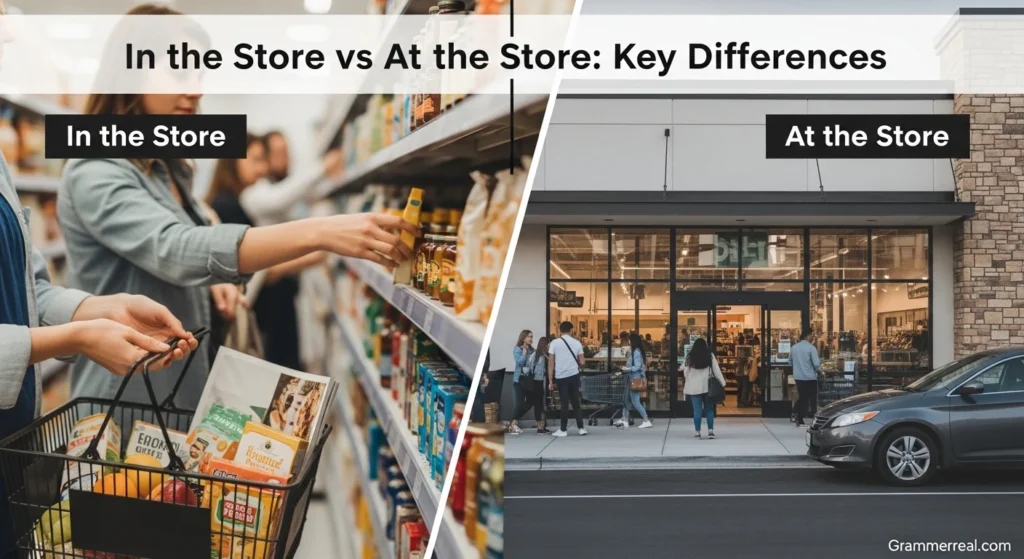
In the store means someone is physically inside the building. The person is within the walls of the shop. This phrase focuses on the exact place where the person stands.
Example: She is in the store buying groceries.
At the store usually means someone is at the location of the store. The person may be inside, outside, or near the building. This phrase focuses on the general place.
Example: He is at the store right now.
Both phrases describe location, but the level of detail changes.
Why learners feel confused about these phrases
Many learners think in the store or at the store have exactly the same meaning. This confusion happens because both phrases talk about the same place.
In normal conversation, people often use them in similar situations. Because of this, learners may not notice the small difference.
Another reason for confusion is translation. Some languages use only one word for location. English, however, uses different prepositions.
Therefore, understanding prepositions becomes important.
Understanding the role of prepositions
Prepositions are small words such as in, at, on, under, and near. These words show relationships between things, especially location.
In the phrase in the store, the preposition in shows that something is inside a place.
Example: The customer is in the store.
In the phrase at the store, the preposition at shows a general point or location.
Example: I will meet you at the store.
These small words may seem simple, but they change the meaning of a sentence.
When to use “in the store”
People use in the store when they want to emphasize that someone is inside the building.
This phrase focuses on the interior of the shop.
Example sentences:
The manager is in the store checking the shelves. There are many customers in the store today. I saw a new product in the store yesterday.
In each sentence, the person or object is clearly inside the store.
Because of this meaning, in the store often appears when talking about activities happening inside.
When to use “at the store”
The phrase at the store usually describes someone’s general location. It does not always mean the person is inside.
For example, a person could be in the parking area, near the entrance, or inside the building.
Example sentences:
She is at the store right now. We are at the store waiting for our friend. My brother stopped at the store after work.
In these examples, the exact position inside or outside the store is not important.
Simple comparison between the two phrases
Understanding the difference becomes easier with comparison.
Example:
I am in the store looking for bread. I am at the store right now.
The first sentence explains what the person is doing inside. The second sentence only shows the location.
Another example:
There are many people in the store. My sister is at the store.
The first sentence focuses on people inside the building, while the second simply tells the location.
Examples from daily life
Daily conversations often include in the store or at the store.
Example situations:
At home: Mom: Where is your brother? Dad: He is at the store.
Shopping: There are many discounts in the store today.
Phone conversation: I cannot talk right now because I am in the store.
These simple examples show how people naturally use these phrases.
Using the phrases in conversations
During conversation, people choose the phrase depending on how specific they want to be.
If the speaker talks about an action happening inside the shop, in the store sounds more natural.
Example: The employees are cleaning in the store.
If the speaker only describes location, at the store works better.
Example: I am at the store right now.
Because conversation moves quickly, many people do not think deeply about the difference.
Examples in sentences
Here are more examples that show the phrases clearly.
Examples with in the store:
There is a long line in the store. Children are running in the store. Music is playing in the store.
Examples with at the store:
She is at the store buying milk. They stopped at the store on the way home. We will meet at the store.
These examples show how context changes the phrase choice.
Common mistakes learners make
Learners often make small mistakes when using in the store or at the store.
One common mistake is using the wrong preposition.
Incorrect example: He is on the store.
Correct sentence: He is in the store.
Another mistake is using the phrases when another location word is better.
Incorrect: I am in the store parking lot.
Correct: I am at the store parking lot.
Learning these details helps improve accuracy.
Sentence structure and clarity
Clear sentences help readers understand the meaning easily.
Short sentences work well for simple explanations.
Example: She is at the store.
Longer sentences add more information.
Example: She is in the store looking for fresh vegetables.
Mixing sentence length keeps writing interesting.
Good structure also avoids confusion.
American and British English differences
Both American and British English use in the store or at the store.
However, some regional differences exist.
In American English, the word store is very common.
Example: I am going to the store.
In British English, people often use the word shop.
Example: I am going to the shop.
Even though the words change, the meaning stays similar.
Similar phrases with other locations
The same pattern appears with other places.
Examples:
in the restaurant / at the restaurant in the office / at the office in the library / at the library
In each pair, in focuses on being inside, while at focuses on location.
Understanding this pattern helps learners use many phrases correctly.
Idiomatic expressions related to stores
English also includes expressions connected with stores and shopping.
Example expressions:
Run to the store – go quickly to buy something Corner store – a small shop near homes Store run – a quick shopping trip
These expressions appear often in casual conversation.
Learning them improves speaking ability.
Practical tips for correct use
Several tips can help learners remember the difference.
First, imagine the physical location. If someone stands inside the building, use in the store.
Second, think about the level of detail. If the location is general, use at the store.
Third, listen carefully to native speakers.
Fourth, practice writing sentences using both phrases.
Practice makes these expressions easier to remember.
Practice sentences for learners
Learners can practice using simple sentences.
Examples:
I am at the store right now. There are many products in the store. My friend is waiting at the store. A new display is in the store.
Writing and reading these sentences helps build confidence.
Why context is important
Context plays a big role in language.
Sometimes both phrases work in the same situation.
Example: I am at the store. I am in the store.
Both sentences may be correct, but they focus on slightly different details.
Because of this, context helps listeners understand the real meaning.
Grammar reflection and writing technique
This article uses simple grammar and easy vocabulary. Short sentences help readers understand ideas quickly. Longer sentences provide extra explanation and detail. Transition words connect ideas smoothly. Examples show how the phrases work in real life. Clear structure also improves readability. Because of these techniques, the text becomes easier for learners. Writing in this way also helps improve grammar awareness and sentence construction.
Conclusion
Understanding the difference between in the store or at the store helps learners use English more accurately. Both phrases describe location, but they focus on different details. In the store usually means inside the building, while at the store describes a general location. Context, conversation style, and sentence purpose often decide which phrase works best. By practicing examples and paying attention to prepositions, learners can avoid common mistakes. Over time, these phrases will become natural in both speaking and writing.
FAQs
1. What is the main difference between in the store and at the store?
In the store means someone is physically inside the building. At the store usually describes a general location and may include areas near the building.
2. Can both phrases sometimes mean the same thing?
Yes. In casual conversation, people sometimes use them in similar ways. However, in the store focuses more on being inside.
3. Is at the store more common in conversation?
Yes. Many speakers use at the store when talking about someone’s location in general.
4. Do British speakers use the same phrases?
Yes, but British speakers often use the word shop instead of store.
5. How can learners remember the difference easily?
Learners can remember that in means inside and at means location. Thinking about the physical place helps choose the correct phrase.



