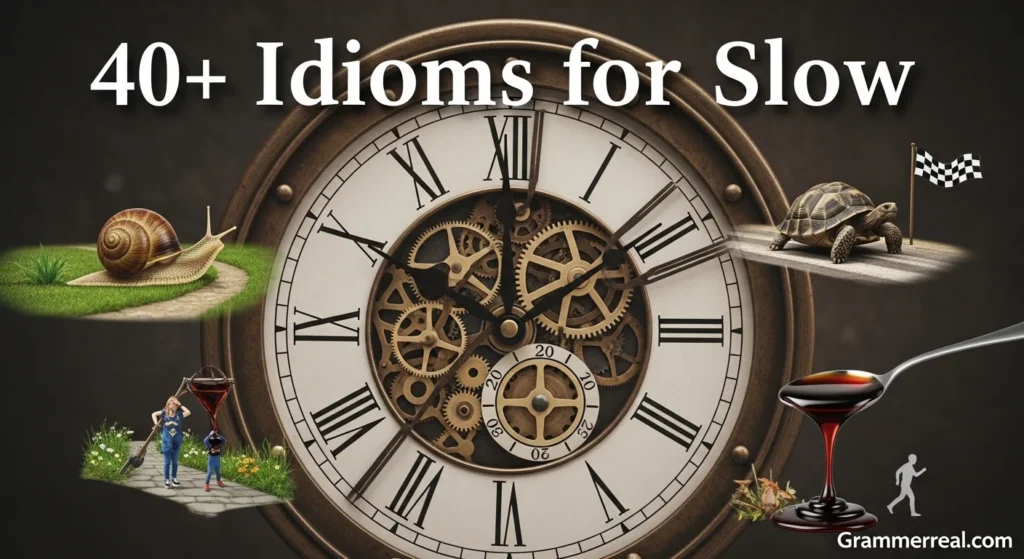
The room feels quiet. A clock ticks on the wall. Each second sounds louder than the last one. You wait. Nothing moves fast. The fan turns slowly. The air feels heavy. Even your thoughts seem to walk instead of run. In moments like this, time feels slow, soft, and stretched.
People often talk about speed. They talk about rushing, running, and finishing fast. But life does not always move quickly. Sometimes things happen little by little. Sometimes people work slowly and sometimes progress comes step by step. Because of this, the English language has many idioms for slow. These idioms help us describe actions, people, and moments that do not move fast.
Learning idioms for slow is useful for writers, students, and anyone who wants to speak in a more natural way. These expressions make sentences colorful. They also help you show feelings, not just facts. In this article, you will learn many slow idioms, their meanings, examples, and fun ways to use them in daily life, writing, and social media.
What Are Idioms for Slow
Idioms are phrases that have a special meaning. The words inside the phrase may look simple, but the meaning is different from the exact words.
For example, when someone says, “slow as a snail,” they do not really talk about a snail. They talk about something that moves very slowly.
Idioms for slow help us describe:
- People who take a long time
- Work that moves step by step
- Situations that feel boring or long
- Progress that comes little by little
Because of this, these idioms are very useful in stories, daily talk, and even jokes.
Also, slow idioms often use animals, nature, or daily life images. These pictures make the meaning easy to understand.
Why Idioms for Slow Are Important in Writing and Speaking
Many people write simple sentences like:
- He is slow.
- The work is slow.
- Time is slow.
These sentences are correct, but they feel flat. They do not show emotion.
Now look at this:
- He moves like a snail in winter.
- The work goes at a snail’s pace.
- The day feels like watching paint dry.
These sentences sound alive. They help the reader see the scene.
Using idioms for slow helps you:
- Make writing more interesting
- Show feelings clearly
- Sound natural in English
- Improve storytelling
- Write better posts and messages
Because of this, learning slow idioms is very helpful for students and writers.
Slow as a Snail – Meaning, Example, and Creative Use
This is one of the most common idioms for slow.
Meaning
Very slow movement.
Example sentence
The internet today is slow as a snail.
Alternative ways to say it
- Very slow
- Moving slowly
- Taking too long
- Not fast at all
Sensory detail
Imagine a snail on the road after rain. It moves little by little. You watch it, and it feels like nothing changes.
Mini story
I once waited for my friend outside the cinema. Five minutes passed. Then ten. Then twenty. I looked at my watch again and said, “He walks as slow as a snail when he is late.”
This idiom works well in jokes and stories.
At a Snail’s Pace – When Progress Feels Too Slow
This idiom is very close to the first one, but people use it more for work and progress.
Meaning
Something moves very slowly.
Example
The project is moving at a snail’s pace.
Alternative expressions
- Very slowly
- Step by step
- Little by little
- Not fast enough
Real-life situation
A student studies every day, but he learns only one page. After one month, he finishes only one chapter. He says, “My study goes at a snail’s pace, but I will not stop.”
This idiom shows patience and effort.
Dragging Your Feet – When Someone Moves Slowly on Purpose
Sometimes slow does not mean weak. Sometimes slow means someone does not want to do something.
Meaning
To do something slowly because you do not want to do it.
Example
He is dragging his feet about cleaning the room.
Alternative ways
- Not in a hurry
- Avoiding work
- Taking too long on purpose
Emotional detail
You know the feeling. Your mother tells you to do homework. You look at the book. You check your phone and you do everything except the work. That is dragging your feet.
This idiom is great for daily life talk.
Slow and Steady Wins the Race – A Famous Lesson About Patience
This idiom comes from a very old story about a turtle and a rabbit.
The rabbit runs fast. The turtle walks slowly. But the rabbit stops to rest. The turtle keeps going. In the end, the turtle wins.
Meaning
Slow work can still win if you never stop.
Example
Do not rush. Remember, slow and steady wins the race.
Alternative ideas
- Keep going
- Do not hurry
- Stay patient
- Work step by step
Mini storytelling
A writer wants to write a book. He writes only one page each day. After one year, he has a full book. His friend says, “You were slow, but you finished. Slow and steady wins the race.”
This idiom gives hope.
Like Watching Paint Dry – When Time Feels Very Slow
This idiom shows boredom.
Meaning
Something feels very slow and boring.
Example
This lecture is like watching paint dry.
Alternatives
- Very boring
- Too slow
- Taking forever
- No excitement
Sensory detail
Imagine staring at a wall after painting it. Nothing moves. Nothing changes. You wait and wait.
Writers use this idiom when they want humor.
Take Your Time – Slow Can Be Good
Not every slow moment is bad. Sometimes slow is better.
Meaning
Do not hurry.
Example
Take your time. Finish the work slowly.
Alternative expressions
- No rush
- Relax
- Go step by step
- Be careful
Real-life example
A teacher tells a student, “Take your time. Good work needs patience.”
This idiom feels kind and calm.
Move Like Molasses – A Funny Way to Say Very Slow
Molasses is thick and sticky. It moves very slowly.
Meaning
Extremely slow movement.
Example
The traffic moves like molasses today.
Alternatives
- Very slow
- Hard to move
- Stuck
- Not moving fast
Image feeling
Think of thick syrup falling from a spoon. That is how slow this idiom feels.
In the Slow Lane – Living Without Hurry
This idiom often talks about lifestyle.
Meaning
Living or working in a calm, slow way.
Example
After retirement, he lives in the slow lane.
Alternative ways
- Relaxed life
- Calm life
- No rush life
This idiom is good for stories about peace.
Step by Step – Slow but Safe
This idiom shows careful progress.
Meaning
Slow progress, but correct progress.
Example
Learn English step by step.
Alternatives
- Little by little
- Slowly
- Carefully
This idiom is perfect for students.
Behind the Times – Slow to Change
Sometimes slow means not modern.
Meaning
Not updated, old style thinking.
Example
This system is behind the times.
Alternatives
- Old style
- Not modern
- Late change
Writers use this idiom for culture and technology.
Slow but Sure – Trust the Process
This idiom shows confidence in slow work.
Meaning
Slow, but success will come.
Example
My progress is slow but sure.
Alternative ways
- I will reach
- I will finish
- I keep going
This idiom feels positive.
Take It Slow – Advice for Life
People often say this when someone feels stress.
Meaning
Relax and do things slowly.
Example
Take it slow. You do not need to hurry.
Alternatives
- Calm down
- Relax
- Go easy
This idiom works in daily talk.
Interactive Exercise: Practice Idioms for Slow
Try these exercises.
Exercise 1
Write a sentence using:
- slow as a snail
- step by step
- dragging your feet
Exercise 2
Describe a boring day using one idiom.
Exercise 3
Tell a short story about slow success.
Practice makes idioms easy.
Tips for Using Slow Idioms in Writing
Use idioms when:
- Writing stories
- Writing essays
- Writing posts
- Writing jokes
Tips:
- Do not use too many in one line
- Use them for emotion
- Use them for pictures
- Use them for fun
Good writing needs variety.
Using Slow Idioms in Daily Life and Social Media
You can use these idioms in messages.
Examples:
- My phone is slow as a snail today
- This week moves at a snail’s pace
- Homework feels like watching paint dry
These sentences sound natural.
People like expressive language.
Conclusion
Speed is not everything. Sometimes slow moments teach the most. When we learn idioms for slow, we learn how to show patience, humor, boredom, and calm feelings in better ways.
These idioms make writing colorful. They make speaking natural. They help stories feel rea and they also help readers see pictures in their minds.
So take your time. Learn step by step. Use these idioms in daily life. Slow learning is still learning, and slow writing can still become great writing.
Remember, slow and steady wins the race.
FAQs
1. What are idioms for slow?
Idioms for slow are phrases that describe something moving slowly, taking time, or happening step by step.
2. Why should I learn idioms for slow?
They make your writing more interesting and help you sound natural in English.
3. What is the most common idiom for slow?
Slow as a snail is one of the most common slow idioms.
4. Can I use slow idioms in essays?
Yes, but use them carefully. They work best in stories, examples, and creative writing.
5. How can I remember idioms easily?
Practice daily, write sentences, and use them in real conversation.