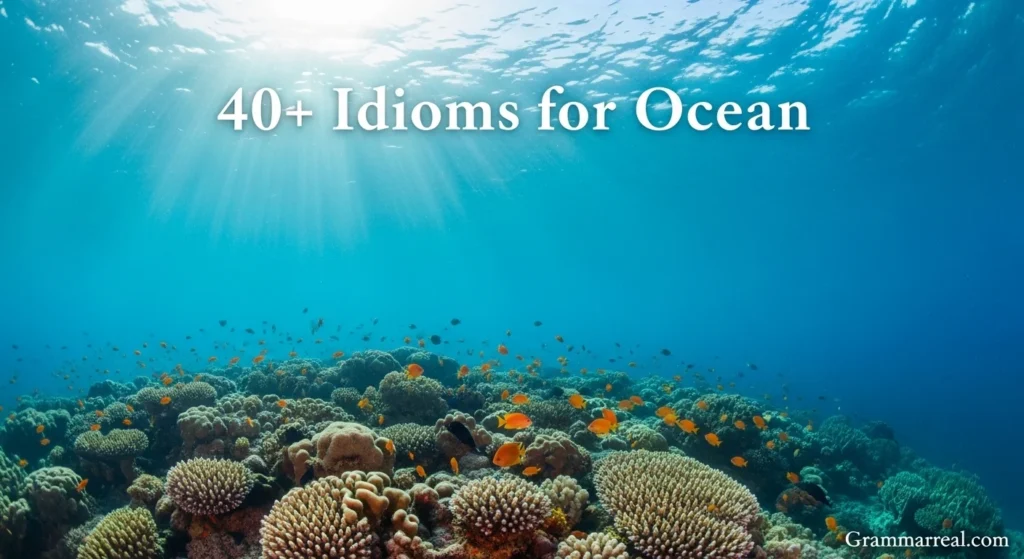
The wind moves slowly over the water. Waves rise, curl, and crash against the shore with a deep roaring sound. The salty smell fills the air, and the cool mist touches your face. You hear seagulls calling while the endless blue water stretches far beyond your sight. The ocean feels alive. It moves all the time, and because of that, people often use the ocean to describe feelings, problems, dreams, and life itself.
For many years, writers, sailors, and storytellers have used idioms for ocean to explain big emotions and deep situations. The ocean looks calm sometimes, but it can also become wild and dangerous. Because of this, ocean idioms help us talk about things that feel large, confusing, or powerful.
Learning these idioms is useful because they make your speech more colorful. They also help you sound natural in conversations, stories, and writing. In addition, ocean idioms make your words feel more alive, just like the sea itself.
In this article, you will learn many idioms for ocean, their meanings, examples, and creative ways to use them. You will also practice with fun exercises, short stories, and writing ideas. By the end, you will feel more confident using these expressions in daily life.
Why People Use Idioms for Ocean in Daily Life
People use ocean idioms because the sea is easy to imagine. Almost everyone has seen water, waves, or rivers, so ocean pictures quickly form in the mind. When we say life is like the ocean, people understand that life can be calm, rough, deep, or full of surprises.
Writers use ocean idioms to show strong feelings. For example, love can feel like a deep ocean. Problems can feel like big waves. Happiness can feel like smooth water. Because of this, ocean idioms help us explain emotions without using long sentences.
Another reason people use these idioms is that they sound natural. Native speakers often choose idioms instead of simple words. When you learn them, your English becomes richer and more interesting.
Also, ocean idioms appear in books, movies, songs, and speeches. So when you know them, you understand stories better. In fact, many famous writers used the sea as a symbol of life and adventure.
How Ocean Idioms Make Language More Colorful
Simple words tell the meaning, but idioms show the feeling. When you say, “I have many problems,” the sentence sounds plain. However, when you say, “I feel like I am drowning in problems,” the picture becomes clear.
Ocean idioms add color, sound, and emotion to language. They help readers imagine waves, storms, and deep water. Because of this, your writing feels stronger and more alive.
For example, a teacher may say, “Don’t make a big deal.” But an idiom sounds better: “Don’t make waves.”
Both sentences have the same meaning, yet the idiom creates a picture. That picture makes the message easier to remember.
When you use idioms often, your speech feels natural. At the same time, your stories become more interesting. That is why learning idioms for ocean helps both beginners and advanced learners.
A Drop in the Ocean
Meaning
“A drop in the ocean” means something very small compared to something very big. The ocean holds a huge amount of water, so one drop does not change anything. People use this idiom when an effort feels too small to make a difference.
Example
Ali gave one book to the library, but the school needed hundreds. His help felt like a drop in the ocean.
Alternative ways to say it
- Very small amount
- Not enough to matter
- Tiny compared to the whole
Story Example
A small village wanted to clean the beach. One boy picked up only one bottle and felt sad. Then his teacher smiled and said, “Every drop matters, even in the ocean.” The boy kept working, and slowly others joined him.
This story shows that even small actions can grow bigger.
Emotional detail
Sometimes this idiom sounds negative, but it can also give hope. A small start can become something large if people continue.
Make Waves
Meaning
To “make waves” means to cause trouble, change, or strong reactions. When waves move, the water does not stay calm. So this idiom shows action that disturbs peace.
Example
Sara asked many questions in class. She did not want to make waves, but she wanted to understand the lesson.
Alternative ways
- Cause trouble
- Create change
- Shake things up
Mini Story
In a company office, everyone stayed quiet even when rules felt unfair. One worker spoke up. At first, people felt nervous. Later, the boss listened and changed the rules. That worker made waves, but the change helped everyone.
Emotional detail
This idiom can sound negative, yet it can also be brave. Sometimes we must make waves to fix problems.
All at Sea
Meaning
“All at sea” means feeling confused or lost. When a ship stays in the middle of the ocean without direction, the crew feels unsure. So this idiom shows a state of confusion.
Example
When the teacher explained the new math rule, I felt all at sea.
Alternative ways
- Very confused
- Not sure what to do
- Lost and unsure
Story Example
A young sailor sailed for the first time. The sky turned dark, and he forgot the map. He felt all at sea, both in water and in his mind. Then the captain guided him, and he learned how to stay calm.
Emotional detail
This idiom often shows fear at first, but it can also show learning. When you feel lost, you have a chance to grow.
More Common Idioms for Ocean You Should Know
There are many ocean idioms in English. Each one shows a different feeling. Here are some useful ones.
- Smooth sailing – everything goes well
- In deep water – in trouble
- Test the waters – try something first
- Wave of emotion – strong feeling
- Sea of faces – many people
- Drown in work – too much work
These idioms appear in daily talk, stories, and movies. When you learn them, your understanding becomes stronger.
How Writers Use Ocean Idioms in Stories
Writers love the ocean because it shows change. The sea can be calm, then suddenly wild. Life feels the same way, so authors often compare life to the ocean.
In adventure stories, the sea shows danger and courage. In love stories, the sea shows deep feelings. In poems, the sea shows mystery and beauty.
For example, a hero may say, “I will cross every ocean for you.” This sentence shows strong love, even without many words.
Because of this, ocean idioms help writers make simple lines feel powerful.
Cultural and Literary References About the Ocean
Many cultures respect the ocean. Sailors tell stories about storms, treasure, and long journeys. These stories created many idioms we use today.
In old tales, the ocean often meant adventure. People believed the sea could test courage. Because of that, phrases like “uncharted waters” became popular.
Poets also wrote about the sea to show deep emotions. They compared the heart to waves, and dreams to ships. Even today, movies and songs use the ocean as a symbol of life.
When you learn ocean idioms, you also learn part of history and culture.
Tips for Remembering Idioms for Ocean Easily
Learning idioms can feel hard, but simple tricks help a lot.
First, imagine the picture. When you hear “drop in the ocean,” see the water in your mind. Pictures help memory stay strong.
Second, use idioms in your own sentences. Practice makes them natural.
Third, connect idioms to real life. When you feel confused, say, “I feel all at sea.” This habit makes learning faster.
Finally, read stories and watch movies. You will hear idioms again and again, so your brain remembers them without effort.
Practice Exercise – Fill the Situation with an Ocean Idiom
Try to complete these ideas. Choose the correct idiom.
- I have so much homework that I feel ______.
- He spoke against the rule and started to ______.
- My help was only ______ compared to the big problem.
Answers
- drowning in work / in deep water
- make waves
- a drop in the ocean
Practice like this every day, and idioms become easy.
Creative Writing Prompt Using Ocean Idioms
Now try a short writing exercise.
Imagine you stand near the ocean at sunset. The sky turns orange, and the wind feels cold. Write five sentences about your feelings using at least two ocean idioms.
Example idea “I felt all at sea when I thought about my future. My dreams looked like waves, big and endless. Still, I knew every step mattered, even if it felt like a drop in the ocean.”
This kind of practice makes your language strong and natural.
Using Ocean Idioms in Social Media and Daily Talk
Ocean idioms work well in short messages. They sound emotional and interesting, so people like reading them.
Examples
- “Too much work today, I am drowning!”
- “Trying something new, just testing the waters.”
- “Big change coming, time to make waves.”
These lines feel friendly and natural. Because of that, they fit perfectly in posts, chats, and captions.
When you use idioms online, your words stand out. People remember them more easily.
Common Mistakes When Using Ocean Idioms
Some learners use idioms in the wrong place. This happens when they translate directly from their language.
For example, saying “big ocean of problems” sounds strange. The correct idiom is “a sea of problems.”
Another mistake happens when people forget the meaning. “In deep water” means trouble, not real swimming.
To avoid mistakes, listen to real examples. Then repeat them in your own words.
Practice slowly, and your confidence will grow.
Fun Activity – Create Your Own Ocean Idiom
Now try something creative. Make your own idiom using the ocean.
Example “Floating without a map” – feeling lost in life.
Write three new idioms and give them meanings. This activity helps you understand how idioms work. It also makes learning fun.
You can even share your idioms with friends and ask them to guess the meaning.
Bonus Tips for Using Idioms in Writing and Speaking
Use idioms when you want emotion. They make sentences strong. Use them in stories to show feeling without long explanation. Use them in speech to sound natural and friendly.
However, do not use too many in one sentence. Too many idioms can confuse the listener.
A good rule is simple. Use one idiom when you want the reader to feel something clearly.
When you follow this rule, your language stays easy and powerful.
Conclusion
The ocean never stays still, and language should not stay plain. When you learn idioms for ocean, your words begin to move like waves. Sometimes they sound calm, sometimes strong, and sometimes deep with meaning.
These idioms help you explain feelings, problems, dreams, and ideas in a natural way. They also make your writing more interesting and your speech more alive. Even small practice can help a lot, and every sentence you try becomes another step forward.
So keep learning, keep practicing, and do not fear mistakes. Even a drop in the ocean can start a wave.
FAQs
1. What are idioms for ocean?
Idioms for ocean are expressions that use sea or water ideas to explain feelings, problems, or situations in a creative way.
2. Why should I learn ocean idioms?
You should learn them because they make your English sound natural, emotional, and more interesting in speaking and writing.
3. Are ocean idioms used in daily conversation?
Yes, people use them often in daily talk, stories, movies, and social media because they are easy to imagine and understand.
4. How can I remember idioms easily?
You can remember them by making pictures in your mind, using them in sentences, reading stories, and practicing every day.
5. Can I create my own idioms?
Yes, you can create new idioms for fun or writing practice. This helps you understand how expressions work and improves your creativity.