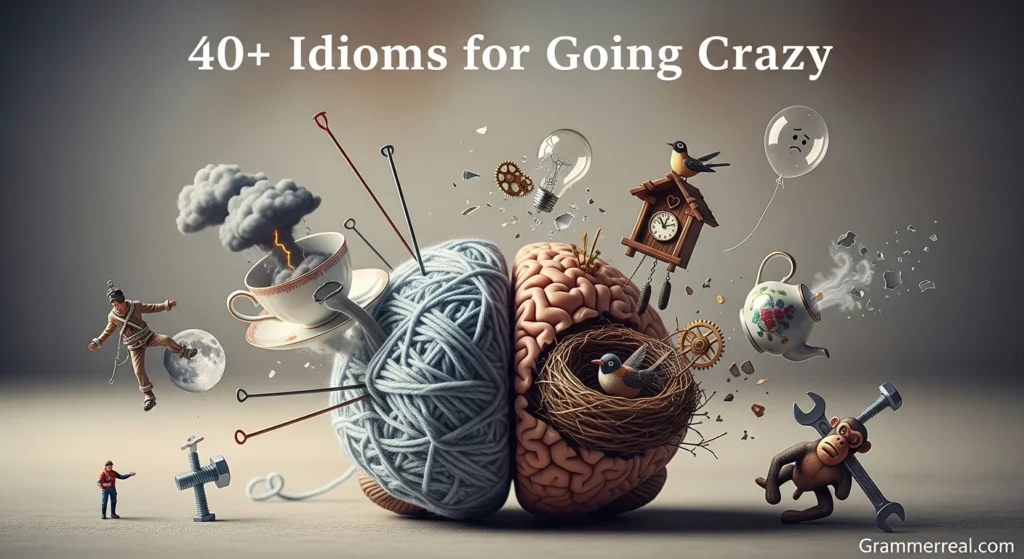
The room hums with a low electric buzz. Your thoughts race like tangled wires sparking in every direction. The clock ticks too loudly, the air feels too tight, and suddenly—you mutter, “I’m losing my mind.” That moment, that sensation of overwhelm, confusion, or emotional overload, lives at the heart of many vivid expressions we use every day. These expressions are called idioms for going crazy—colorful, imaginative phrases that capture what plain language often cannot.
Idioms for going crazy don’t just describe mental states; they dramatize them. They turn frustration into imagery, anxiety into motion, and confusion into storytelling. Whether you’re writing creatively, speaking casually, or posting on social media, these idioms add flavor, depth, and relatability to your communication. Moreover, they help you connect emotionally with others, because everyone has felt overwhelmed at some point. So, learning these idioms isn’t just about language—it’s about expression, connection, and storytelling power.
Understanding Idioms for Going Crazy
Idioms for going crazy refer to figurative expressions that describe feelings of confusion, frustration, stress, or emotional overload. They don’t literally mean someone is losing sanity; instead, they exaggerate emotions in a vivid and often humorous way.
For example, when someone says, “I’m going nuts,” they don’t mean they are literally turning into a nut. Instead, they express intense frustration or overwhelm. These idioms often rely on imagery, exaggeration, and cultural context.
Importantly, idioms like these appear in everyday conversations, movies, books, and even professional writing when used carefully. Therefore, mastering them helps you sound more natural and expressive.
Why Idioms Add Power to Language
Language becomes memorable when it paints pictures. Instead of saying, “I feel stressed,” you might say, “I’m at the end of my rope.” Instantly, the listener imagines tension, struggle, and emotional exhaustion.
Furthermore, idioms:
- Add emotional intensity
- Make speech more engaging
- Help convey tone quickly
- Create relatability
As a result, they transform ordinary communication into something dynamic and expressive.
Common Themes in “Going Crazy” Idioms
Interestingly, many idioms for going crazy share similar themes. They often involve:
- Losing control (e.g., “lose your marbles”)
- Breaking or snapping (e.g., “snap”)
- Movement or chaos (e.g., “running in circles”)
- Explosions or pressure (e.g., “blow a fuse”)
These themes reflect how humans experience stress and confusion—as something physical, intense, and sometimes uncontrollable.
Lose Your Marbles
Meaning and Explanation
“Lose your marbles” means to become confused, irrational, or mentally unstable. The phrase suggests losing something small but essential—like marbles—symbolizing a loss of control or clarity.
Example Scenario
After working non-stop for three days, Ali stared at his laptop and laughed randomly. His friend walked in and said, “You’ve finally lost your marbles, haven’t you?”
Alternative Expressions
- Go crazy
- Lose your mind
- Go off the rails
- Lose it
Sensory and Emotional Details
This idiom feels scattered and chaotic. You can almost hear marbles rolling across the floor, bouncing unpredictably—just like disorganized thoughts.
Mini Story
Imagine a writer surrounded by crumpled papers, empty coffee cups, and blinking screens. Each rejected sentence feels like another marble slipping away. Slowly, frustration builds, and suddenly—everything feels out of control.
Go Nuts
Meaning and Explanation
“Go nuts” describes a sudden burst of extreme emotion—excitement, anger, or frustration. It suggests an explosive reaction rather than a slow build.
Example Scenario
When the internet stopped working during an important meeting, Sara went nuts trying to fix it.
Alternative Expressions
- Freak out
- Lose control
- Go wild
- Flip out
Sensory and Emotional Details
This idiom feels loud and intense. You might imagine shouting, rapid movements, or even a racing heartbeat.
Cultural Reference
In many movies, characters “go nuts” when pushed beyond their limits. This dramatic reaction often marks a turning point in the story.
At Your Wits’ End
Meaning and Explanation
“At your wits’ end” means feeling completely overwhelmed and unsure what to do next. It reflects mental exhaustion rather than sudden chaos.
Example Scenario
After trying every solution to fix the problem, Ahmed sat back and sighed, “I’m at my wits’ end.”
Alternative Expressions
- Out of ideas
- Completely stuck
- Mentally drained
- At a loss
Sensory and Emotional Details
This idiom feels quiet but heavy. It carries a sense of stillness, like sitting in silence after exhausting every option.
Mini Story
A parent trying to calm a crying child late at night might reach this point. The room feels still, the clock ticks slowly, and the exhaustion becomes almost tangible.
The Role of Emotion in These Idioms
Emotion drives these expressions. Without emotion, they lose their power. When you say “I’m going crazy,” you don’t just describe a state—you express urgency, frustration, or intensity.
Therefore, always match the idiom to the emotion you want to convey. A calm situation doesn’t need a dramatic idiom, while a chaotic one benefits from it.
How Context Changes Meaning
Context shapes how these idioms sound. For example:
- “He went nuts” can sound humorous among friends
- The same phrase might sound serious in a professional setting
Thus, always consider your audience and tone before using these expressions.
Using Idioms in Everyday Conversations
Idioms make conversations more natural. Instead of sounding robotic, you sound human, expressive, and relatable.
For instance:
- Instead of: “I am very stressed.”
- Say: “I’m losing my mind over this project.”
As a result, your speech becomes more engaging and memorable.
Idioms in Creative Writing
Writers use these idioms to build character and mood. A character who says, “I’ve lost my marbles,” feels more vivid than one who simply says, “I am confused.”
Moreover, idioms can:
- Reveal personality
- Add humor
- Create tension
Therefore, they play a powerful role in storytelling.
Avoiding Overuse of Idioms
Although idioms add flavor, too many can overwhelm the reader. Imagine every sentence filled with dramatic expressions—it becomes exhausting.
Instead:
- Use idioms sparingly
- Choose the most impactful ones
- Balance them with clear language
This way, your writing stays effective and enjoyable.
Cultural Differences in Idioms
Different cultures use different idioms to express similar feelings. For example, one culture might say “going bananas,” while another uses a completely different image.
Because of this, idioms can sometimes confuse non-native speakers. However, learning them also offers insight into culture and humor.
The Psychology Behind “Going Crazy” Expressions
These idioms reflect how the human brain processes stress. When overwhelmed, we often describe feelings in exaggerated ways.
This exaggeration helps:
- Release tension
- Communicate intensity
- Create humor
Interestingly, humor often softens the seriousness of stress.
Interactive Exercise: Fill in the Idiom
Try completing these sentences:
- After the long meeting, I felt like I was ________.
- When the plans changed suddenly, she went ________.
- I’ve tried everything—I’m at my ________.
Now, check your answers:
- Losing my marbles
- Nuts
- Wits’ end
Creative Writing Prompt
Write a short paragraph describing a stressful situation using at least two idioms for going crazy.
For example: Describe a student before exams or a worker facing a deadline.
Focus on sensory details:
- What do they hear?
- What do they feel?
- What do they think?
This exercise strengthens both creativity and expression.
Social Media Tips for Using Idioms
Idioms work great on social media because they are short and expressive.
For example:
- “Deadlines got me losing my marbles today”
- “Internet down again—I’m going nuts!”
However, keep your audience in mind. Some idioms may not be universally understood.
Real-Life Situations Where These Idioms Fit
You might use these idioms when:
- Facing deadlines
- Dealing with technology issues
- Handling emotional stress
- Experiencing confusion
In these moments, idioms help you express feelings quickly and vividly.
Building Your Own Idiom Style
Over time, you can develop a personal style. Some people prefer humorous idioms, while others lean toward dramatic ones.
Experiment with:
- Tone
- Context
- Creativity
Eventually, you’ll find what feels natural and effective.
Bonus Tips for Stronger Expression
- Combine idioms with descriptive details
- Use tone to match the situation
- Avoid mixing too many idioms in one sentence
- Practice using them in speech and writing
These small adjustments make a big difference.
Expanding Your Idiom Vocabulary
The more idioms you learn, the more expressive you become. Try keeping a notebook or digital list of interesting phrases.
Whenever you hear a new idiom:
- Write it down
- Learn its meaning
- Use it in a sentence
This habit builds confidence and fluency.
Final Thoughts
As you explore these idioms, practice using them naturally. Blend them into conversations, writing, and even social media posts. However, always stay mindful of context and tone. When used thoughtfully, these expressions become tools—not just for language, but for storytelling and connection.
So the next time life feels overwhelming, don’t just say you’re stressed. Say you’re losing your marbles, going nuts, or at your wits’ end—and let your words carry the emotion for you.
Conclusion
Idioms for going crazy bring language to life. They transform simple emotions into vivid, relatable experiences. Instead of merely stating feelings, you paint them—loud, chaotic, or quietly overwhelming. From “losing your marbles” to being “at your wits’ end,” these expressions capture the human experience in all its intensity.
Moreover, they help you connect with others. Everyone understands stress, confusion, and emotional overload. When you use these idioms, you don’t just communicate—you resonate. You invite others into your experience, making your words more powerful and memorable.
FAQs
1. What are idioms for going crazy?
Idioms for going crazy are figurative expressions used to describe feelings of stress, confusion, or emotional overwhelm in a vivid and imaginative way.
2. Are these idioms used in formal writing?
Generally, they are more common in informal contexts. However, writers may use them creatively in storytelling or conversational-style writing.
3. Why do people use exaggerated expressions like these?
Exaggeration helps communicate emotions more clearly and makes language more engaging and relatable.
4. Can non-native speakers use these idioms easily?
Yes, but they should learn the meanings and contexts carefully, as idioms can sometimes be confusing or culture-specific.
5. How can I improve my use of idioms?
Practice regularly, observe how native speakers use them, and try incorporating them into your daily conversations and writing.



