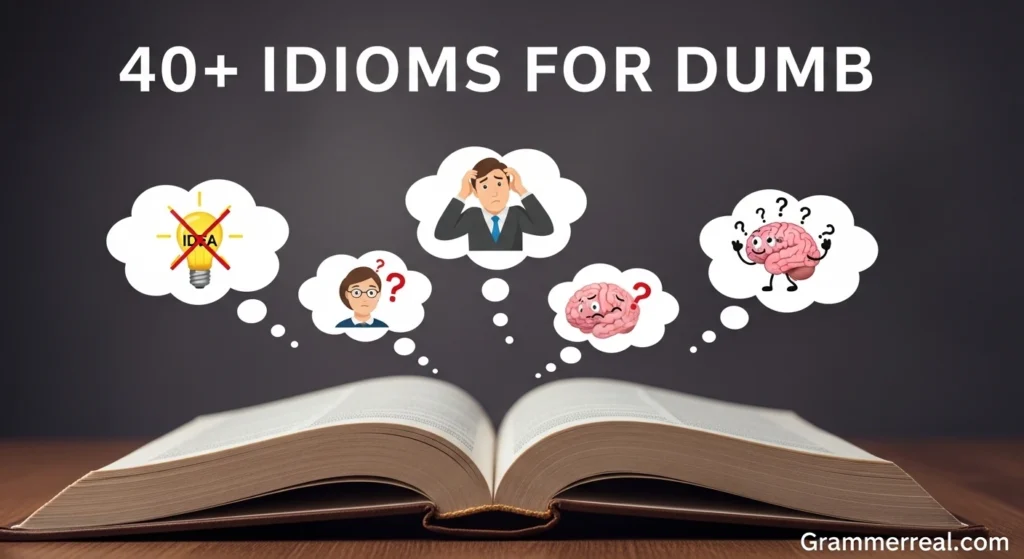
Learning idioms for dumb is important for English learners because native speakers often use creative expressions instead of directly saying someone is stupid or not smart. In real conversations, people prefer idioms, slang, or humorous phrases to describe mistakes, confusion, or foolish behavior. Understanding these idioms helps learners sound more natural and confident in everyday English.
There is also an emotional and practical benefit. When you know different idioms, you can choose polite, funny, or informal expressions depending on the situation. This helps avoid misunderstandings and makes communication smoother in school, work, and social life.
Students, professionals, and language learners frequently hear these idioms in movies, TV shows, books, and conversations. Without knowing them, it becomes difficult to understand real English. With practice, however, these expressions become easy to use.
In this complete guide, you will learn 18 idioms for dumb, including meanings, examples, origins, alternative expressions, use cases, exercises, and expert tips. This article is designed to be more detailed and helpful than typical guides, so you can truly master these expressions.
What Does “Idioms for Dumb” Mean?
The phrase idioms for dumb refers to expressions used to describe someone who is acting foolish, confused, careless, or not thinking clearly.
Important note for learners:
In modern English, the word dumb can sometimes sound rude or offensive. Because of this, native speakers often use idioms instead. Idioms allow people to express the same idea in a softer, funnier, or less direct way.
Examples of simple vs idiomatic speech:
Simple sentence He is dumb.
Idiomatic sentence He is not the sharpest tool in the shed.
Both mean the same, but the idiom sounds more natural and less harsh.
These idioms are common in:
- Casual conversation
- Movies and TV shows
- Jokes and humor
- Informal writing
- Friendly teasing
Learning them helps you understand real English better.
Why Learning Idioms Improves Fluency and Natural Speech
Many English learners know grammar but still sound unnatural. This happens because real English uses idioms very often.
Benefits of learning idioms:
Better listening skills You will understand movies and conversations more easily.
More natural speaking Native speakers rarely say things in a direct way.
Stronger vocabulary Idioms help you describe people and situations more precisely.
Cultural understanding Many idioms come from history, tools, farming, sports, or daily life.
Professional advantage Knowing idioms helps you understand jokes, informal talk, and friendly discussions at work.
When you learn idioms for dumb, you also learn how English speakers talk about mistakes, confusion, and silly behavior in a polite or humorous way.
Not the Sharpest Tool in the Shed
Meaning Someone who is not very intelligent.
Example He forgot his keys again. He is not the sharpest tool in the shed.
Alternative expressions
- Not the brightest bulb
- Not the sharpest knife
- Not very clever
Origin This idiom comes from tools. A dull tool cannot work well, just like a person who is not thinking clearly.
Use cases
- Friendly jokes
- Casual conversations
- Informal situations
Not the Brightest Bulb
Meaning Someone who is not very smart.
Example He believed that rumor easily. He is not the brightest bulb.
Alternative expressions
- Not the sharpest tool
- Not very bright
- Slow thinker
Fun fact This idiom comes from light bulbs. A dim bulb gives less light, meaning less intelligence.
Use cases
- Humor
- Friendly teasing
- Storytelling
A Few Sandwiches Short of a Picnic
Meaning Someone who is not thinking normally or missing common sense.
Example If he thinks that will work, he is a few sandwiches short of a picnic.
Alternative expressions
- A few screws loose
- Not all there
- Missing something
Origin The idea is that a picnic is incomplete without enough food.
Use cases
- Jokes
- Funny conversations
- Informal talk
A Few Screws Loose
Meaning Someone who behaves strangely or foolishly.
Example He talks to himself all the time. He may have a few screws loose.
Alternative expressions
- Not all there
- Crazy
- Odd
Origin Machines do not work properly when screws are loose.
Use cases
- Humor
- Informal speech
- Describing strange behavior
Not Playing with a Full Deck
Meaning Someone who is not thinking clearly or lacks intelligence.
Example If he believes that story, he is not playing with a full deck.
Alternative expressions
- Not all there
- Missing something
- Not very smart
Origin A card game needs a full deck to work properly.
Use cases
- Friendly jokes
- Casual talk
- Storytelling
Dumb as a Rock
Meaning Very unintelligent.
Example He did not understand anything. He was dumb as a rock.
Alternative expressions
- Dumb as a brick
- Very slow
- No idea
Use cases
- Informal speech
- Jokes
- Strong criticism
Note This idiom can sound rude, so use carefully.
Thick as a Brick
Meaning Very slow to understand.
Example He could not solve the easy problem. He is thick as a brick.
Alternative expressions
- Slow learner
- Not very bright
- Hard to understand
Origin A brick is heavy and solid, so the idiom suggests slow thinking.
Slow on the Uptake
Meaning Someone who takes a long time to understand.
Example He is slow on the uptake but he learns eventually.
Alternative expressions
- Slow learner
- Takes time to understand
- Not quick thinker
Use cases
- Polite description
- Classroom situations
- Work situations
Not All There
Meaning Someone who is confused or not thinking normally.
Example He keeps forgetting simple things. He is not all there today.
Alternative expressions
- Not focused
- Distracted
- Absent-minded
Use cases
- Friendly talk
- Informal situations
- Light criticism
Empty-Headed
Meaning Someone who does not think carefully.
Example That was an empty-headed decision.
Alternative expressions
- Silly
- Thoughtless
- Careless
Use cases
- Writing
- Speaking
- Describing mistakes
Boneheaded
Meaning Very foolish or stupid.
Example That was a boneheaded mistake.
Alternative expressions
- Silly
- Foolish
- Stupid mistake
Origin Bonehead means a hard head that does not think.
Blockhead
Meaning A person who is not intelligent.
Example Do not be a blockhead. Think before you speak.
Alternative expressions
- Fool
- Dummy
- Silly person
Origin Used in old English literature.
Clueless
Meaning Someone who has no idea what is happening.
Example He looked clueless during the meeting.
Alternative expressions
- Confused
- Lost
- No idea
Use cases
- Workplace
- School
- Daily life
Out to Lunch
Meaning Not paying attention.
Example He was out to lunch during the lecture.
Alternative expressions
- Not focused
- Distracted
- Not thinking
Origin Someone who is out for lunch is not present.
Birdbrain
Meaning Someone who is silly or forgetful.
Example You forgot again, birdbrain.
Alternative expressions
- Silly person
- Forgetful
- Not thinking
Use carefully This can sound insulting.
No Common Sense
Meaning Someone who cannot make simple decisions.
Example He has no common sense.
Alternative expressions
- Foolish
- Careless
- Thoughtless
Use cases
- Advice
- Complaints
- Teaching situations
Grouping Idioms by Context
Funny idioms
- Not the brightest bulb
- A few sandwiches short
- Birdbrain
Polite idioms
- Slow on the uptake
- Not all there
- Clueless
Strong idioms
- Dumb as a rock
- Thick as a brick
- Boneheaded
Workplace-friendly idioms
- Not focused
- Slow learner
- Clueless
Grouping helps remember idioms faster.
Tips for Using These Idioms Correctly
Use polite idioms in professional situations.
Avoid strong idioms with strangers.
Use humor carefully.
Learn the context before speaking.
Listen to native speakers.
Practice in sentences.
Common Mistakes Learners Make
Using idioms in formal writing.
Using rude idioms in serious situations.
And using idioms without context.
Translating directly from your language.
Forgetting tense.
Practice Exercise 1 (Easy)
Fill in the blanks.
- He forgot again. He is not the ______ bulb.
- She looked ______ during the meeting.
- He is slow on the ______.
Answers
- brightest
- clueless
- uptake
Practice Exercise 2 (Medium)
Choose correct idiom.
- Someone very slow a slow on the uptake b paint the town red c live it up
- Someone confused a clueless b sharp c smart
Answers
- a
- a
Practice Exercise 3 (Advanced)
Rewrite sentence.
He is not smart.
Possible answers
- He is not the brightest bulb.
- He is slow on the uptake.
- He is not the sharpest tool in the shed.
Suggested Visual Ideas for Learning
Infographic of idioms
Cartoons showing idioms
Context charts
Conversation examples
Memory cards
Visual learning improves memory.
Key Takeaways
Idioms for dumb are common in real English.
They help you sound natural.
They make speech more interesting.
And they help understand movies and jokes.
Practice is the key.
Conclusion
Learning idioms for dumb helps English learners understand how native speakers talk about mistakes, confusion, and foolish behavior in everyday life. These expressions are common in conversations, movies, and informal writing, so knowing them improves both listening and speaking skills.
Instead of using direct or rude words, idioms allow you to speak in a more natural, humorous, or polite way. Expressions like “not the sharpest tool in the shed” or “slow on the uptake” make communication more interesting and less offensive.
The best way to master these idioms is to practice them in real sentences, conversations, and exercises. Over time, they become easy to remember and natural to use.
Keep learning, keep practicing, and soon you will understand and use English idioms with confidence.
FAQs
1. What are idioms for dumb?
They are expressions used to describe someone who is confused, foolish, or not thinking clearly without using direct rude words.
2. Are these idioms rude?
Some are polite, some are strong. Always check context before using.
3. Can I use these idioms in formal writing?
Most idioms are better for informal speech.
4. How can I remember idioms easily?
Practice daily, read stories, and watch English videos.
5. Which idiom is most common?
Not the sharpest tool in the shed and not the brightest bulb are very common.