Understanding idioms for being sick is more than just learning words—it is about speaking naturally and confidently in English. Using idioms correctly can make your conversations sound authentic, fun, and relatable. Whether you are a student, professional, or English learner, knowing these idioms will help you describe illnesses, symptoms, or feelings when unwell in a way that native speakers do.
Idioms also help you understand everyday conversations, TV shows, movies, and books, where direct medical terminology is rarely used. Knowing how to say “I feel sick” in many creative ways can make your English communication more expressive and emotionally rich.
This article will take you through a wide range of idioms related to being sick, their meanings, examples, origins, and how to use them in daily life. By the end, you will be able to confidently use these idioms, understand others, and even enjoy practicing English in a new, engaging way.
Feeling Under the Weather
Meaning: Feeling slightly sick or unwell.
Example: “I think I’ll stay home today; I’m feeling under the weather.”
Alternative Expressions: “Feeling off,” “Not feeling my best,” “Out of sorts.”
Fun Fact/Origin: This idiom comes from old nautical language. Sailors used to say they felt “under the weather bow” when seasickness or bad weather made them feel ill.
Typical Use: Casual conversation about mild illness, like colds or fatigue.
Interactive Exercise (Easy): Fill in the blank: “After working late last night, I felt _________ and decided to take a nap.” Answer: under the weather
Feeling Off
Meaning: Not feeling quite right physically or mentally.
Example: “I felt off all day, so I skipped the meeting.”
Alternative Expressions: “Feeling funny,” “Not myself today,” “Out of sorts.”
Use Cases: Can describe physical sickness or a general feeling of discomfort or unease.
Interactive Exercise (Medium): Choose the correct idiom: “After the long hike, I felt _________ and needed to sit down.” a) on cloud nine b) off c) over the moon Answer: b) off
Feeling Like Death Warmed Over
Meaning: Feeling extremely ill, tired, or worn out.
Example: “I stayed up all night with a fever and now I feel like death warmed over.”
Alternative Expressions: “Feeling awful,” “Completely drained,” “At death’s door.”
Origin: This idiom dates back to the 1600s in English literature, describing someone appearing pale and weak, like a corpse that had been warmed slightly.
Use Cases: Severe illness or extreme exhaustion.
Interactive Exercise (Advanced): Complete the sentence: “After the flu, I got up in the morning and felt ________.” Answer: like death warmed over
Down with Something
Meaning: To be sick with a particular illness.
Example: “He’s down with the flu and will be out for a week.”
Alternative Expressions: “Struck by,” “Suffering from,” “Battling with.”
Use Cases: Used to talk about illnesses like the flu, cold, or stomach bugs.
Fun Fact: Commonly used in medical announcements and casual conversations.
Interactive Exercise (Medium): Fill in the blank: “She’s _______ a cold, so she’s resting at home.” Answer: down with
On the Mend
Meaning: Recovering from an illness or injury.
Example: “I’m finally on the mend after a week of flu.”
Alternative Expressions: “Getting better,” “Improving,” “Healing.”
Origin: The phrase comes from the old English word “mend,” meaning to repair or improve.
Use Cases: Describing recovery from illness or physical injury.
Interactive Exercise (Easy): Choose the correct completion: “After taking the medicine, he is slowly ________.” a) down with b) on the mend c) under the weather Answer: b) on the mend
Off Color
Meaning: Slightly unwell or not in good health.
Example: “I’m feeling a bit off color today, so I won’t go to the gym.”
Alternative Expressions: “Feeling poorly,” “Not in top form,” “Under the weather.”
Fun Fact: “Off color” originally referred to things that looked unhealthy or not quite right in color, like pale skin indicating illness.
Use Cases: Mild sickness or discomfort, often used in British English.
Under the Knife
Meaning: To undergo surgery or medical operation.
Example: “She will be under the knife tomorrow for her appendix removal.”
Alternative Expressions: “Having surgery,” “Going into surgery,” “Undergoing an operation.”
Origin: Refers to the surgical knife, symbolizing medical intervention.
Use Cases: Formal or semi-formal discussions about health and medical procedures.
Interactive Exercise (Advanced): Complete the sentence: “Next week, he will be _______ to remove his gallbladder.” Answer: under the knife
Sick as a Dog
Meaning: Extremely ill, usually with stomach or digestive problems.
Example: “I was sick as a dog after eating the seafood.”
Alternative Expressions: “Really sick,” “Very ill,” “Feeling terrible.”
Origin: Dates back to the 1600s; dogs were commonly observed being very ill, giving rise to the comparison.
Use Cases: Informal speech, often exaggerating sickness for emphasis.
Green Around the Gills
Meaning: Looking ill or nauseated.
Example: “You look green around the gills. Are you feeling okay?”
Alternative Expressions: “Pale,” “Sickly,” “Looking unwell.”
Fun Fact: The idiom uses “gills” like a fish; green suggests nausea and paleness.
Use Cases: Often used to describe someone who looks about to vomit or faint.
Interactive Exercise (Medium): Identify the correct idiom: “After spinning on the ride, she felt ________.” Answer: green around the gills
Feeling Rough
Meaning: Feeling unwell, tired, or uncomfortable.
Example: “I’m feeling rough after staying up all night studying.”
Alternative Expressions: “Feeling lousy,” “Feeling awful,” “Feeling off.”
Use Cases: Casual conversations about minor illnesses or fatigue.
Under the Weather Bow
Meaning: Specifically used for seasickness or mild illness caused by environmental factors.
Example: “After the boat ride, he was under the weather bow all day.”
Origin: Nautical term referring to being under the bow of a ship, which can cause seasickness.
Use Cases: Mainly historical or context-specific, interesting for language learners.
At Death’s Door
Meaning: Extremely ill, close to dying.
Example: “He was at death’s door after the severe infection.”
Alternative Expressions: “On the brink of death,” “Seriously ill,” “Critical condition.”
Fun Fact: Dramatic idiom often used in literature and storytelling.
Use Cases: To describe serious illness or life-threatening conditions.
Feeling Woozy
Meaning: Lightheaded, dizzy, or slightly sick.
Example: “I felt woozy after standing in the sun too long.”
Alternative Expressions: “Dizzy,” “Faint,” “Unsteady.”
Use Cases: Mild sickness, often related to physical strain, heat, or medication.
Interactive Exercise (Easy): Fill in the blank: “After the roller coaster, he felt _______ and had to sit down.” Answer: woozy
Feeling Peaky
Meaning: Looking pale, tired, or slightly ill.
Example: “You look peaky today. Did you get enough sleep?”
Alternative Expressions: “Pale,” “Under the weather,” “Not looking well.”
Fun Fact: Commonly used in British English. “Peaky” comes from “peak,” meaning sharp or pointed, indicating a sharp decline in health.
Laid Up
Meaning: Confined to bed or resting due to illness.
Example: “He’s laid up with a bad cold and can’t come to work.”
Alternative Expressions: “Bedridden,” “Out of action,” “Stuck in bed.”
Use Cases: Describing someone who is temporarily unable to function due to sickness.
Run Down
Meaning: Physically weak or sick due to overwork or stress.
Example: “She’s been working too hard and is feeling run down.”
Alternative Expressions: “Exhausted,” “Weakened,” “Burned out.”
Use Cases: Describes mild illness or fatigue caused by stress, overwork, or lack of rest.
Interactive Exercise (Medium): Choose the correct idiom: “After weeks of overtime, I felt completely _______.” Answer: run down
Under Par
Meaning: Not in good health or not performing well.
Example: “I’ve been under par all week because of my cold.”
Alternative Expressions: “Off my game,” “Not feeling well,” “Below standard.”
Origin: Comes from golf, where being under par means below the expected score, metaphorically applied to health.
Use Cases: Casual or semi-formal speech about mild sickness or reduced performance.
Going Down with Something
Meaning: Starting to get sick with an illness.
Example: “I think I’m going down with the flu, I have a headache and chills.”
Alternative Expressions: “Catching something,” “Getting sick,” “Feeling unwell.”
Use Cases: Talking about early signs of sickness, commonly used in daily conversation.
Interactive Exercise (Advanced): Complete the sentence: “After spending a day in the rain, I felt like I was ________.” Answer: going down with something
Extra Tips for Using Idioms for Being Sick Effectively
- Context Matters: Use casual idioms like “sick as a dog” with friends, but more formal expressions like “under the knife” for professional conversations.
- Observe Native Usage: Watch movies, series, or YouTube videos to see how native speakers describe being sick.
- Avoid Overuse: Using too many idioms in one conversation can sound unnatural.
- Pronunciation Practice: Some idioms like “green around the gills” may be tricky; practice saying them aloud.
- Pair with Simple Words: For learners, combine idioms with simpler explanations to ensure clarity.
Common Mistakes to Avoid
- Confusing idioms with literal meaning. Example: “Feeling under the knife” does not mean lying in bed—it means surgery.
- Using idioms only in writing—many are informal and better in spoken English.
- Forgetting context: some idioms describe mild sickness, others severe illness.
Suggested Visuals or Infographics
- Chart of Idioms by Severity: Mild (under the weather) → Severe (at death’s door)
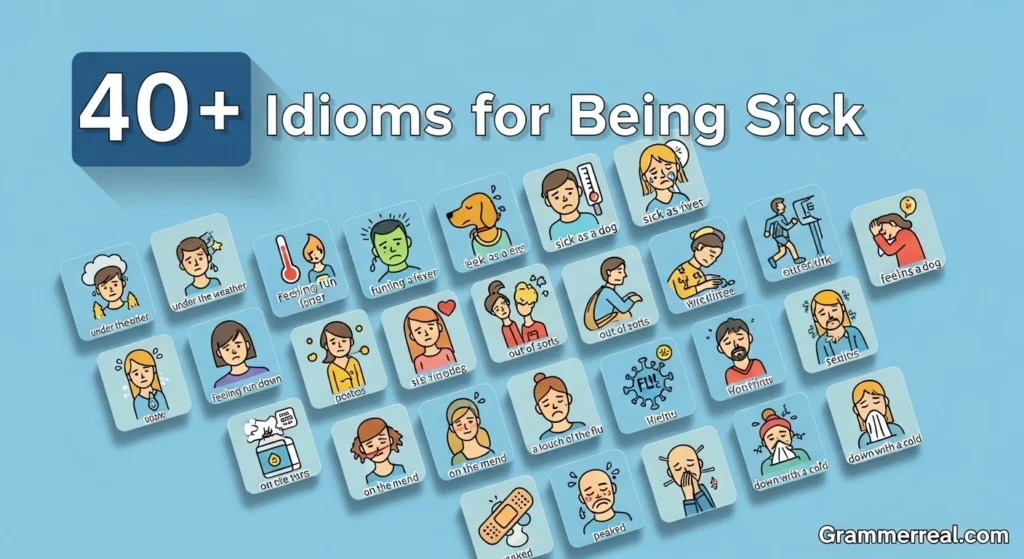
- Illustrations of Expressions: Faces showing “green around the gills,” “sick as a dog,” etc.
- Interactive Quizzes: Fill-in-the-blank idioms with images of symptoms.
Fun Interactive Quiz (Mixed Difficulty)
1. Which idiom describes extreme sickness? a) Under the weather b) At death’s door c) Off color Answer: b) At death’s door
2. Fill in the blank: “I ate too much spicy food and now I feel _______.” Answer: sick as a dog
3. Which idiom means starting to get sick? a) Down with something b) Going down with something c) On the mend Answer: b) Going down with something
4. Which idiom is used for recovering from illness? a) On the mend b) Feeling off c) Green around the gills Answer: a) On the mend
5. Fill in the blank: “After standing in the sun too long, I felt _______ and dizzy.” Answer: woozy
Conclusion
Learning idioms for being sick is not only about memorizing phrases; it is about understanding English as it is naturally spoken. These idioms enrich your conversations, help you understand movies, books, and everyday dialogue, and make your English sound more native.
By practicing these idioms, observing context, and using them in real-life situations, you can improve your fluency and express your feelings of illness clearly and creatively. Remember, idioms often carry emotional weight, so using them appropriately can also help you connect better with native speakers.
Keep practicing, and soon describing sickness in English will be second nature.
FAQs
What does “under the weather” mean?
It means feeling slightly sick or unwell, often used for mild illness or discomfort.
Can I use “sick as a dog” in professional settings?
No, it is informal and best used with friends or casual conversations.
What is the difference between “down with something” and “going down with something”?
“Down with something” means currently sick with an illness, while “going down with something” means starting to get sick.
Are these idioms used worldwide?
Many are common in English-speaking countries like the US, UK, Canada, and Australia, but usage may vary by region.
How can I practice these idioms effectively?
Use them in conversations, write short sentences or stories, watch English media, and do quizzes to reinforce your learning.