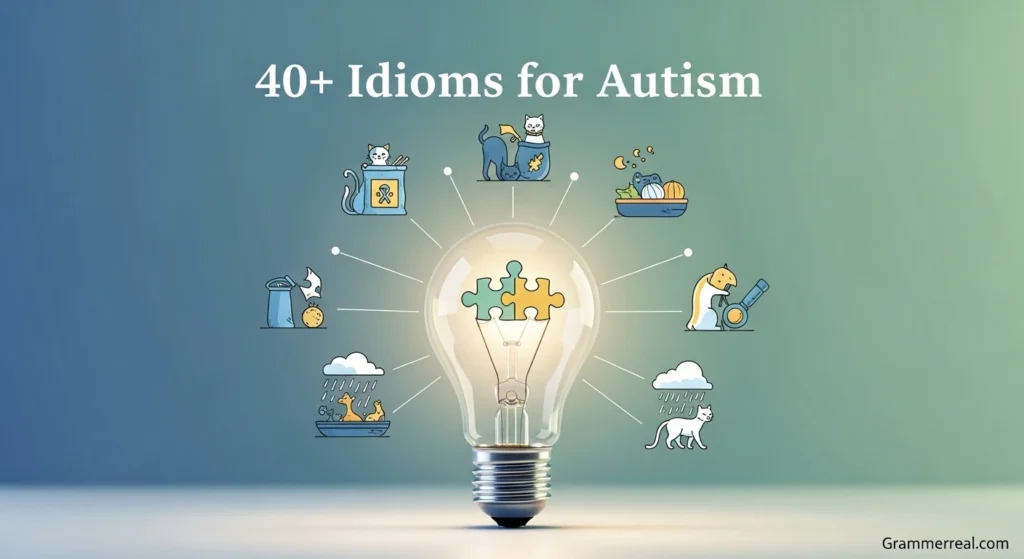
Understanding autism is an important skill in today’s diverse world. Autism affects how people communicate, interact, and perceive the world around them. Learning idioms related to autism not only helps improve
English skills but also develops empathy and awareness. This knowledge can help students, professionals, and anyone interacting with autistic individuals to communicate more effectively. By understanding these idioms, readers can navigate conversations with care, avoid misunderstandings, and create supportive environments for autistic people.
Understanding the Concept of Autism in Simple Terms
Before diving into idioms, it is crucial to understand autism itself. Autism, or Autism Spectrum Disorder (ASD), is a developmental condition that affects social skills, communication, behavior, and sometimes learning patterns. Autistic individuals may have unique ways of interacting with the world. They may have intense focus on specific interests, face challenges in social communication, or express emotions differently.
Knowing idioms that relate to autism helps learners understand how English speakers express ideas about social behavior, communication, and neurodiversity. This understanding is useful in workplaces, classrooms, and everyday life.
Why Learning Idioms for Autism is Important
Idioms are phrases where the meaning is not literal but figurative. For example, “reading between the lines” does not literally mean reading lines but understanding hidden meaning. Learning idioms related to autism allows learners to:
- Communicate with sensitivity and awareness.
- Understand literature, news, and everyday conversations.
- Improve vocabulary and cultural knowledge.
- Avoid misinterpretation or offensive usage.
For students and professionals, knowing these idioms is useful in psychology, education, healthcare, and social services. They also help build empathy and create a respectful environment for autistic individuals.
Common Idioms Used in Relation to Autism
Here are some frequently used idioms connected with autism and social behavior. Each idiom is explained with meaning, examples, and tips for usage:
- “On the spectrum”
- Meaning: Refers to someone who has autism or exhibits traits of autism.
- Example: “My cousin is on the spectrum, and he loves painting.”
- Alternative Expressions: “Has autistic traits,” “Neurodiverse.”
- Use Case: Often used in casual conversation or awareness campaigns.
- “Socially awkward”
- Meaning: Someone who finds social interactions difficult.
- Example: “She can be socially awkward in large groups, but she is very kind.”
- Fun Fact: Social awkwardness is not exclusive to autism but is a common trait.
- “Marching to the beat of their own drum”
- Meaning: Doing things in a unique or unconventional way.
- Example: “He’s on the spectrum and marches to the beat of his own drum when it comes to fashion.”
- Tip: This idiom can be used positively to celebrate individuality.
- “Thinking outside the box”
- Meaning: Approaching problems creatively or unusually.
- Example: “Her solution was unexpected but brilliant, showing how she thinks outside the box.”
- Use Case: Often used in professional settings to praise creativity.
- “Lost in their own world”
- Meaning: Someone is deeply focused on their thoughts or interests.
- Example: “He was lost in his own world, drawing detailed pictures for hours.”
- Alternative Expressions: “In a bubble,” “Daydreaming.”
Idioms Reflecting Communication Differences
Autistic individuals often communicate differently. Some idioms describe these unique communication styles:
- “Not read between the lines”
- Meaning: Difficulty understanding implied meanings.
- Example: “She didn’t understand the sarcasm because she can’t read between the lines.”
- Tip: Useful for describing literal thinking often observed in autism.
- “Speak your mind”
- Meaning: Expressing thoughts directly without filtering.
- Example: “He always speaks his mind, even when it surprises others.”
- Fun Fact: Direct communication is a strength in many autistic individuals.
- “Call a spade a spade”
- Meaning: Being honest and straightforward.
- Example: “She calls a spade a spade, which some people find blunt.”
- “Lost in translation”
- Meaning: Struggling to understand social or nonverbal cues.
- Example: “Sometimes her jokes are lost in translation because she takes things literally.”
- “Keep it simple”
- Meaning: Using clear, straightforward language.
- Example: “When explaining instructions, it’s better to keep it simple for better understanding.”
Idioms About Emotional Expression
Understanding emotions is another key area where idioms help:
- “Wear your heart on your sleeve”
- Meaning: Showing emotions openly.
- Example: “He wears his heart on his sleeve, so you always know how he feels.”
- Tip: Can describe an autistic person who expresses feelings openly.
- “Bottling up emotions”
- Meaning: Keeping feelings hidden.
- Example: “He tends to bottle up his emotions when overwhelmed.”
- “Read the room”
- Meaning: Understanding the mood of a group.
- Example: “She struggled to read the room at the party.”
- Fun Fact: Reading social cues is often challenging for autistic individuals.
- “A rollercoaster of emotions”
- Meaning: Experiencing many emotions quickly.
- Example: “His response was a rollercoaster of emotions from excitement to frustration.”
Idioms for Behavior and Routine
Routines and behavior patterns are important in autism. These idioms explain related traits:
- “Creature of habit”
- Meaning: Someone who likes routines and predictability.
- Example: “He is a creature of habit, waking up at the same time every day.”
- “Set in your ways”
- Meaning: Resistant to change.
- Example: “She is set in her ways, but her routine makes her feel secure.”
- “Stick to your guns”
- Meaning: Maintaining personal beliefs or habits.
- Example: “Even if others disagree, he sticks to his guns about his hobbies.”
- “In a groove”
- Meaning: Following a comfortable routine or pattern.
- Example: “He was in a groove, completing his tasks efficiently every morning.”
Grouping Idioms by Context
For better understanding, idioms can be grouped by context:
- Social Interaction: socially awkward, lost in translation, read the room
- Emotional Expression: wear your heart on your sleeve, bottling up emotions, rollercoaster of emotions
- Routine and Habits: creature of habit, stick to your guns, in a groove
- Individuality and Creativity: thinking outside the box, marching to the beat of their own drum
This grouping helps learners remember idioms more easily and use them in the right context.
Tips for Using Idioms Effectively
- Understand the meaning: Never guess idiom meanings.
- Know the context: Some idioms are casual, others formal.
- Practice regularly: Use idioms in sentences and conversations.
- Avoid stereotypes: Idioms should not be used to mock or insult autistic people.
- Combine with real-life examples: Use personal or observed examples for clarity.
Common Mistakes to Avoid
- Using idioms literally. For example, “lost in translation” is figurative, not about languages.
- Overusing idioms in formal writing. Keep some sentences plain for clarity.
- Misapplying idioms to stereotype autistic individuals. Always use with respect.
- Ignoring tone. Idioms like “stick to your guns” can sound harsh if misused.
Visuals and Infographic Suggestions
Visual aids help learners remember idioms better. Suggestions include:
- Illustrations: Show literal vs. figurative meaning of idioms.
- Mind maps: Group idioms by context or meaning.
- Charts: Compare idioms for communication, emotions, and routines.
- Example scenarios: Visual storytelling of idioms in real-life situations.
Exercises to Practice Idioms
Exercise 1: Fill in the blanks (Easy)
- He always ______ his mind, so people know what he thinks.
- She is a ______ of habit and follows the same routine every day.
- He was ______ in his own world, drawing for hours.
Answers:
- speaks
- creature
- lost
Exercise 2: Match idioms to meaning (Medium)
- Read the room
- Marching to the beat of their own drum
- Bottling up emotions
a. Expressing feelings openly b. Understanding group mood c. Following personal uniqueness
Answers: 1 → b 2 → c 3 → a
Exercise 3: Create sentences using idioms (Advanced)
- Task: Write three sentences using any idioms from the article. Include context and explanation.
Fun Facts About Idioms and Autism
- Many idioms related to autism reflect creativity and individuality.
- “Marching to the beat of your own drum” comes from music and literally means moving differently from others.
- Some idioms have been adapted from psychological research about behavior and social patterns.
Practical Tips for Learners
- Start with 3–5 idioms per week and use them in conversations.
- Listen to native speakers using idioms in context through videos or podcasts.
- Keep a personal idiom journal with meanings, examples, and scenarios.
- Pair idioms with visual cues to reinforce memory.
- Teach someone else the idioms; explaining helps retention.
Enhancing Communication Skills Using Idioms
Using idioms thoughtfully helps learners:
- Express empathy toward autistic individuals.
- Explain behaviors or situations clearly.
- Understand literature, articles, and media content about autism.
- Avoid misunderstandings and show respect in diverse social settings.
Integrating Idioms in Daily Life
- At school: Use idioms to describe observations in psychology or sociology class.
- At work: Use idioms in reports or presentations about neurodiversity.
- In social situations: Describe behaviors respectfully, e.g., “He is a creature of habit.”
- Online learning: Participate in discussions with accurate idiom usage.
Encouraging Respectful Language
When using idioms about autism:
- Focus on traits and behaviors, not labels.
- Avoid making idioms sound judgmental.
- Use idioms to explain positively or neutrally.
- Combine idioms with proper context to avoid confusion.
Role of Idioms in Learning English
Idioms enhance English learning by:
- Making conversations natural.
- Teaching cultural expressions.
- Improving reading comprehension of articles, books, and media.
- Providing creative ways to describe people, emotions, and actions.
Interactive Quiz to Test Knowledge
Question 1: Which idiom means someone follows routines strictly? a. Lost in translation b. Creature of habit c. Speak your mind
Answer: b
Question 2: Which idiom is used to describe direct communication? a. Call a spade a spade b. In a groove c. Bottling up emotions
Answer: a
Question 3: Which idiom refers to creativity? a. Marching to the beat of their own drum b. Socially awkward c. Set in your ways
Answer: a
Question 4: Which idiom refers to understanding hidden meanings? a. Read the room b. Not read between the lines c. Rollercoaster of emotions
Answer: b
Question 5: Which idiom describes someone who shows emotions openly? a. Wear your heart on your sleeve b. Stick to your guns c. Lost in their own world
Answer: a
Conclusion
Idioms for autism are not just phrases; they are bridges to understanding behavior, communication, and emotional expression. For English learners, students, and professionals, mastering these idioms improves language skills and builds empathy. By grouping idioms by context, practicing through exercises, and using visual aids, learners can remember and apply idioms effectively. Respectful and mindful usage ensures that idioms contribute to a positive and supportive environment for autistic individuals.
Consistent practice, observation, and careful application in real life make idioms a powerful tool for learning and personal growth. Start small, practice regularly, and notice the difference in your communication skills and understanding of autism.
FAQs
1: Why are idioms important for learning about autism?
Idioms help describe behaviors, communication styles, and emotions. They make English more expressive and help learners understand autism with sensitivity.
2: Can idioms about autism be used in formal writing?
Yes, but with care. Use neutral or positive idioms, and avoid casual slang that may seem disrespectful.
3: How can I remember idioms effectively?
Group idioms by context, use them in sentences, keep a journal, and pair them with visuals.
4: Are all idioms literal?
No, idioms are figurative. For example, “lost in translation” means misunderstanding, not actual translation issues.
5: How do idioms improve communication skills?
They make language richer, describe behaviors clearly, help express empathy, and make social interactions more natural.



