The air feels thick, like thoughts pressing against the inside of your skull. A faint hum echoes—maybe it’s a memory, maybe a worry, maybe a dream that refuses to fade. You blink, and suddenly your mind races like a wild horse, jumping from idea to idea, while somewhere deep inside, a quiet voice whispers clarity. This is the strange, powerful, and beautiful world of the human mind—a place where language often struggles, so we turn to idioms to capture what we feel but cannot easily explain.
Idioms about the mind give color, emotion, and depth to our everyday conversations. They help us express confusion, brilliance, stress, calmness, and everything in between. More importantly, they connect us. When you say someone is “out of their mind” or “has a sharp mind,” people instantly understand—not just the meaning, but the feeling behind it. In this article, you will explore rich idioms, vivid examples, creative exercises, and practical tips to help you use these expressions confidently in writing, speech, and daily life.
What Are Idioms About the Mind
Idioms about the mind are expressions that describe thinking, emotions, memory, intelligence, or mental states in a creative, non-literal way. Instead of saying “I am confused,” you might say “My mind is in a fog.” That small shift transforms a plain sentence into something visual and memorable.
These idioms often come from culture, history, and shared human experiences. For instance, people across the world understand what it feels like to “lose your mind” or “keep something in mind.” Therefore, these phrases become universal tools for communication.
Moreover, idioms about the mind help you sound more natural and expressive. They make your language lively, relatable, and engaging.
Why Idioms About the Mind Matter in Everyday Language
First, idioms bring emotions to life. When you say “My mind is racing,” the listener can almost feel your heartbeat speeding up.
Second, they improve storytelling. Instead of explaining every detail, idioms paint quick mental pictures.
Third, they build connection. Because idioms reflect shared experiences, they make communication feel human and warm.
Finally, they enhance creativity. Whether you write stories, posts, or messages, idioms add flavor and originality.
The Power of Visual Thinking in Mind Idioms
Interestingly, most mind idioms rely on visual imagination. You don’t just hear them—you see them.
For example:
- “A cluttered mind” feels like a messy room.
- “A clear mind” looks like a calm lake.
- “A sharp mind” feels like a blade cutting through confusion.
Because of this, idioms stay in memory longer. They connect language with senses, which makes learning easier and more enjoyable.
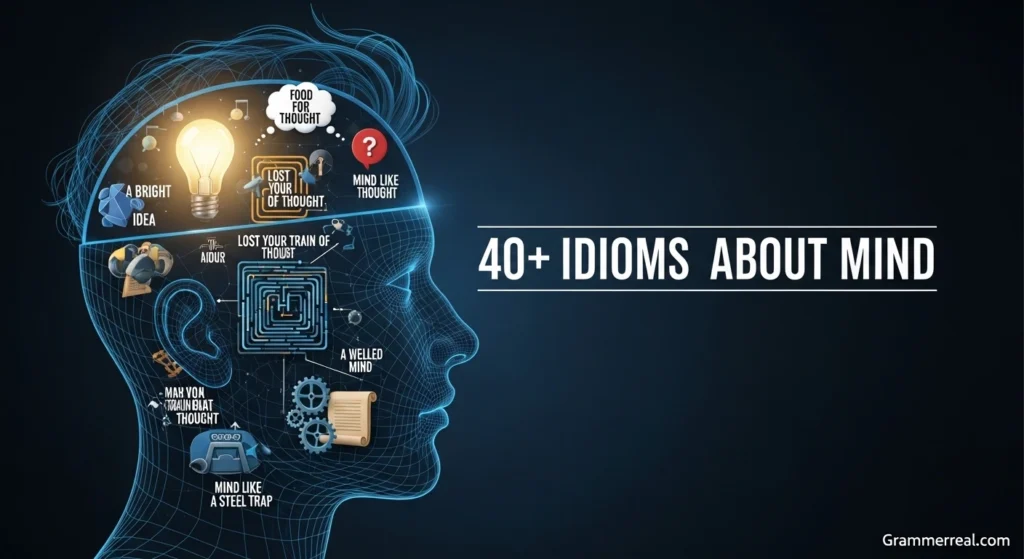
A Mind Like a Steel Trap
Meaning and Explanation
This idiom describes someone who remembers everything and thinks quickly. Their mind works fast and holds information tightly, just like a steel trap snapping shut.
Example Scenario
Ali sits quietly during class, but when the teacher asks a question, he answers instantly with perfect detail. His classmates whisper, “He has a mind like a steel trap.”
Alternative Ways to Express It
- Sharp memory
- Quick thinker
- Highly intelligent
Sensory and Emotional Detail
You can almost hear the metallic “click” of a trap closing—fast, precise, and unstoppable. It gives a sense of control and power.
Mini Story
Once, a detective in a novel solved a mystery just by remembering a tiny detail—a misplaced key. His mind held onto it when everyone else forgot. That is the essence of this idiom.
Lose Your Mind
Meaning and Explanation
This idiom means becoming extremely upset, irrational, or overwhelmed. It doesn’t always mean actual madness—it often reflects emotional intensity.
Example Scenario
When Sara saw her phone missing, she ran around the house shouting, “I’m losing my mind!” Later, she found it in her bag.
Alternative Ways to Express It
- Go crazy
- Panic
- Freak out
Sensory and Emotional Detail
Imagine noise, confusion, and spinning thoughts. The mind feels like a storm—loud, chaotic, and hard to control.
Cultural Reference
In movies, characters often shout this line during stressful moments. It shows urgency and emotional overload instantly.
Have Something on Your Mind
Meaning and Explanation
This idiom means you are thinking deeply about something, often with concern or worry.
Example Scenario
Your friend looks quiet and distracted. You ask, “Do you have something on your mind?” They sigh and begin to share their problem.
Alternative Ways to Express It
- Thinking about something
- Worried
- Preoccupied
Sensory and Emotional Detail
It feels like carrying a weight inside your head—heavy, persistent, and impossible to ignore.
Mini Story
A student walks alone after school, replaying a conversation again and again. That thought sits in his mind like an echo.
How to Use Mind Idioms in Daily Conversations
You don’t need to force idioms into every sentence. Instead, use them naturally when they match your feelings.
For example:
- During stress: “My mind is all over the place.”
- During clarity: “I finally cleared my mind.”
- During focus: “I have something important in mind.”
Additionally, listen to how others use idioms. Then practice slowly. Over time, they will feel natural.
Mind Idioms in Storytelling and Writing
Writers use mind idioms to show emotions instead of explaining them.
Instead of writing: “He was very confused.”
You can write: “His mind spun in circles, chasing answers that never stayed.”
This approach makes your writing vivid and engaging. It also helps readers feel the scene instead of just reading it.
Common Themes in Idioms About the Mind
Most idioms fall into a few key themes:
- Clarity: clear mind, open mind
- Confusion: foggy mind, lost in thought
- Speed: racing mind
- Memory: sharp mind
- Emotion: heavy mind
Recognizing these themes helps you choose the right idiom quickly.
Comparing Mind Idioms with Metaphors
Idioms and metaphors often overlap, but they differ slightly.
- Idioms have fixed meanings (“lose your mind”).
- Metaphors are more flexible (“my thoughts are storms”).
However, both create vivid imagery. Therefore, combining them can make your language even stronger.
Tips to Remember Idioms Easily
First, connect idioms with images. For example, imagine fog when you hear “foggy mind.”
Second, use them in sentences daily. Practice builds memory.
Third, group similar idioms together. This makes learning faster.
Finally, repeat them in conversation. Real use strengthens understanding.
Interactive Exercise 1: Fill the Feeling
Complete these sentences:
- When I forgot everything in the exam, my mind was ______.
- When I solved the puzzle quickly, I had a ______ mind.
- When I worried all night, I had something ______.
Try to answer using idioms you learned.
Create Your Own Idiom Scene
Think of a moment when you felt:
- Confused
- Excited
- Focused
Now describe it using a mind idiom. Add sensory details like sound, color, or movement.
Using Mind Idioms on Social Media
Short and expressive phrases work well online.
Examples:
- “My mind is racing tonight”
- “Clearing my mind, one step at a time.”
- “Too many thoughts, not enough peace.”
These posts feel relatable and emotional.
Mind Idioms in Daily Life Situations
You can use these idioms in real-life moments:
- At work: “Let me clear my mind first.”
- With friends: “You seem to have something on your mind.”
- During stress: “I’m losing my mind right now!”
They make conversations natural and expressive.
Mistakes to Avoid When Using Mind Idioms
Avoid overusing idioms. Too many can confuse the listener.
Also, don’t mix idioms incorrectly. For example: Wrong: “My mind is racing like a steel trap.” Correct: Use one idiom at a time.
Finally, always match the idiom with the situation.
Expanding Your Vocabulary Beyond Basic Idioms
Once you master simple idioms, explore advanced ones like:
- “Pick someone’s brain”
- “In two minds”
- “Slip your mind”
Each adds new layers to your communication.
Emotional Depth in Mind Idioms
Mind idioms don’t just describe thinking—they reveal feelings.
For example:
- “Heavy mind” shows sadness
- “Clear mind” shows peace
- “Racing mind” shows anxiety
Therefore, they act like emotional shortcuts in language.
Bonus Tips for Writing and Creativity
- Use idioms in dialogue to make characters realistic.
- Combine idioms with sensory details.
- Keep your tone natural and simple.
- Practice rewriting plain sentences with idioms.
These steps improve both creativity and clarity.
Bringing It All Together: Practice Paragraph
Write a short paragraph about your day. Include at least two mind idioms. Focus on emotions, not just actions.
Example: “Today, my mind was racing in the morning, but later I cleared my mind with a walk. By evening, I had something on my mind again…”
Conclusion
Idioms about the mind turn ordinary language into something alive and expressive. They allow you to describe thoughts, emotions, and experiences with color and depth. Instead of plain sentences, you create vivid pictures that people can feel and understand instantly.
As you practice these idioms, you will notice a change. Your conversations will feel richer. Your writing will become more engaging. And most importantly, you will connect with others more deeply, because you will speak not just with words—but with imagination.
FAQs
1. What are idioms about the mind?
Idioms about the mind are expressions that describe thinking, memory, emotions, or mental states in a non-literal and creative way.
2. Why should I learn mind idioms?
They make your language more expressive, improve communication, and help you connect emotionally with others.
3. Can I use mind idioms in formal writing?
Yes, but use them carefully. They work best in creative writing, storytelling, or informal communication.
4. How can I remember idioms easily?
Visualize them, practice daily, and use them in real conversations.
5. Are idioms the same in every language?
No, different languages have unique idioms, but many share similar meanings because human experiences are universal.