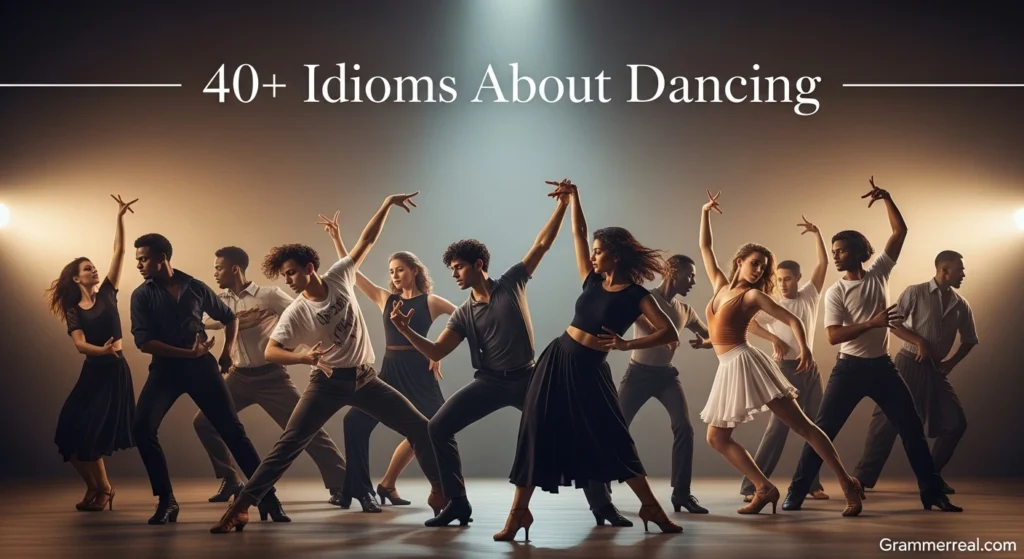
The music begins as a low hum, almost like a heartbeat echoing through the room. Then the rhythm rises—soft taps, a brush of feet against the floor, a swirl of fabric, a laugh caught between breaths. You can almost feel the air move as bodies sway, spin, and step in time. There is something electric about dancing. It is not just movement. It is language without words.
Now, imagine turning that movement into language itself. That is where idioms about dancing come alive.
Idioms are phrases that carry meanings beyond their literal words. When we use dance-related idioms, we borrow the grace, chaos, rhythm, and emotion of dance to explain life. These expressions help us describe situations with color, energy, and feeling.
More importantly, they make our communication richer. Whether you are writing a story, posting on social media, or simply talking to a friend, these idioms add movement to your words.
So, let’s step onto the dance floor of language.
What Are Idioms About Dancing
Idioms about dancing are phrases inspired by movement, rhythm, and performance. However, they rarely talk about dancing directly. Instead, they describe emotions, situations, relationships, and actions.
For example, when someone says, “dance to someone’s tune,” they are not talking about music at all. They mean following someone else’s instructions or control.
These idioms are powerful because they:
- Add emotion and imagery
- Make speech more engaging
- Help express complex ideas simply
- Connect language with human experience
In short, they turn plain words into something alive.
Why Dancing Idioms Matter in Everyday Language
Language without imagery feels flat. However, when you add idioms, especially ones rooted in something as expressive as dance, your words begin to move.
Think about it. Saying “He changed his behavior” sounds dull. But saying “He changed his tune” feels dynamic.
These idioms matter because they:
- Make conversations memorable
- Help writers create vivid scenes
- Add personality to speech
- Make learning English more fun
Moreover, they connect emotions with action. Dance, after all, is emotion in motion.
The Beauty of Movement in Language
Every dance tells a story. Similarly, every idiom carries a hidden narrative.
When you say someone is “leading the dance,” you imagine control, confidence, and direction. When someone is “stepping on toes,” you feel awkwardness and tension.
Because of this, dance idioms allow you to:
- Show instead of tell
- Create emotional depth
- Add rhythm to your sentences
In writing, this can transform a simple paragraph into something poetic.
Dance to Someone’s Tune
Let’s begin with a classic.
Meaning and Explanation
“Dance to someone’s tune” means to do what someone else wants, often without question. It suggests a lack of independence.
Example Scenario
Ali always agrees with his boss, even when he disagrees inside. His friend says, “You always dance to his tune.”
Alternative Ways to Express It
- Follow orders blindly
- Do someone’s bidding
- Be under someone’s control
Sensory and Emotional Detail
Imagine a puppet pulled by invisible strings. The music plays, but the dancer does not choose the steps. That is the feeling behind this idiom—controlled, restricted, and silent.
Mini Story
A young artist once painted what his mentor liked, not what he loved. Over time, his work lost its spark. Finally, he stopped dancing to someone else’s tune and created something truly his. That moment changed everything.
Lead Someone a Merry Dance
This idiom feels playful, yet it carries a hint of trouble.
Meaning and Explanation
To “lead someone a merry dance” means to confuse, mislead, or cause someone trouble in a playful or frustrating way.
Example Scenario
The child kept hiding and changing places, making his parents search everywhere. “He led us a merry dance all evening,” they laughed.
Alternative Expressions
- Keep someone guessing
- Run someone around
- Cause playful chaos
Emotional Layer
There is movement here—quick, unpredictable, almost teasing. It feels like chasing someone through a crowd, laughing but slightly annoyed.
Real-Life Reflection
Children often do this naturally. Their curiosity leads them into mischief, and adults follow, half amused, half tired.
Dance Around Something
This idiom appears often in conversations.
Meaning and Explanation
To “dance around something” means to avoid directly addressing an issue.
Example Scenario
Instead of answering the question, she kept talking about unrelated things. “She is dancing around the topic.”
Alternative Ways
- Avoid the issue
- Beat around the bush
- Evade the question
Sensory Detail
Picture someone circling a spot on the floor, never stepping into the center. That hesitation—that avoidance—is the heart of this idiom.
Dancing Idioms in Daily Conversations
You may not notice it, but these idioms appear everywhere:
- In office discussions
- In friendships
- In storytelling
- In social media captions
For example:
- “Stop dancing around the truth.”
- “I won’t dance to their tune anymore.”
These phrases feel natural because they mirror human behavior.
Cultural and Literary Touches of Dance Idioms
Dance has always been part of culture. From classical poetry to modern films, movement expresses what words cannot.
Writers often use dance imagery to:
- Show emotional conflict
- Represent relationships
- Describe power dynamics
For instance, a romantic story may describe two characters as “moving in perfect rhythm.” Meanwhile, a tense story might show them “missing each other’s steps.”
Thus, dance idioms bridge language and art.
How Dancing Idioms Add Emotion to Writing
When you use these idioms, your writing becomes more vivid.
Instead of saying:
- “He avoided the topic,”
You can say:
- “He danced around the question.”
Immediately, the sentence feels alive.
Because of this, writers often use dance idioms to:
- Build imagery
- Add rhythm
- Express subtle emotions
Mini Story: A Life That Changed Its Rhythm
Sara always followed others. She studied what her parents wanted, worked where her friends worked, and spoke carefully.
One day, she realized she had spent years dancing to someone else’s tune.
So, she made a change. She chose her own rhythm.
At first, it felt strange. However, slowly, her steps became confident. Her life turned into something beautiful—something real.
Tips to Use Dancing Idioms Naturally
Using idioms well takes practice. However, with a few simple tips, you can master them.
Match the Situation
Use idioms where they fit naturally. Do not force them.
Keep It Simple
Avoid using too many idioms in one sentence.
Understand the Meaning
Always know what the idiom means before using it.
Practice in Speech
Try using them in daily conversations.
Common Mistakes to Avoid
Even though idioms are fun, mistakes can happen.
- Using them in the wrong context
- Overusing them
- Mixing idioms incorrectly
For example, saying “dance around someone’s tune” would confuse listeners.
Therefore, clarity always comes first.
Fill in the Rhythm
Complete these sentences:
- He refused to ______ to their tune.
- She kept ______ around the question.
- The children led us a ______ dance.
Try to answer without looking back.
Create Your Own Scenario
Think of a real-life situation:
- When did you avoid something?
- When did you follow someone’s lead?
Now, describe it using a dance idiom.
Social Media Practice
Write a caption using a dancing idiom.
Examples:
- “No more dancing to someone else’s tune.”
- “Life feels better when you find your rhythm.”
Keep it short, emotional, and expressive.
Bonus Tips for Writing and Daily Life
If you want to stand out, use idioms creatively.
In Writing
- Use them in dialogues
- Add them to descriptions
- Pair them with sensory details
Social Media
- Use them as captions
- Turn them into quotes
- Combine with emojis (sparingly)
In Daily Life
- Use them in casual talks
- Practice with friends
- Notice how others use them
The Emotional Power Behind Dancing Idioms
Every idiom carries emotion.
- Control → “dance to someone’s tune”
- Avoidance → “dance around something”
- Chaos → “lead a merry dance”
Because of this, they help you express feelings without long explanations.
How to Remember Dancing Idioms Easily
Memory improves with association.
- Link idioms to real-life scenes
- Imagine the movement
- Repeat them in context
For example, picture someone circling a topic. That image will help you remember “dance around.”
Expanding Your Vocabulary with Dance Imagery
Once you learn a few idioms, your vocabulary grows naturally.
You begin to notice patterns:
- Movement = action
- Rhythm = behavior
- Steps = decisions
Thus, language becomes easier and more creative.
Conclusion
Language is not just about words. It is about movement, emotion, and expression.
Idioms about dancing remind us that communication can flow like music. They help us speak with color, write with depth, and connect with others more meaningfully.
So, do not be afraid to experiment. Try new phrases. Play with rhythm. Let your words dance.
Because when language moves, it truly comes alive.
FAQs
1. What are idioms about dancing?
Idioms about dancing are expressions that use dance-related imagery to describe situations, emotions, or behaviors in a non-literal way.
2. Why should I use dancing idioms in writing?
They make your writing more vivid, emotional, and engaging. They also help readers visualize your ideas more clearly.
3. Are dancing idioms common in daily conversation?
Yes, many people use them naturally in conversations, especially phrases like “dance around the topic” or “dance to someone’s tune.”
4. How can I learn idioms faster?
Practice regularly, use them in sentences, and connect them with real-life situations or images.
5. Can I use dancing idioms in formal writing?
You can use them carefully. They work best in creative writing, storytelling, or informal communication, but limited use can enhance formal content too.