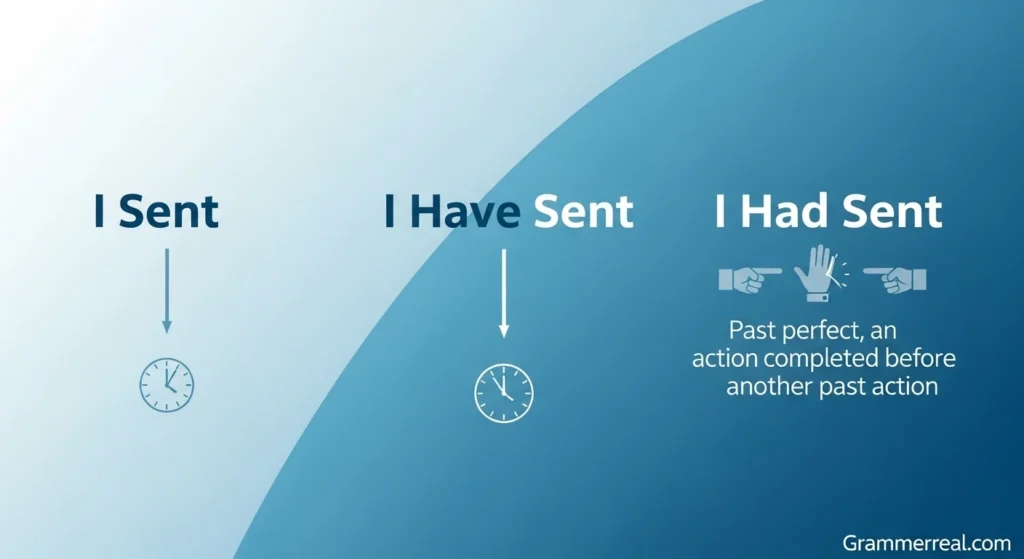
Many English learners feel confused when choosing between i sent, i have sent, and i had sent. These three forms look similar, but they belong to different verb tenses and are used in different situations.
Because they all talk about sending something, the meaning can feel the same at first. However, the time reference and sentence context change the correct choice. This confusion often appears in emails, messages, exams, and spoken English. Using the wrong form can make your meaning unclear or grammatically incorrect. Understanding i sent vs i have sent vs i had sent helps you communicate clearly and correctly. This article explains the differences in very simple language. It uses clear examples, common mistakes, and practical tips. By the end, you will confidently know which form to use and why.
Understanding Verb Tenses in Simple Words
Before comparing i sent, i have sent, and i had sent, it helps to understand verb tenses in a basic way.
- Verb tense shows time.
- It tells us when an action happens.
- English often focuses on whether an action is finished and how it relates to other events.
These three forms all come from the verb send, but they show different times and relationships.
What Does “I Sent” Mean?
The sentence i sent is written in the simple past tense. It describes an action that happened in the past and is already finished. The time is usually clear or understood.
Simple meaning of “i sent”
- the action is completed
- it happened in the past
- the time is known or implied
Examples of “i sent” in sentences
- I sent the email yesterday.
- I sent the documents last night.
- I sent her the message an hour ago.
- I sent the package on Monday.
In each example, the action is finished, and the time is mentioned or understood.
When to Use “I Sent”
Use i sent when:
- the action is complete
- the time is specific
- you are talking about the past only
Common time words with “i sent”
- yesterday
- last night
- last week
- two days ago
- in 2022
Example:
- I sent the form last week.
This tense is very common in daily conversation.
What Does “I Have Sent” Mean?
The sentence i have sent is written in the present perfect tense. It describes an action that happened in the past but is still connected to the present.
Simple meaning of “i have sent”
- the action is completed
- the result matters now
- the exact time is not important
Examples of “i have sent” in sentences
- I have sent the email.
- I have sent all the required files.
- I have sent the payment already.
- I have sent you the details.
Here, the focus is on the result, not the time.
When to Use “I Have Sent”
Use i have sent when:
- the action is finished
- the result affects the present
- the time is not mentioned
Common words with “i have sent”
- already
- just
- recently
- yet
- so far
Examples:
- I have sent the report already.
- I have sent the email, so please check.
This tense is very common in emails and formal messages.
What Does “I Had Sent” Mean?
The sentence i had sent is written in the past perfect tense. It describes an action that was completed before another past action.
Simple meaning of “i had sent”
- the action happened before another past event
- both actions are in the past
- it gives clear time order
Examples of “i had sent” in sentences
- I had sent the email before the meeting started.
- I had sent the files when he called me.
- I had sent the message, but she did not reply.
- I had sent the invitation earlier that day.
Here, i had sent shows which action happened first.
When to Use “I Had Sent”
Use i had sent when:
- two past actions are involved
- you need to show which happened first
- time order is important
Example:
- I had sent the form before the deadline passed.
Without had, the meaning can become unclear.
i Sent vs i Have Sent vs i Had Sent: Basic Comparison
Here is a simple comparison of i sent vs i have sent vs i had sent.
- i sent → past action, finished, time is known
- i have sent → past action, result matters now
- i had sent → past action before another past action
Each form has a clear role.
Timeline Explanation (Very Simple)
Think of time like a straight line.
- i sent → one point in the past
- i have sent → past action connected to now
- i had sent → past action before another past point
This mental picture helps many learners.
Contextual Examples in Real Situations
Seeing real-life contexts makes the difference clearer.
Email example
- I sent the email yesterday.
- I have sent the email, please check your inbox.
- I had sent the email before you asked again.
Each sentence fits a different situation.
Office example
- I sent the report last Friday.
- I have sent the report, so the task is complete.
- I had sent the report before the manager called.
The meaning changes based on tense.
Common Mistakes With These Tenses
Many learners make similar mistakes when using i sent vs i have sent vs i had sent.
Mistake 1: Using “i sent” with no time context
- Incorrect: I sent the email. (when?)
- Better: I have sent the email.
If time is not clear, present perfect is safer.
Mistake 2: Using “i have sent” with past time words
- Incorrect: I have sent the email yesterday.
- Correct: I sent the email yesterday.
Present perfect does not use finished time words.
Mistake 3: Using “i had sent” without another past action
- Incorrect: I had sent the email.
- Correct: I sent the email.
Past perfect needs a second past event.
Sentence Structure and Clarity
Good sentence structure helps tense clarity.
Simple past structure
- Subject + verb (past) Example: I sent the file.
Present perfect structure
- Subject + have/has + past participle Example: I have sent the file.
Past perfect structure
- Subject + had + past participle Example: I had sent the file.
Clear structure prevents confusion.
American vs British English Usage
There is a small difference between American and British English.
British English
- Uses i have sent more often
- Even with recent time
Example:
- I have sent the email just now.
American English
- Uses i sent more often
- Especially in spoken English
Example:
- I sent the email already.
Both are correct, but style differs slightly.
Formal vs Informal Writing
Formal writing
- I have sent the documents.
- I had sent the request earlier.
Informal writing
- I sent it already.
- I sent the message last night.
Choose the tense based on tone and context.
Idiomatic and Natural Usage
These forms appear naturally in daily English.
Common patterns
- I have sent you…
- I sent it yesterday…
- I had sent it before…
These patterns sound natural to native speakers.
Choosing the Right Tense: Easy Questions
Ask yourself these questions:
- Is the time finished and known? → use i sent
- Does the result matter now? → use i have sent
- Are two past actions involved? → use i had sent
These questions guide correct choice.
Practical Tips to Avoid Confusion
- Use i sent with past time words
- Use i have sent in emails and updates
- Use i had sent only with another past action
- Avoid mixing time markers
- Read the sentence aloud
Practice makes this automatic.
Grammar Rules Applied
Verb tense
Each tense shows a different time relationship.
Subject-verb agreement
- I have sent
- I had sent Agreement stays correct in all forms.
Modifiers and prepositions
Time words must match the tense.
Correct grammar improves clarity.
Writing Flow and Style
This article uses:
- short sentences for clarity
- longer sentences for explanation
- active voice for direct meaning
- passive voice where suitable
Simple wording helps understanding.
Rewritten and Polished Explanation (Clear Summary)
To explain again in simple terms, i sent talks about a finished action in the past with a clear time. i have sent talks about a finished action that matters now, without focusing on time. i had sent talks about an action that happened before another past event. The meaning changes based on time and context, not just the verb form. Choosing the correct tense makes writing clear and natural. With practice, the correct choice becomes easy.
Why This Practice Improves Writing
Learning i sent vs i have sent vs i had sent improves writing by:
- improving tense accuracy
- reducing common mistakes
- making messages clearer
- increasing confidence
- improving grammar awareness
Strong tense control improves overall writing quality.
Conclusion
In conclusion, i sent, i have sent, and i had sent are all correct but used in different situations. i sent describes a finished past action with a clear time. i have sent connects a past action to the present. i had sent shows an action that happened before another past event. Understanding these differences helps you write clearly and correctly. With practice and attention to context, choosing the right form becomes simple and natural.
FAQs
1. Is “i sent” correct English?
Yes, it is simple past tense.
2. Can I say “i have sent yesterday”?
No, use i sent yesterday.
3. When should I use “i have sent”?
When the result matters now.
4. Is “i had sent” always correct?
Only when another past action is mentioned.
5. Which tense is best for emails?
I have sent is very common.
6. Do Americans use “i sent” more?
Yes, especially in spoken English.
7. Can all three forms be correct?
Yes, depending on context.
8. Does tense change meaning?
Yes, it changes time and focus.
9. Is past perfect common in daily speech?
It is less common but still important.
10. What is the easiest way to remember?
Think about time and order of events.



