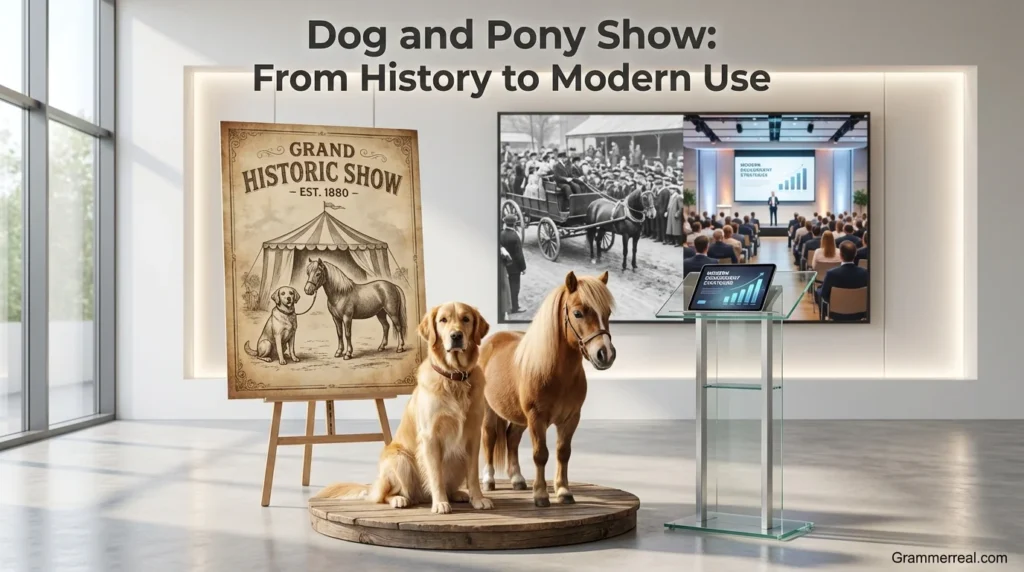
The phrase dog and pony show is a common English expression that many people hear in business, politics, media, and daily conversation. At first glance, it sounds playful and harmless, almost like a small circus event meant for children.
However, its meaning goes far beyond animals and entertainment. A dog and pony show usually describes an event, presentation, or performance that is carefully staged to impress people, often without offering much real value or substance. It can be used in a neutral way, but it is often critical or slightly negative in tone. People use this phrase when they feel something is more about appearance than truth. In modern English, it appears in offices, news reports, sales meetings, and political speeches. Understanding this expression helps learners grasp both literal history and figurative meaning. This article explains the phrase clearly, with simple language and real-life examples, so even beginners can understand it easily.
Meaning of “dog and pony show”
The dog and pony show means a showy presentation that is designed to impress an audience rather than inform them honestly. It often suggests that the event looks exciting on the surface but lacks depth or real value underneath. When someone calls something a dog and pony show, they usually feel skeptical about it.
The phrase is often used when:
- A company gives a fancy presentation but avoids real details
- A politician makes big promises without clear plans
- A manager arranges a flashy meeting with little substance
For example:
- The sales pitch was just a dog and pony show with no real data.
- Voters were tired of the dog and pony show and wanted real answers.
In short, the phrase highlights style over substance.
Origin and history of the phrase
The phrase dog and pony show comes from small traveling circuses in the United States during the late 1800s and early 1900s. These shows were cheap, simple, and easy to move from town to town. They often featured trained dogs, ponies, and basic tricks to entertain rural audiences.
These shows were not grand or impressive compared to large circuses. Over time, the phrase became symbolic of something that looks entertaining but is limited in value or depth. As English evolved, people began using it figuratively rather than literally.
Today, the phrase has almost nothing to do with animals. Instead, it reflects a critical view of exaggerated performances meant to distract or impress.
How the phrase is used in modern English
In modern English, dog and pony show is used mainly in spoken language, news writing, and informal professional settings. It often carries a tone of doubt or mild criticism.
Common contexts include:
- Business meetings
- Political campaigns
- Marketing events
- Corporate presentations
Examples:
- The new product launch felt like a dog and pony show instead of a serious discussion.
- The manager arranged a dog and pony show to convince investors.
The phrase is usually informal, so it may not be suitable for very formal academic writing.
Literal meaning vs figurative meaning
Understanding the difference between literal and figurative meaning is key to mastering this phrase.
Literal meaning
A dog and pony show literally refers to a small animal performance. This meaning is rarely used today and mostly appears in historical contexts.
Figurative meaning
Figuratively, the phrase describes an event that focuses on appearance, drama, or excitement instead of real content or truth.
Most modern uses are figurative, not literal.
Contextual examples in daily life
Seeing the phrase in context makes it easier to understand and remember.
Business perspective
- The client wanted results, not another dog and pony show.
- Employees were tired of flashy meetings that solved nothing.
Political context
- People felt the debate was just a dog and pony show.
- Voters demanded clear plans instead of staged speeches.
Educational setting
- The seminar turned into a dog and pony show with too many slides and no discussion.
These examples show how flexible the phrase is.
Tone and connotation of “dog and pony show”
The tone of dog and pony show is usually negative or critical. It suggests frustration or disappointment. However, in some cases, it can be playful or humorous.
Negative tone:
- Suggests dishonesty
- Suggests lack of depth
Light tone:
- Used jokingly among friends
- Used casually in conversation
Understanding tone helps avoid misuse.
Common mistakes when using the phrase
Many learners make mistakes with idioms. Here are some common errors to avoid.
Using it in very formal writing
This phrase is informal and may sound out of place in legal or academic writing.
Using it too literally
Modern listeners expect the figurative meaning, not actual animals.
Wrong grammar or structure
Incorrect: This meeting is dog and pony show. Correct: This meeting is a dog and pony show.
The article “a” is important here.
Grammar notes related to the phrase
The phrase dog and pony show is a noun phrase. It often follows articles like a or the.
Correct forms:
- a dog and pony show
- the dog and pony show
It can function as:
- A subject: The dog and pony show annoyed everyone.
- An object: They planned a dog and pony show.
It rarely changes form and is not pluralized often.
American vs British English usage
The phrase dog and pony show is far more common in American English than in British English.
American English
- Widely used in business and politics
- Easily understood by native speakers
British English
- Less common
- May sound very American
- Sometimes explained when used
British speakers might prefer phrases like empty display or showy performance.
Similar idioms and expressions
English has many expressions with similar meanings.
Related phrases include:
- All show and no substance
- Smoke and mirrors
- Window dressing
- Putting on a show
Each phrase has a slightly different tone, but all suggest a lack of real value.
When you should avoid using this phrase
Although useful, the phrase is not always appropriate.
Avoid using it:
- In formal academic writing
- In respectful official communication
- When speaking to people unfamiliar with idioms
In such cases, a clearer phrase may work better.
Practical tips for using “dog and pony show” correctly
Here are simple tips to help you use the phrase well:
- Use it in informal or semi-formal settings
- Make sure the context suggests exaggeration or show
- Use correct articles like a or the
- Avoid using it with sensitive audiences
- Listen for tone before using it yourself
Practicing with examples improves confidence.
Examples in sentences (simple and clear)
- The presentation was a dog and pony show with no real facts.
- They organized a dog and pony show to impress the boss.
- People want solutions, not a dog and pony show.
These sentences show natural usage.
Cultural meaning and modern relevance
The phrase reflects modern frustration with surface-level communication. People want honesty, clarity, and value. Calling something a dog and pony show shows a desire for truth and depth.
This is why the phrase remains popular today. It fits well in discussions about trust, leadership, and communication.
Writing techniques used in this article
This article uses:
- Short and clear sentences
- Simple vocabulary
- Active and passive voice
- Clear examples
- Logical flow between ideas
These techniques help readers understand the topic easily.
Reflection on grammar and clarity
Strong grammar makes ideas clear and trustworthy. This article carefully checks verb tense, subject-verb agreement, and article use. Sentences are balanced to avoid confusion. Clear structure improves readability and understanding.
Writing with care improves communication and builds confidence.
How learning this phrase improves English skills
Learning idioms like dog and pony show helps learners:
- Understand native speakers better
- Sound more natural
- Read news and conversations with confidence
It also builds cultural awareness.
Conclusion
The phrase dog and pony show is a colorful and meaningful part of modern English. It describes events that focus more on appearance than real value. Although it began as a literal animal show, it now carries a strong figurative meaning. Understanding its tone, grammar, and context helps avoid mistakes. Using simple language, clear examples, and correct structure makes communication stronger. By learning this phrase, writers and speakers improve clarity, accuracy, and confidence. When used carefully, it adds depth and expression to everyday English.
FAQs
1. What does “dog and pony show” mean?
It means a showy event meant to impress without real substance.
2. Is the phrase positive or negative?
It is usually negative or critical in tone.
3. Is it still used today?
Yes, it is common in modern English, especially in the United States.
4. Can I use it in formal writing?
No, it is better suited for informal or semi-formal contexts.
5. Does it refer to real animals?
No, it is mostly used figuratively today.
6. Is it American or British English?
It is mainly American English.
7. What are similar expressions?
Examples include smoke and mirrors and window dressing.
8. Can it be used in business talk?
Yes, but carefully and in the right tone.
9. Is it offensive?
It is not offensive, but it can sound critical.
10. How can I practice using it?
Read examples, listen to conversations, and try using it in simple sentences.



